JavaScript is disabled in your browser. Please enable JavaScript to view this website.
AB9335

Biotin Anti-Phosphoserine antibody

Be the first to review this product! Submit a review

|

(4 Publications )
Anti-Phosphoserine antibody conjugated to Biotin is a rabbit polyclonal antibody suitable for ELISA, IP, Western blot.
1 Images
Western blot - Biotin Anti-Phosphoserine antibody (AB9335)
  • WB

Unknown

Western blot - Biotin Anti-Phosphoserine antibody (AB9335)

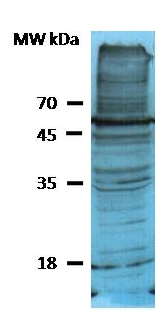
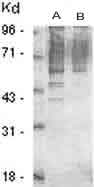
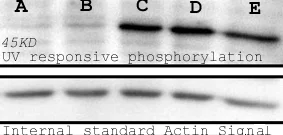
Western blotting of a melanoma cell lysate with anti-phosphoserine antibodies

The detected band is 53 kD, and is a similar size to the p53 tumor suppressor factor.

The cells were treated with 0, 50, 200 or 400 J UV (lane A to D, respectively) and with 0.1uM of okadaic acid(lane E). Actin level was measured as an internal standard of cell protein.

Western blotting of a melanoma cell lysate with anti-phosphoserine antibodies. The detected band is 53 kD, and is a similar size to the p53 tumor suppressor factor. The cells were treated with 0, 50, 200 or 400 J UV (lane A to D, respectively) and with 0.1uM of okadaic acid (lane E). Actin level was measured as an internal standard of cell protein.

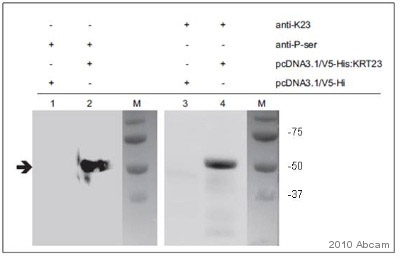
Lane 1:

Western blot - Biotin Anti-Phosphoserine antibody (ab9335)

Lane 1:

Western blot - Anti-Phosphoserine antibody (<a href='/en-us/products/primary-antibodies/phosphoserine-antibody-ab9332'>ab9332</a>)

false

Key facts

Host species

Rabbit

Clonality

Polyclonal

Isotype

IgG

Conjugation

Biotin

Excitation/Emission
Carrier free

No

Applications

WB, IP, ELISA

applications

Specificity

Specifically recognizes both free-phosphoserine, serine-phosphorylated peptide and proteins. Does not cross-react with ATP, phosphotyrosine, peptidyl phosphothreonine and serine. Slight cross-reactivity with free phosphothreonine. Readily reacts to known phosphoproteins such as phosvitin and alpha casein.

Reactivity data

{ "title": "Reactivity Data", "filters": { "stats": ["", "Species", "Dilution Info", "Notes"], "tabs": { "all-applications": {"fullname" : "All Applications", "shortname": "All Applications"}, "IP" : {"fullname" : "Immunoprecipitation", "shortname":"IP"}, "ELISA" : {"fullname" : "ELISA", "shortname":"ELISA"}, "WB" : {"fullname" : "Western blot", "shortname":"WB"} }, "product-promise": { "all": "all", "testedAndGuaranteed": "tested", "guaranteed": "expected", "predicted": "predicted", "notRecommended": "not-recommended" } }, "values": { "Modified Amino Acid": { "IP-species-checked": "guaranteed", "IP-species-dilution-info": "", "IP-species-notes": "<p></p>", "ELISA-species-checked": "guaranteed", "ELISA-species-dilution-info": "", "ELISA-species-notes": "<p></p>", "WB-species-checked": "testedAndGuaranteed", "WB-species-dilution-info": "", "WB-species-notes": "<p>Do not use milk as a blocking agent or in diluents, as milk casein is phosphorylated at several serine residues. BSA is recommended instead.</p>" } } }

Properties and storage information

Form
Liquid
Purification technique
Affinity purification Immunogen
Purification notes
Immunoaffinity chromatography with phosphoserine-agarose.
Storage buffer
pH: 6 - 8 Preservative: 0.02% Sodium azide
Shipped at conditions
Blue Ice
Appropriate short-term storage duration
1-2 weeks
Appropriate short-term storage conditions
+4°C
Appropriate long-term storage conditions
-20°C
Storage information
Avoid freeze / thaw cycle

Supplementary information

This supplementary information is collated from multiple sources and compiled automatically.

Phosphoserine often referred to by its common alternate name "P-Ser" represents a phosphorylated form of the amino acid serine. This small molecule under a molecular mass of near 166 Daltons plays an important role in cellular signaling. It is expressed widely across various cell types particularly in tissues with high cell turnover. Phosphoserine results from the action of kinases which transfer a phosphate group from ATP to the serine's hydroxyl group. This phosphorylation process provides a critical modulatory mechanism that impacts protein function and cellular pathways.
Biological function summary

Phosphorylated serine residues are involved in controlling a multitude of cellular processes including cell cycle regulation and apoptosis. These phosphorylated regions form parts of protein kinases phosphatases and glycoproteins acting as switches for cellular signaling. Phosphoserine is often part of multi-protein complexes binding to other proteins and influencing their activity through changes in conformation. This active participation in biological pathways signifies its significant influence in maintaining cellular homeostasis.

Pathways

Phosphoserine plays a significant role in the MAPK signaling and PI3K/AKT pathways both important for cell growth and survival. It interacts with proteins like AKT and MAPK facilitating cellular responses to extracellular stimuli. This phosphorylation state dictates the activation or inactivation of these proteins effectively regulating key steps in signal transduction and transcriptional control. Such pathways highlight the importance of phosphoserine in coordinating complex cellular activities.

Aberrations in phosphoserine activity have been linked to conditions such as cancer and neurodegenerative diseases. In cancer dysregulation in its phosphorylation status may lead to uncontrolled cellular proliferation and resistance to apoptosis. Proteins such as p53 which plays a pivotal role in DNA repair and cell cycle arrest often show altered phosphorylation patterns in the presence of disease. Similarly in neurodegenerative disorders improper phosphorylation of tau proteins is a hallmark of conditions like Alzheimer's disease pointing to the critical involvement of phosphoserine and its associated pathways in disease pathology.

Product protocols

For this product, it's our understanding that no specific protocols are required. You can visit:

Target data

See full target information Phosphoserine

Alternative Names

PS, pSER, phospho-Ser

Publications (4)

Recent publications for all applications. Explore the full listand refine your search

Viruses 16: PubMed39599850

2024

Dimerization of Rabies Virus Phosphoprotein and Phosphorylation of Its Nucleoprotein Enhance Their Binding Affinity.

Applications

Unspecified application

Species

Unspecified reactive species

Euripedes de Almeida Ribeiro,Cédric Leyrat,Francine C A Gérard,Marc Jamin

Intervirology 60:90-101 PubMed28957812

2017

Humoral Immune Response in Mice Elicited by Combined Yeast-Derived Hepatitis B Virus Core, Surface, and Mosaic Surface Antigens.

Applications

Unspecified application

Species

Unspecified reactive species

Vladimir Granovski,Jonny Yokosawa,Vanessa Rodrigues-Granovski,Carlos Cueto Castro,Alfonso Camacho Urbina,Nikolai Granovski

Scientific reports 7:3769 PubMed28630428

2017

Nuclear accumulation of symplekin promotes cellular proliferation and dedifferentiation in an ERK1/2-dependent manner.

Applications

WB

Species

Human

Chen Zhang,Hai-Lei Mao,Yi Cao

Journal of cell science 119:581-91 PubMed16443755

2006

Glucocorticoid-induced osteogenesis is negatively regulated by Runx2/Cbfa1 serine phosphorylation.

Applications

WB

Species

Unspecified reactive species

Jennifer E Phillips,Charles A Gersbach,Abigail M Wojtowicz,Andrés J García
View all publications

Product promise

We are committed to supporting your work with high-quality reagents, and we're here for you every step of the way. In the unlikely event that one of our products does not perform as expected, you're protected by our Product Promise.
For full details, please see our Terms & Conditions

Please note: All products are 'FOR RESEARCH USE ONLY. NOT FOR USE IN DIAGNOSTIC OR THERAPEUTIC PROCEDURES'.

For licensing inquiries, please contact partnerships@abcam.com