JavaScript is disabled in your browser. Please enable JavaScript to view this website.
AB24942

Biotin Anti-VCAM1 antibody [M/K-2]

Be the first to review this product! Submit a review

|

(1 Publication)
Anti-VCAM1 antibody [M/K-2] conjugated to Biotin - suitable for flow cytometry, and reacts with mouse samples. Clone [M/K-2] is a rat monoclonal antibody cited in 10 publications.
1 Images
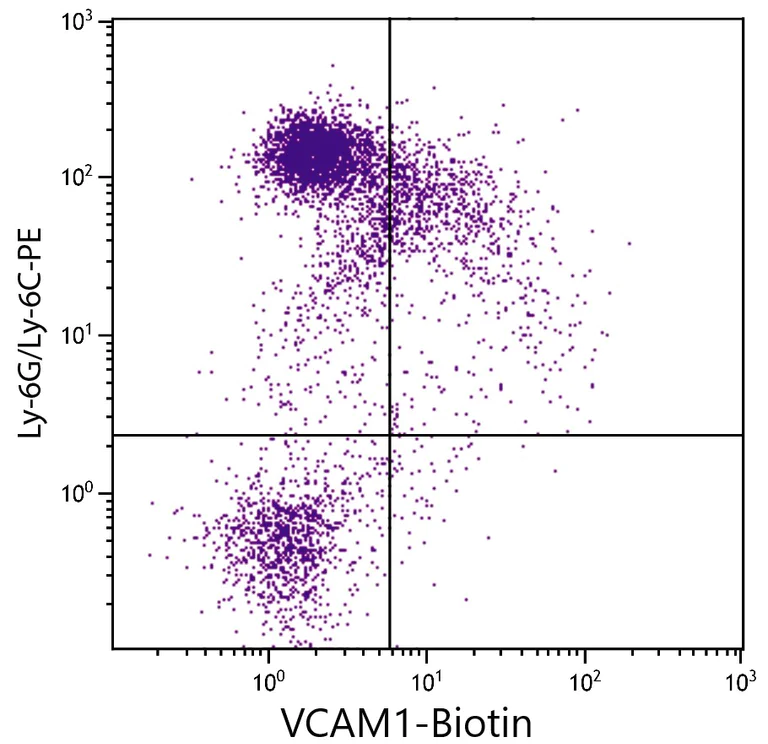
Flow Cytometry - Biotin Anti-VCAM1 antibody [M/K-2] (AB24942)
  • Flow Cyt

Supplier Data

Flow Cytometry - Biotin Anti-VCAM1 antibody [M/K-2] (AB24942)

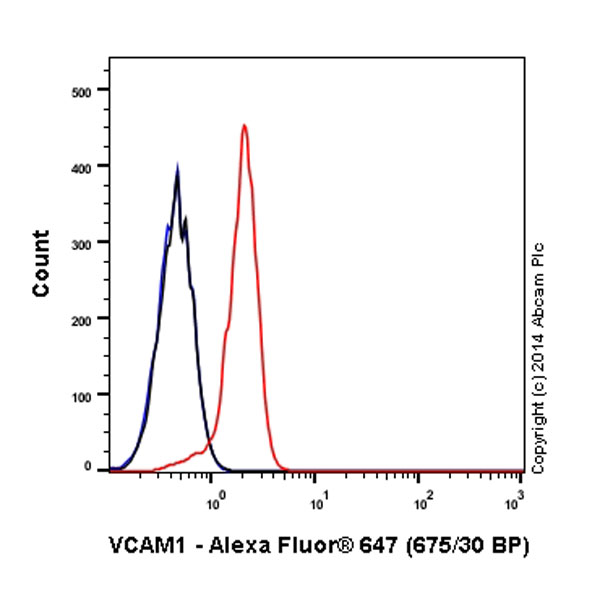
BALB/c mouse bone marrow cells were stained with Anti-VCAM1 antibody [M/K-2] (Biotin) (ab24942) and Rat Anti-Mouse Ly-6G/Ly-6C-PE followed by Streptavidin-FITC.

  • 519 FITC

    FITC Anti-VCAM1 antibody [M/K-2]

  • 578 PE

    PE Anti-VCAM1 antibody [M/K-2]

Key facts

Host species

Rat

Clonality

Monoclonal

Clone number

M/K-2

Isotype

IgG1

Light chain type

kappa

Conjugation

Biotin

Excitation/Emission
Carrier free

No

Reacts with

Mouse

Applications

Flow Cyt

applications

Reactivity data

{ "title": "Reactivity Data", "filters": { "stats": ["", "Species", "Dilution Info", "Notes"], "tabs": { "all-applications": {"fullname" : "All Applications", "shortname": "All Applications"}, "FlowCyt" : {"fullname" : "Flow Cytometry", "shortname":"Flow Cyt"} }, "product-promise": { "all": "all", "testedAndGuaranteed": "tested", "guaranteed": "expected", "predicted": "predicted", "notRecommended": "not-recommended" } }, "values": { "Mouse": { "FlowCyt-species-checked": "testedAndGuaranteed", "FlowCyt-species-dilution-info": "1 µg for 10^6 Cells", "FlowCyt-species-notes": "<p><a href='/en-us/products/primary-antibodies/biotin-rat-igg1-kappa-rtk2071-isotype-control-ab18403'>ab18403</a> - Rat monoclonal IgG1, is suitable for use as an isotype control with this antibody.</p>" } } }

Properties and storage information

Form
Liquid
Purification technique
Affinity purification
Storage buffer
pH: 7.4 Preservative: 0.1% Sodium azide Constituents: PBS
Shipped at conditions
Blue Ice
Appropriate short-term storage duration
1-2 weeks
Appropriate short-term storage conditions
+4°C
Appropriate long-term storage conditions
-20°C
Aliquoting information
Upon delivery aliquot
Storage information
Avoid freeze / thaw cycle

Supplementary information

This supplementary information is collated from multiple sources and compiled automatically.

VCAM1 also known as vascular cell adhesion molecule 1 plays an important role in mediating adhesion and signal transduction. VCAM1 has an approximate molecular mass of 110 kDa. It is expressed on the surface of endothelial cells and can be upregulated by cytokines released during inflammation. The protein serves as a ligand for the integrin VLA-4 also known as α4β1 and contributes to the adhesion of leukocytes to endothelial cells.
Biological function summary

Adhesion molecules like VCAM1 participate in immune response by recruiting leukocytes to sites of inflammation. VCAM1 helps guide immune cells to directed locations where they perform defense activities. Although VCAM1 is not part of any known large protein complex its interaction with integrins facilitates the migration of immune cells across the endothelium and into tissue.

Pathways

VCAM1 contributes significantly to the leukocyte extravasation process in inflammatory pathways. It plays a role in both the cytokine-cytokine receptor interaction pathway and the NF-kB signaling pathway which are essential for immune response and cell signaling. Through these pathways it interacts with proteins like ICAM1 and various chemokines helping to coordinate the immune cell movement through vascular tissue barriers.

Abnormal regulation of VCAM1 links to various cardiovascular diseases such as atherosclerosis and inflammatory diseases like rheumatoid arthritis. The protein levels may increase in these conditions promoting excessive immune cell recruitment and tissue damage. VCAM1 also interfaces with other proteins like ICAM1 in these pathological states which together contribute to the progression and severity of these diseases.

Product protocols

For this product, it's our understanding that no specific protocols are required. You can visit:

Target data

Cell adhesion glycoprotein predominantly expressed on the surface of endothelial cells that plays an important role in immune surveillance and inflammation. Acts as a major regulator of leukocyte adhesion to the endothelium through interaction with different types of integrins. During inflammatory responses, binds ligands on the surface of activated endothelial cells to initiate the activation of calcium channels and the plasma membrane-associated small GTPase RAC1 leading to leukocyte transendothelial migration. Serves also as a quality-control checkpoint for entry into bone marrow by providing a 'don't-eat-me' stamping in the context of major histocompatibility complex (MHC) class-I presentation.
See full target information Vcam1

Alternative Names

CD106, Vcam-1, Vcam1, Vascular cell adhesion protein 1, V-CAM 1, VCAM-1

Publications (1)

Recent publications for all applications. Explore the full list and refine your search

Immunity 50:137-151.e6 PubMed30650373

2019

Fever Promotes T Lymphocyte Trafficking via a Thermal Sensory Pathway Involving Heat Shock Protein 90 and α4 Integrins.

Applications

Unspecified application

Species

Unspecified reactive species

ChangDong Lin,YouHua Zhang,Kun Zhang,YaJuan Zheng,Ling Lu,HaiShuang Chang,Hui Yang,YanRong Yang,YaoYing Wan,ShiHui Wang,MengYa Yuan,ZhanJun Yan,RongGuang Zhang,YongNing He,GaoXiang Ge,Dianqing Wu,JianFeng Chen
View all publications

Product promise

We are committed to supporting your work with high-quality reagents, and we're here for you every step of the way. In the unlikely event that one of our products does not perform as expected, you're protected by our Product Promise.
For full details, please see our Terms & Conditions

Please note: All products are 'FOR RESEARCH USE ONLY. NOT FOR USE IN DIAGNOSTIC OR THERAPEUTIC PROCEDURES'.

For licensing inquiries, please contact partnerships@abcam.com