Anti-BTG4 antibody [EPRZJU-21] - BSA and Azide free
- RabMAb
- Recombinant
- What is this?
Be the first to review this product! Submit a review
|
(1 Publication)
- ICC/IF
Supplier Data
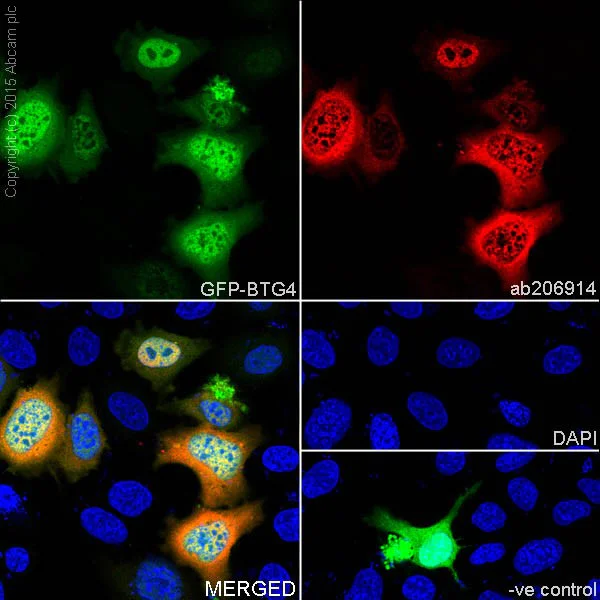
Immunocytochemistry/ Immunofluorescence - Anti-BTG4 antibody [EPRZJU-21] - BSA and Azide free (AB251461)
This data was developed using ab206914, the same antibody clone in a different buffer formulation.
Immunofluorescent analysis of 4% paraformaldehyde-fixed, 0.1% Triton X-100 permeabilized HeLa (Human epithelial cell line from cervix adenocarcinoma) cells labeling BTG4 with ab206914 at 1/1000 dilution, followed by Goat Anti-Rabbit IgG (Alexa Fluor® 594) (ab150080) secondary antibody at 1/1000 dilution (red).
Confocal image showing nuclear and weakly cytoplasmic staining on HeLa cell transfected with GFP-BTG4.
The nuclear counterstain is DAPI (blue).
- IP
Supplier Data
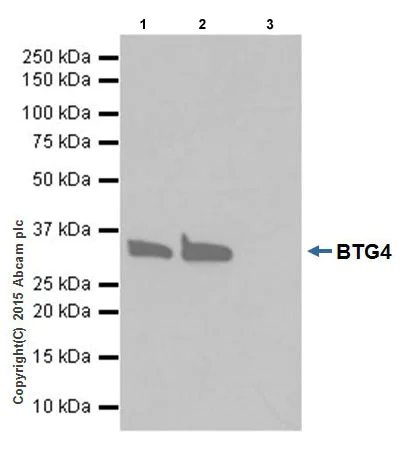
Immunoprecipitation - Anti-BTG4 antibody [EPRZJU-21] - BSA and Azide free (AB251461)
This data was developed using ab206914, the same antibody clone in a different buffer formulation.
BTG4 was immunoprecipitated from 1mg of 293T (Human epithelial cell line from embryonic kidney) transfected with mouse BTG4 with HA-tag whole cell lysate with ab206914 at 1/50 dilution.
Western blot was performed from the immunoprecipitate using ab206914 at 1/1000 dilution.
VeriBlot for IP Detection Reagent (HRP) (ab131366), was used for detection at 1/10000 dilution.
Lane 1 : 293T transfected with mouse BTG4 with HA-tag whole cell lysate, 10μg (Input).
Lane 2 : ab206914 IP in 293T transfected with mouse BTG4 with HA-tag whole cell lysate.
Lane 3 : Rabbit IgG,monoclonal [EPR25A] - Isotype Control (ab172730) instead of ab206914 in 293T transfected with mouse BTG4 with HA-tag whole cell lysate.
Blocking and dilution buffer and concentration : 5% NFDM/TBST.
Exposure time : 1 second.
All lanes:
Immunoprecipitation - Anti-BTG4 antibody [EPRZJU-21] (<a href='/en-us/products/primary-antibodies/btg4-antibody-eprzju-21-ab206914'>ab206914</a>)
Predicted band size: 26 kDa
false
- WB
Supplier Data
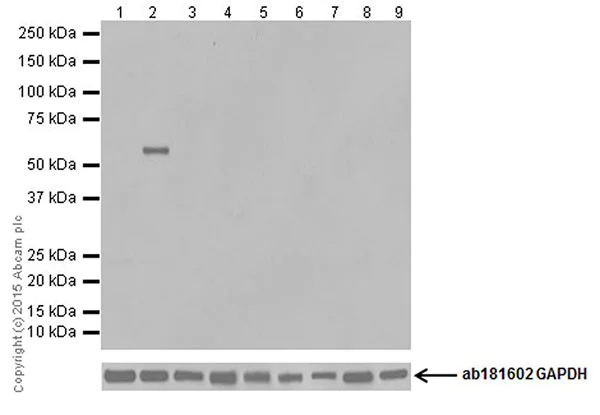
Western blot - Anti-BTG4 antibody [EPRZJU-21] - BSA and Azide free (AB251461)
This data was developed using ab206914, the same antibody clone in a different buffer formulation.
Blocking and dilution buffer : 5% NFDM/TBST.
All lanes:
Western blot - Anti-BTG4 antibody [EPRZJU-21] (<a href='/en-us/products/primary-antibodies/btg4-antibody-eprzju-21-ab206914'>ab206914</a>) at 1/1000 dilution
Lane 1:
HeLa (Human epithelial cell line from cervix adenocarcinoma) whole cell lysate transfected with empty vector (vector control) at 20 µg
Lane 2:
HeLa (Human epithelial cell line from cervix adenocarcinoma) whole cell lysate lysate transfected with mouse BTG4 with GFP-tag at 20 µg
Lane 3:
Human ovary lysate at 20 µg
Lane 4:
Mouse ovary tissue lysate at 20 µg
Lane 5:
Mouse testis tissue lysate at 20 µg
Lane 6:
Rat ovary tissue lysate at 20 µg
Lane 7:
Rat testis tissue lysate at 20 µg
Lane 8:
Mouse P0 olfactory epithelium lysate at 20 µg
Lane 9:
Rat P0 olfactory epithelium lysate at 20 µg
Secondary
All lanes:
Western blot - Goat Anti-Rabbit IgG H&L (HRP) (<a href='/en-us/products/secondary-antibodies/goat-rabbit-igg-h-l-hrp-ab97051'>ab97051</a>) at 1/100000 dilution
Predicted band size: 26 kDa
Observed band size: 55 kDa
false
Exposure time: 30s
Related conjugates and formulations (1)
-
Anti-BTG4 antibody [EPRZJU-21]
Complementary Products

Primary Antibodies
AB181557
Anti-Oct4 antibody [EPR17929] - ChIP Grade
20ul selling size|RabMAb|Advanced Validation|Recombinant

- 5
- 20
Primary Antibodies
AB214549
Anti-Nanog antibody [EPR20694] - ChIP Grade
RabMAb|Advanced Validation|Recombinant|20ul selling size

- 5
- 3

Reactivity data
Product details
ab251461 is the carrier-free version of ab206914.
Patented technology
Our RabMAb® technology is a patented hybridoma-based technology for making rabbit monoclonal antibodies. For details on our patents, please refer to RabMAb® patents.
What are the advantages of a recombinant monoclonal antibody?
This product is a recombinant monoclonal antibody, which offers several advantages including:
- - High batch-to-batch consistency and reproducibility
- - Improved sensitivity and specificity
- - Long-term security of supply
- - Animal-free batch production
For more information, read more on recombinant antibodies.
Conjugation ready
Our carrier-free antibodies are typically supplied in a PBS-only formulation, purified and free of BSA, sodium azide and glycerol. This conjugation-ready format is designed for use with fluorochromes, metal isotopes, oligonucleotides, and enzymes, which makes them ideal for antibody labelling, functional and cell-based assays, flow-based assays (e.g. mass cytometry) and Multiplex Imaging applications.
Use our conjugation kits for antibody conjugates that are ready-to-use in as little as 20 minutes with 1 minute hands-on-time and 100% antibody recovery: available for fluorescent dyes, HRP, biotin and gold.
Compatibility
This product is compatible with the Maxpar® Antibody Labeling Kit from Fluidigm, without the need for antibody preparation. Maxpar® is a trademark of Fluidigm Canada Inc.
Properties and storage information
Form
Storage buffer
Shipped at conditions
Appropriate short-term storage conditions
Appropriate long-term storage conditions
Storage information
Supplementary information
This supplementary information is collated from multiple sources and compiled automatically.
Biological function summary
BTG4 associates with several cellular processes including cell cycle regulation and transcriptional control. It does not operate as an isolated unit but forms complexes with elements like protein arginine methyltransferase suggesting functions in post-translational modifications. BTG4 influences mRNA deadenylation impacting mRNA stability and translation rates processes critical for cellular and developmental adjustments.
Pathways
BTG4 plays a role in the cell cycle and mRNA degradation pathways. Its interaction with proteins like cyclin B1 and Cdc2 highlights its position in the regulation of cellular proliferation and division cycles. As part of these pathways BTG4 modulates key transitions in the cell cycle that ensure proper cellular functions and development.
Product protocols
- Visit the General protocols
- Visit the Troubleshooting
Target data
Alternative Names
Publications (1)
Recent publications for all applications. Explore the full listand refine your search
Scientific reports 14:26521 PubMed39489850
2024
Applications
Unspecified application
Species
Unspecified reactive species
Product promise
Please note: All products are 'FOR RESEARCH USE ONLY. NOT FOR USE IN DIAGNOSTIC OR THERAPEUTIC PROCEDURES'.
For licensing inquiries, please contact partnerships@abcam.com