Anti c-Myc antibody
- Lab Essentials
- What is this?
Be the first to review this product! Submit a review
|
(0 Publication)
Goat Polyclonal C-Myc/MYC antibody. Suitable for ICC/IF and reacts with Tag samples. Immunogen corresponding to Synthetic Peptide within Human MYC conjugated to Keyhole Limpet Haemocyanin.
View Alternative Names
BHLHE39, MYC, Myc proto-oncogene protein, Class E basic helix-loop-helix protein 39, Proto-oncogene c-Myc, Transcription factor p64, bHLHe39
- ICC/IF
Supplier Data
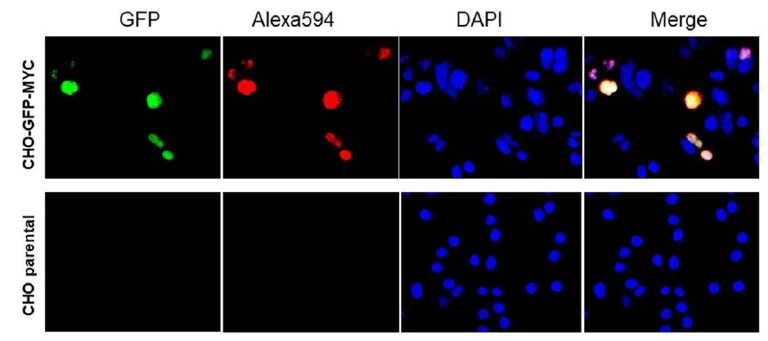
Immunocytochemistry/ Immunofluorescence - Anti c-Myc Antibody (AB316922)
Immunofluorescent analysis of 4% paraformaldehyde (PFA)-fixed, 0.1% Triton X-100 permeabilized CHO cells transfected with GFP-MYC constructs (named as CHO-GFP-MYC, Top) and parental CHO cells (Bottom) labeling c-Myc with ab316922 at 1.5 ug/ml, followed by Donkey Anti-Goat IgG (H&L) Alexa-Fluor594® conjugated secondary antibody at 3 ug/ml) (Red). Nucleus was counterstained with DAPI (Blue).
- ICC/IF
Supplier Data
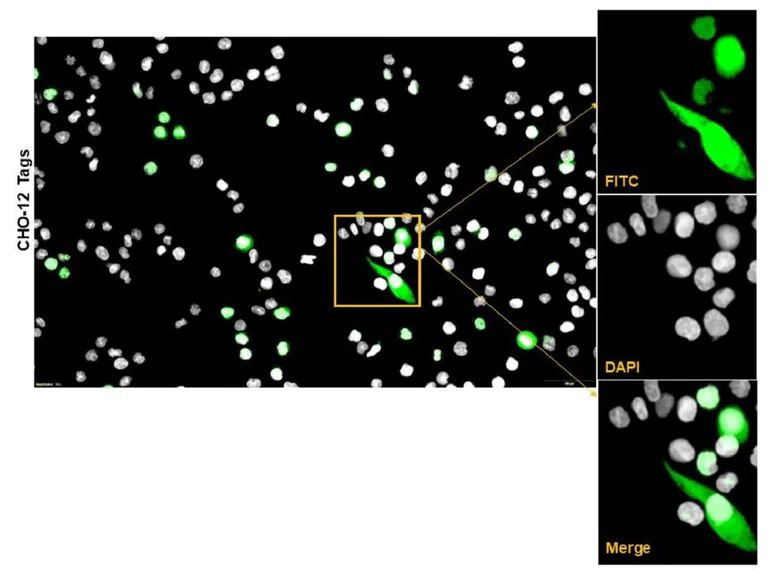
Immunocytochemistry/ Immunofluorescence - Anti c-Myc Antibody (AB316922)
Immunofluorescent analysis of 4% paraformaldehyde (PFA)-fixed, 0.1% Triton X-100 permeabilized CHO cells transfected with 12 tags constructs (CHO-12 tags) labeling c-Myc with ab316922 at 4 ug/ml, followed by Donkey Anti-Goat IgG (H&L) FITC conjugated secondary antibody at a 1/1000 dilution (1 ug/ml) (Green). Nucleus was counterstained with DAPI (White).

- ICC/IF
Supplier Data
Immunocytochemistry/ Immunofluorescence - Anti c-Myc Antibody (AB316922)
Parallel staining with ab316922 and Donkey Anti-Goat IgG (H&L) FITC conjugated secondary antibody in negative control parental CHO cell line.
Complementary Products

Primary Antibodies
AB236632
Anti-HA tag antibody [EPR22819-101]
BOND RX™ Validated|RabMAb|Recombinant|Lab Essentials|20ul selling size

- 3
- 1

Primary Antibodies
AB183734
RabMAb|Recombinant|Lab Essentials|20ul selling size

- 5
- 24
Primary Antibodies
AB9485
Anti-GAPDH antibody - Loading Control
BOND RX™ Validated|Lab Essentials

- 5
- 88
Reactivity data
Properties and storage information
Form
Purification technique
Storage buffer
Shipped at conditions
Appropriate short-term storage conditions
Appropriate long-term storage conditions
Supplementary information
This supplementary information is collated from multiple sources and compiled automatically.
Biological function summary
C-Myc is involved in regulating cell growth and proliferation. It forms part of the Myc/Max complex which binds to DNA to regulate gene expression. This activity affects cellular metabolism ribosome biogenesis and cell cycle entry emphasizing its regulation of cellular energy and stress response. Its expression levels critically govern normal cellular functions and homeostasis.
Pathways
C-Myc plays an important role in the cell cycle pathway and apoptosis regulation. Specifically c-Myc is associated with the Wnt signaling pathway which influences cellular proliferation and differentiation. It also interacts with other proteins like Cyclin D1 influencing cell cycle control. These interactions ensure c-Myc's involvement in regulating key processes related to cell proliferation and stability.
Product protocols
- Visit the General protocols
- Visit the Troubleshooting
Target data
Product promise
Please note: All products are 'FOR RESEARCH USE ONLY. NOT FOR USE IN DIAGNOSTIC OR THERAPEUTIC PROCEDURES'.
For licensing inquiries, please contact partnerships@abcam.com