JavaScript is disabled in your browser. Please enable JavaScript to view this website.
AB234825

Anti-C16orf62 antibody

Be the first to review this product! Submit a review

|

(1 Publication)

Rabbit Polyclonal C16orf62 antibody. Suitable for WB, ICC/IF and reacts with Human samples. Cited in 1 publication. Immunogen corresponding to Recombinant Fragment Protein within Human VPS35L aa 1 to C-terminus.
1 Images
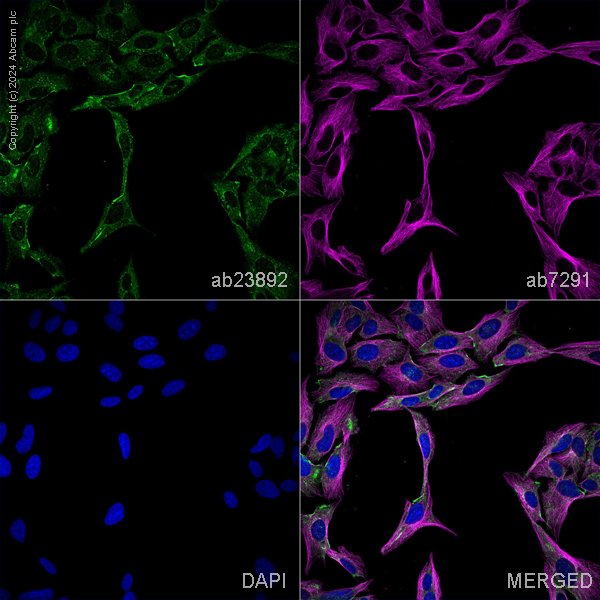
Immunocytochemistry/ Immunofluorescence - Anti-C16orf62 antibody (AB234825)
  • ICC/IF

Supplier Data

Immunocytochemistry/ Immunofluorescence - Anti-C16orf62 antibody (AB234825)

HepG2 (human liver hepatocellular carcinoma cell line) cells labeling C16orf62 (green) using ab234825 at 1/100 dilution in ICC/IF, followed by Alexa Fluor 488® congugated Goat Anti-Rabbit IgG (H+L).

Key facts

Host species

Rabbit

Clonality

Polyclonal

Isotype

IgG

Carrier free

No

Reacts with

Human

Applications

ICC/IF, WB

applications

Immunogen

Recombinant Fragment Protein within Human VPS35L aa 1 to C-terminus. The exact immunogen used to generate this antibody is proprietary information.

Q7Z3J2

Reactivity data

{ "title": "Reactivity Data", "filters": { "stats": ["", "Species", "Dilution Info", "Notes"], "tabs": { "all-applications": {"fullname" : "All Applications", "shortname": "All Applications"}, "WB" : {"fullname" : "Western blot", "shortname":"WB"}, "ICCIF" : {"fullname" : "Immunocytochemistry/ Immunofluorescence", "shortname":"ICC/IF"} }, "product-promise": { "all": "all", "testedAndGuaranteed": "tested", "guaranteed": "expected", "predicted": "predicted", "notRecommended": "not-recommended" } }, "values": { "Human": { "WB-species-checked": "testedAndGuaranteed", "WB-species-dilution-info": "1/500 - 1/5000", "WB-species-notes": "<p></p>", "ICCIF-species-checked": "testedAndGuaranteed", "ICCIF-species-dilution-info": "1/50 - 1/200", "ICCIF-species-notes": "<p></p>" } } }

Properties and storage information

Form
Liquid
Purification technique
Affinity purification Protein G
Purification notes
Purity >95%.
Storage buffer
pH: 7.4 Preservative: 0.03% Proclin 300 Constituents: PBS, 50% Glycerol (glycerin, glycerine)
Shipped at conditions
Blue Ice
Appropriate short-term storage duration
1-2 weeks
Appropriate short-term storage conditions
+4°C
Appropriate long-term storage conditions
-20°C
Aliquoting information
Upon delivery aliquot
Storage information
Avoid freeze / thaw cycle

Supplementary information

This supplementary information is collated from multiple sources and compiled automatically.

C16orf62 also known as Chromosome 16 Open Reading Frame 62 is a lesser-known but important protein with a predicted mass of approximately 40 kDa. These proteins are most notably expressed in tissues such as the pancreas and liver. While not widely studied it is thought that C16orf62 might contribute to processes that have not been fully elucidated yet. As research on this gene progresses a clearer understanding of its precise mechanical roles will likely emerge.
Biological function summary

C16orf62 plays an important role in cellular homeostasis and metabolic regulation. It is part of a multiprotein complex called the ER-associated degradation (ERAD) complex. Within this complex C16orf62 contributes to the detection and degradation of misfolded proteins maintaining protein quality control inside the cells. The balance achieved by C16orf62 and its complex partners is critical in preventing the accumulation of defective proteins that can lead to cellular stress and dysfunction.

Pathways

C16orf62's function as part of the ERAD complex integrates into the broader protein processing pathways in the endoplasmic reticulum. This regulation involves pathways like the ER stress response and the ubiquitin-proteasome system. C16orf62 collaborates with other proteins in these pathways such as ubiquitin ligases which tag misfolded proteins for degradation. These interactions emphasize its role in maintaining cellular protein homeostasis and adapting to stress conditions.

The misregulation of C16orf62 has implications for conditions like cystic fibrosis and certain liver diseases. In cystic fibrosis the improper degradation of misfolded proteins can exacerbate the disease pathogenesis. This protein functioning with partners like the CFTR protein highlights its potential connection to the disease mechanisms. Similarly in liver disorders defects in protein quality control pathways can lead to accumulation of toxic proteins contributing to disease progression. Understanding C16orf62's influence on these disorders could open new avenues for therapeutic approaches.

Product protocols

For this product, it's our understanding that no specific protocols are required. You can visit:

Target data

Acts as a component of the retriever complex. The retriever complex is a heterotrimeric complex related to retromer cargo-selective complex (CSC) and essential for retromer-independent retrieval and recycling of numerous cargos such as integrin alpha-5/beta-1 (ITGA5 : ITGB1) (PubMed : 28892079). The recruitment of the retriever complex to the endosomal membrane involves CCC and WASH complexes (PubMed : 28892079). In the endosomes, drives the retrieval and recycling of NxxY-motif-containing cargo proteins by coupling to SNX17, a cargo essential for the homeostatic maintenance of numerous cell surface proteins associated with processes that include cell migration, cell adhesion, nutrient supply and cell signaling (PubMed : 28892079). Involved in copper-dependent ATP7A trafficking between the trans-Golgi network and vesicles in the cell periphery; the function is proposed to depend on its association with the CCC complex and cooperation with the WASH complex on early endosomes. Does not seem to be required for CCC complex stability (PubMed : 25355947).. (Microbial infection) The heterotrimeric retriever complex, in collaboration with the CCC complex, mediates the exit of human papillomavirus to the cell surface.
See full target information VPS35L

Alternative Names

C16orf62, 101F10.2, VPS35L, VPS35 endosomal protein-sorting factor-like, Esophageal cancer-associated protein

Publications (1)

Recent publications for all applications. Explore the full listand refine your search

The Journal of clinical investigation 134: PubMed39352757

2024

Neuropilin-2-expressing breast cancer cells mitigate radiation-induced oxidative stress through nitric oxide signaling.

Applications

Unspecified application

Species

Unspecified reactive species

Ayush Kumar,Hira Lal Goel,Christi A Silva,Tao Wang,Yansong Geng,Mengdie Wang,Shivam Goel,Kai Hu,Rui Li,Lihua J Zhu,Jennifer L Clark,Lindsay M Ferreira,Michael A Brehm,Thomas J FitzGerald,Arthur M Mercurio
View all publications

Product promise

We are committed to supporting your work with high-quality reagents, and we're here for you every step of the way. In the unlikely event that one of our products does not perform as expected, you're protected by our Product Promise.
For full details, please see our Terms & Conditions

Please note: All products are 'FOR RESEARCH USE ONLY. NOT FOR USE IN DIAGNOSTIC OR THERAPEUTIC PROCEDURES'.

For licensing inquiries, please contact partnerships@abcam.com