JavaScript is disabled in your browser. Please enable JavaScript to view this website.
AB81980

Anti-CACNA1C antibody

Be the first to review this product! Submit a review

|

(3 Publications )

Goat Polyclonal CACNA1C antibody. Suitable for WB and reacts with Human samples. Cited in 3 publications. Immunogen corresponding to Synthetic Peptide within Human CACNA1C aa 2200 to C-terminus.
1 Images
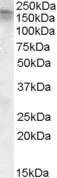
Western blot - Anti-CACNA1C antibody (AB81980)
  • WB

Unknown

Western blot - Anti-CACNA1C antibody (AB81980)

Primary incubation was 1 hour. Detected by chemiluminescence.

All lanes:

Western blot - Anti-CACNA1C antibody (ab81980) at 0.5 µg/mL

All lanes:

Human Heart lysate in RIPA buffer at 35 µg

Predicted band size: 248 kDa

Observed band size: 249 kDa

false

Key facts

Host species

Goat

Clonality

Polyclonal

Isotype

IgG

Carrier free

No

Reacts with

Human

Applications

WB

applications

Immunogen

Synthetic Peptide within Human CACNA1C aa 2200 to C-terminus. The exact immunogen used to generate this antibody is proprietary information.

Q13936

Reactivity data

{ "title": "Reactivity Data", "filters": { "stats": ["", "Species", "Dilution Info", "Notes"], "tabs": { "all-applications": {"fullname" : "All Applications", "shortname": "All Applications"}, "WB" : {"fullname" : "Western blot", "shortname":"WB"} }, "product-promise": { "all": "all", "testedAndGuaranteed": "tested", "guaranteed": "expected", "predicted": "predicted", "notRecommended": "not-recommended" } }, "values": { "Human": { "WB-species-checked": "testedAndGuaranteed", "WB-species-dilution-info": "0.5-1.5 µg/mL", "WB-species-notes": "<p>1 hour primary incubation is recommended for this product.</p>" }, "Cynomolgus monkey": { "WB-species-checked": "predicted", "WB-species-dilution-info": "", "WB-species-notes": "" } } }

Properties and storage information

Form
Liquid
Purification technique
Affinity purification Immunogen
Purification notes
ab81980 was purified from goat serum by ammonium sulphate precipitation followed by antigen affinity chromatography using the immunizing peptide.
Storage buffer
pH: 7.3 Preservative: 0.02% Sodium azide Constituents: Tris buffered saline, 0.5% BSA
Shipped at conditions
Blue Ice
Appropriate short-term storage conditions
+4°C
Appropriate long-term storage conditions
-20°C
Aliquoting information
Upon delivery aliquot
Storage information
Avoid freeze / thaw cycle

Supplementary information

This supplementary information is collated from multiple sources and compiled automatically.

CACNA1C also known as Cav1.2 is a voltage-dependent calcium channel α1C subunit. It primarily facilitates the influx of calcium ions into cells upon depolarization. Cav1.2 weighs approximately 250 kDa and plays an essential role in cellular processes across multiple systems. You can find it highly expressed in the heart brain and smooth muscle tissues. It's significant for conducting electrical signals that control muscle contractions and neurotransmitter release.
Biological function summary

Cav1.2 channels regulate intracellular calcium levels affecting processes such as cardiac contraction neuronal excitability and gene expression. This protein does not function alone; it forms complexes with other auxiliary subunits that modulate its activity and localization. Through this regulation CACNA1C supports critical cellular responses and maintains homeostasis within its expressed organs.

Pathways

Cav1.2 integrates into important pathways like the excitation-contraction coupling in cardiac myocytes and the neural signaling pathways in neurons. Through its interaction with calcium/calmodulin-dependent protein kinase II (CaMKII) CACNA1C affects downstream cascades that influence cellular functions and responses to external stimuli. The protein also interacts with other ion channels facilitating comprehensive cellular communication and function in its specialized tissues.

Altered CACNA1C function associates with cardiac diseases like Timothy syndrome and various forms of Long QT syndrome. The abnormal activity of this channel also links to psychiatric disorders such as bipolar disorder where it interacts with proteins involved in mood regulation. Substantial research focuses on targeting CACNA1C for therapeutic intervention due to its significant role in these disorders highlighting the protein as an important target for new treatments.

Product protocols

For this product, it's our understanding that no specific protocols are required. You can visit:

Target data

Pore-forming, alpha-1C subunit of the voltage-gated calcium channel that gives rise to L-type calcium currents (PubMed : 12181424, PubMed : 15454078, PubMed : 15863612, PubMed : 16299511, PubMed : 17224476, PubMed : 20953164, PubMed : 23677916, PubMed : 24728418, PubMed : 26253506, PubMed : 27218670, PubMed : 29078335, PubMed : 29742403, PubMed : 30023270, PubMed : 30172029, PubMed : 34163037, PubMed : 8099908). Mediates influx of calcium ions into the cytoplasm, and thereby triggers calcium release from the sarcoplasm (By similarity). Plays an important role in excitation-contraction coupling in the heart. Required for normal heart development and normal regulation of heart rhythm (PubMed : 15454078, PubMed : 15863612, PubMed : 17224476, PubMed : 24728418, PubMed : 26253506). Required for normal contraction of smooth muscle cells in blood vessels and in the intestine. Essential for normal blood pressure regulation via its role in the contraction of arterial smooth muscle cells (PubMed : 28119464). Long-lasting (L-type) calcium channels belong to the 'high-voltage activated' (HVA) group (Probable).. Isoform 12. Pore-forming, alpha-1C subunit of the voltage-gated calcium channel that gives rise to L-type calcium currents.. Isoform 13. Pore-forming, alpha-1C subunit of the voltage-gated calcium channel that gives rise to L-type calcium currents.. Isoform 14. Pore-forming, alpha-1C subunit of the voltage-gated calcium channel that gives rise to L-type calcium currents.. Isoform 15. Pore-forming, alpha-1C subunit of the voltage-gated calcium channel that gives rise to L-type calcium currents.. Isoform 16. Pore-forming, alpha-1C subunit of the voltage-gated calcium channel that gives rise to L-type calcium currents.. Isoform 17. Pore-forming, alpha-1C subunit of the voltage-gated calcium channel that gives rise to L-type calcium currents.. Isoform 18. Pore-forming, alpha-1C subunit of the voltage-gated calcium channel that gives rise to L-type calcium currents.. Isoform 19. Pore-forming, alpha-1C subunit of the voltage-gated calcium channel that gives rise to L-type calcium currents.. Isoform 20. Pore-forming, alpha-1C subunit of the voltage-gated calcium channel that gives rise to L-type calcium currents.. Isoform 21. Pore-forming, alpha-1C subunit of the voltage-gated calcium channel that gives rise to L-type calcium currents.. Isoform 22. Pore-forming, alpha-1C subunit of the voltage-gated calcium channel that gives rise to L-type calcium currents.. Isoform 23. Pore-forming, alpha-1C subunit of the voltage-gated calcium channel that gives rise to L-type calcium currents.. Isoform 24. Pore-forming, alpha-1C subunit of the voltage-gated calcium channel that gives rise to L-type calcium currents.. Isoform 25. Pore-forming, alpha-1C subunit of the voltage-gated calcium channel that gives rise to L-type calcium currents.. Isoform 26. Pore-forming, alpha-1C subunit of the voltage-gated calcium channel that gives rise to L-type calcium currents.. Isoform 27. Pore-forming, alpha-1C subunit of the voltage-gated calcium channel that gives rise to L-type calcium currents.. Isoform 34. Pore-forming, alpha-1C subunit of the voltage-gated calcium channel that gives rise to L-type calcium currents.. (Microbial infection) Acts as a receptor for Influenzavirus (PubMed : 29779930). May play a critical role in allowing virus entry when sialylated and expressed on lung tissues (PubMed : 29779930).
See full target information CACNA1C

Alternative Names

CACH2, CACN2, CACNL1A1, CCHL1A1, CACNA1C, Voltage-dependent L-type calcium channel subunit alpha-1C, Voltage-gated calcium channel subunit alpha Cav1.2

Publications (3)

Recent publications for all applications. Explore the full list and refine your search

World journal of gastroenterology 30:4817-4835 PubMed39649544

2024

Quantitative proteomics analysis reveals the pathogenesis of obstructed defecation syndrome caused by abnormal expression of dystrophin.

Applications

Unspecified application

Species

Unspecified reactive species

Wen-Zhe Li,Yu Xiong,Tian-Kun Wang,Yan-Yan Chen,Song-Lin Wan,Lu-Yao Li,Meng Xu,Jing-Jing Tong,Qun Qian,Cong-Qing Jiang,Wei-Cheng Liu

Biology of sex differences 8:26 PubMed28807015

2017

Genomic upregulation of cardiac Cav1.2α and NCX1 by estrogen in women.

Applications

Unspecified application

Species

Unspecified reactive species

Rita Papp,Glenna C L Bett,Agnieszka Lis,Randall L Rasmusson,István Baczkó,András Varró,Guy Salama

Cardiovascular research 106:76-86 PubMed25712961

2015

Ageing is associated with deterioration of calcium homeostasis in isolated human right atrial myocytes.

Applications

Unspecified application

Species

Unspecified reactive species

Adela Herraiz-Martínez,Jesus Álvarez-García,Anna Llach,Cristina E Molina,Jacqueline Fernandes,Andreu Ferrero-Gregori,Cristina Rodríguez,Alexander Vallmitjana,Raúl Benítez,Josep M Padró,José Martínez-González,Juan Cinca,Leif Hove-Madsen
View all publications

Product promise

We are committed to supporting your work with high-quality reagents, and we're here for you every step of the way. In the unlikely event that one of our products does not perform as expected, you're protected by our Product Promise.
For full details, please see our Terms & Conditions

Please note: All products are 'FOR RESEARCH USE ONLY. NOT FOR USE IN DIAGNOSTIC OR THERAPEUTIC PROCEDURES'.

For licensing inquiries, please contact partnerships@abcam.com