Anti-CALHM3 antibody [EPR12513]
- RabMAb
- Recombinant
- What is this?
Be the first to review this product! Submit a review
|
(1 Publication)
- WB
Supplier Data
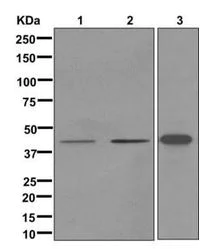
Western blot - Anti-CALHM3 antibody [EPR12513] (AB175206)
All lanes:
Western blot - Anti-CALHM3 antibody [EPR12513] (ab175206) at 1/1000 dilution
Lane 1:
A673 cell lysate at 10 µg
Lane 2:
HepG2 cell lysate at 10 µg
Lane 3:
HT-1376 cell lysate at 10 µg
Predicted band size: 39 kDa
false
Related conjugates and formulations (1)
-
Anti-CALHM3 antibody [EPR12513] - BSA and Azide free
Complementary Products

Reactivity data
Product details
Species reactivity
Mouse, Rat: We have preliminary internal testing data to indicate this antibody may not react with these species.
Please contact us for more information.
Patented technology
Our RabMAb® technology is a patented hybridoma-based technology for making rabbit monoclonal antibodies. For details on our patents, please refer to RabMAb® patents.
What are the advantages of a recombinant monoclonal antibody?
This product is a recombinant monoclonal antibody, which offers several advantages including:
- - High batch-to-batch consistency and reproducibility
- - Improved sensitivity and specificity
- - Long-term security of supply
- - Animal-free batch production
For more information, read more on recombinant antibodies.
Properties and storage information
Form
Purification technique
Storage buffer
Shipped at conditions
Appropriate short-term storage duration
Appropriate short-term storage conditions
Appropriate long-term storage conditions
Aliquoting information
Storage information
Supplementary information
This supplementary information is collated from multiple sources and compiled automatically.
Biological function summary
CALHM3 participates in taste perception by working with other proteins to form a pore complex that allows ATP release. This complex is important for signal transmission in taste receptor cells. The ability of CALHM3 channels to release ATP on taste bud stimulation is important for the communication of taste signals to sensory neurons. Through this interaction CALHM3 significantly influences the sensory response and perception of different tastes.
Pathways
CALHM3 is part of the taste signaling pathway interacting with CALHM1 and other subunits to regulate gustatory signals. This pathway plays an important role in how organisms interpret various taste stimuli. Furthermore CALHM3's involvement in calcium signaling pathways connects it with other proteins such as P2X receptors which also mediate ATP signaling. These interactions demonstrate the protein's integration and contribution to essential sensory processes in the body.
Product protocols
- Visit the General protocols
- Visit the Troubleshooting
Target data
Alternative Names
Publications (1)
Recent publications for all applications. Explore the full listand refine your search
Cellular and molecular life sciences : CMLS 82:192 PubMed40323446
2025
Applications
Unspecified application
Species
Unspecified reactive species
Product promise
Please note: All products are 'FOR RESEARCH USE ONLY. NOT FOR USE IN DIAGNOSTIC OR THERAPEUTIC PROCEDURES'.
For licensing inquiries, please contact partnerships@abcam.com