Anti-Caspr2/CNTNAP2 antibody [K67/25]
- BOND RX™ Validated
- Recombinant
- What is this?
Be the first to review this product! Submit a review
|
(1 Publication)
- IHC-P
Supplier Data
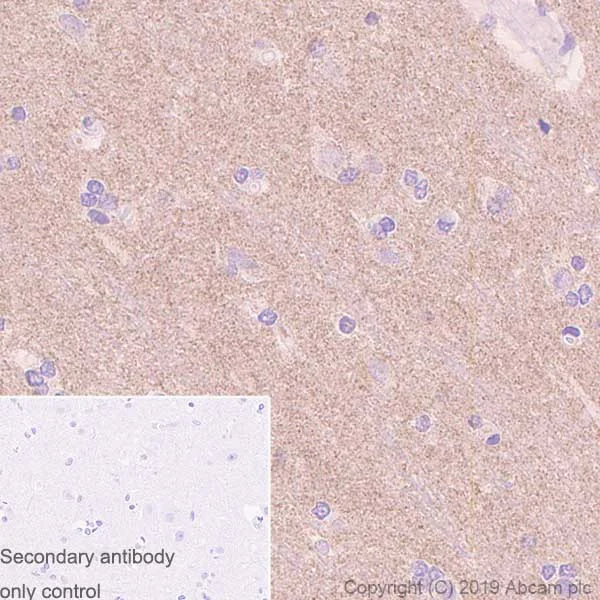
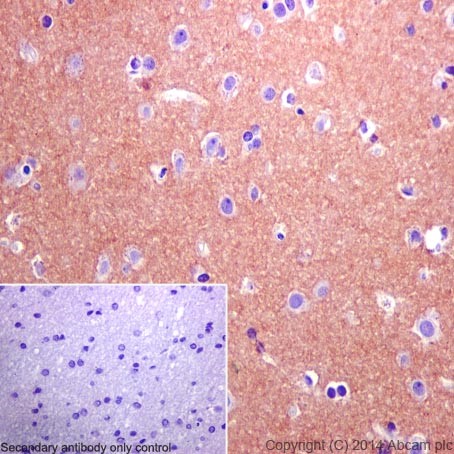
Immunohistochemistry (Formalin/PFA-fixed paraffin-embedded sections) - Anti-Caspr2/CNTNAP2 antibody [K67/25] (AB252534)
Immunohistochemical analysis of paraffin-embedded human cerebrum tissue labeling Caspr2/CNTNAP2 with ab252534 at 0.45μg/ml, followed by a ready to use secondary antibody. Positive staining on human cerebrum is observed. Counter stained with hematoxylin.
Secondary antibody only control : Used PBS instead of primary antibody, secondary antibody is a ready to use secondary.
Heat mediated antigen retrieval with Tris-EDTA buffer (pH 9.0, epitope retrieval solution 2) for 20 mins.
The section was incubated with ab252534 for 30 mins at room temperature.
The immunostaining staining was performed on a Leica Biosystems BOND® RX instrument.
Related conjugates and formulations (1)
-
Anti-Caspr2/CNTNAP2 antibody [K67/25] - BSA and Azide free
Alternative Products
Primary Antibodies
AB248788
Anti-Caspr2/CNTNAP2 antibody [EPR8738] - BSA and Azide free
RabMAb|Recombinant
- 0
- 0
Complementary Products
Primary Antibodies
AB198506
Anti-DPP6 antibody [EPR15944-24]
20ul selling size|RabMAb|Recombinant
- 4
- 1
Primary Antibodies
AB16667
BOND RX™ Validated|KO Validated|RabMAb|Advanced Validation|Recombinant|20ul selling size

- 5
- 133
Primary Antibodies
AB133634
BOND RX™ Validated|RabMAb|Recombinant|KO Validated
- 4
- 4
Reactivity data
Product details
What are the advantages of a recombinant monoclonal antibody?
This product is a recombinant monoclonal antibody, which offers several advantages including:
- - High batch-to-batch consistency and reproducibility
- - Improved sensitivity and specificity
- - Long-term security of supply
- - Animal-free batch production
For more information, read more on recombinant antibodies.
Want a custom formulation?
This antibody clone is manufactured by Abcam. If you require a custom buffer formulation or conjugation for your experiments, please contact orders@abcam.com
Properties and storage information
Form
Purification technique
Storage buffer
Shipped at conditions
Appropriate short-term storage duration
Appropriate short-term storage conditions
Appropriate long-term storage conditions
Aliquoting information
Storage information
Supplementary information
This supplementary information is collated from multiple sources and compiled automatically.
Biological function summary
This protein is important in maintaining the integrity of the neuronal membrane. Caspr2 works as part of a complex associating with contactin proteins to stabilize neuronal networks. It is involved in synaptic plasticity and potentially influences neuronal connectivity and communication. Through its adhesive functions Caspr2 contributes to structural frameworks that ensure proper signal transmission in the neural circuits.
Pathways
Caspr2 participates in pathways responsible for neuronal excitability and membrane potential regulation. It plays an important role within the voltage-gated potassium channel complex. Caspr2 also connects to proteins like TAG-1 forming a vital part of the complex involved in the assembly of potassium channels and ensuring efficient nerve impulse conduction. Its interaction within these pathways impacts synaptic function and cognitive processes by modulating neuronal excitability.
Product protocols
- Visit the General protocols
- Visit the Troubleshooting
Target data
Alternative Names
Publications (1)
Recent publications for all applications. Explore the full listand refine your search
Frontiers in molecular neuroscience 15:1046992 PubMed36479526
2022
Applications
Unspecified application
Species
Unspecified reactive species
Product promise
Please note: All products are 'FOR RESEARCH USE ONLY. NOT FOR USE IN DIAGNOSTIC OR THERAPEUTIC PROCEDURES'.
For licensing inquiries, please contact partnerships@abcam.com