JavaScript is disabled in your browser. Please enable JavaScript to view this website.
AB91101

Anti-CD160 antibody [CNX46-3]

Be the first to review this product! Submit a review

|

(1 Publication)
Rat Monoclonal CD160 antibody CNX46-3. Suitable for Flow Cyt and reacts with Mouse samples. Cited in 1 publication.
1 Images
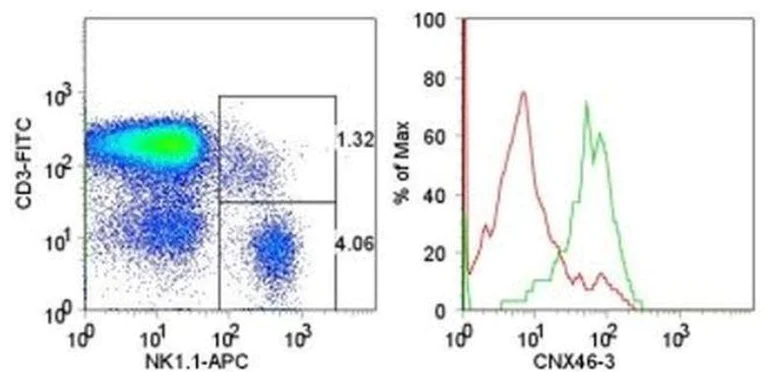
Flow Cytometry - Anti-CD160 antibody [CNX46-3] (AB91101)
  • Flow Cyt

Supplier Data

Flow Cytometry - Anti-CD160 antibody [CNX46-3] (AB91101)

Flow cytometry analysis of C57BL/6 splenocytes labelling CD160 with ab91101 at 0.5 μg, followed by F (ab')2 Anti-Rat IgG PE and subsequently with anti-Mouse CD3e FITC and anti-Mouse NK1-1 APC. The histogram (right) demonstrates staining of ab911001 on NK1-1+CD3. cells (red histogram) and NK1-1+CD3+ cells (green histogram), as gated in the dot plot (left).

Key facts

Host species

Rat

Clonality

Monoclonal

Clone number

CNX46-3

Isotype

IgG2a

Light chain type

kappa

Carrier free

No

Reacts with

Mouse

Applications

Flow Cyt

applications

Immunogen

Recombinant Full Length Protein corresponding to Mouse Cd160.

O88875

Reactivity data

{ "title": "Reactivity Data", "filters": { "stats": ["", "Species", "Dilution Info", "Notes"], "tabs": { "all-applications": {"fullname" : "All Applications", "shortname": "All Applications"}, "FlowCyt" : {"fullname" : "Flow Cytometry", "shortname":"Flow Cyt"} }, "product-promise": { "all": "all", "testedAndGuaranteed": "tested", "guaranteed": "expected", "predicted": "predicted", "notRecommended": "not-recommended" } }, "values": { "Mouse": { "FlowCyt-species-checked": "testedAndGuaranteed", "FlowCyt-species-dilution-info": "", "FlowCyt-species-notes": "<p>1 μg/test</p>" } } }

Properties and storage information

Form
Liquid
Purification technique
Affinity purification Protein A
Storage buffer
pH: 7.2 Preservative: 0.09% Sodium azide Constituents: PBS
Shipped at conditions
Blue Ice
Appropriate short-term storage duration
1-2 weeks
Appropriate short-term storage conditions
+4°C
Appropriate long-term storage conditions
-20°C
Storage information
Avoid freeze / thaw cycle

Supplementary information

This supplementary information is collated from multiple sources and compiled automatically.

CD160 also known as BY55 is a glycosylphosphatidylinositol (GPI)-anchored protein with a molecular weight of approximately 27 kDa. This protein is expressed on the surface of natural killer (NK) cells CD8+ T cells and certain NKT cells. It functions as a receptor for MHC class I molecules and HLA-C playing a role in regulating immune responses. Researchers have also identified its expression in some endothelial cells.
Biological function summary

The protein CD160 plays a role in immune modulation by interacting with major histocompatibility complex (MHC) class I ligands. It participates in the immune response by enhancing cytotoxic activity in NK and CD8+ T cells therefore influencing cell-mediated immunity. CD160 does not associate with large signal transduction complexes but operates as a standalone receptor capable of mediating cellular effects upon ligand binding. Although primarily known for its role in immune modulation CD160 can impact endothelial functions suggesting a broader biological significance.

Pathways

CD160 engages in the pathway associated with immune cell signaling. It operates within the natural killer cell signaling cascade contributing to the regulation of cell-mediated cytotoxicity. In the context of adaptive immunity CD160 influences the T cell receptor signaling pathway indirectly coordinating its actions with proteins such as NKG2D and PD-1. These interactions are important in how immune cells assess threats and modulate responses.

CD160 has implications in chronic inflammatory and autoimmune conditions. It is linked to disorders such as inflammatory bowel disease and psoriasis where immune regulation is disrupted. Its interaction with other proteins such as PD-1 may either exacerbate or alleviate symptoms depending on the pathological context. Understanding CD160's role provides insights into therapeutic strategies aimed at modulating immune responses in these conditions.

Product protocols

For this product, it's our understanding that no specific protocols are required. You can visit:

Target data

CD160 antigen. Receptor on immune cells capable to deliver stimulatory or inhibitory signals that regulate cell activation and differentiation. Exists as a GPI-anchored and as a transmembrane form, each likely initiating distinct signaling pathways via phosphoinositol 3-kinase in activated NK cells and via LCK and CD247/CD3 zeta chain in activated T cells (By similarity). Receptor for both classical and non-classical MHC class I molecules (PubMed : 16177084). Receptor or ligand for TNF superfamily member TNFRSF14, participating in bidirectional cell-cell contact signaling between antigen presenting cells and lymphocytes. Upon ligation of TNFRSF14, provides stimulatory signal to NK cells enhancing IFNG production and anti-tumor immune response (PubMed : 25711213). On activated CD4+ T cells, interacts with TNFRSF14 and down-regulates CD28 costimulatory signaling, restricting memory and alloantigen-specific immune response (By similarity). In the context of bacterial infection, acts as a ligand for TNFRSF14 on epithelial cells, triggering the production of antimicrobial proteins and pro-inflammatory cytokines (PubMed : 22801499).. CD160 antigen, soluble form. The soluble GPI-cleaved form, usually released by activated lymphocytes, might play an immune regulatory role by limiting lymphocyte effector functions.
See full target information Cd160

Alternative Names

CD160, By55, Cd160, CD160 antigen, Natural killer cell receptor BY55

Publications (1)

Recent publications for all applications. Explore the full list and refine your search

Journal of immunology (Baltimore, Md. : 1950) 175:4426-32 PubMed16177084

2005

Murine CD160, Ig-like receptor on NK cells and NKT cells, recognizes classical and nonclassical MHC class I and regulates NK cell activation.

Applications

FuncS, WB, IP, Flow Cyt

Species

Unspecified reactive species, Unspecified reactive species, Unspecified reactive species, Unspecified reactive species

Motoi Maeda,Carmine Carpenito,Ryan C Russell,Jyoti Dasanjh,Linnea L Veinotte,Hideaki Ohta,Takashi Yamamura,Rusung Tan,Fumio Takei
View all publications

Product promise

We are committed to supporting your work with high-quality reagents, and we're here for you every step of the way. In the unlikely event that one of our products does not perform as expected, you're protected by our Product Promise.
For full details, please see our Terms & Conditions

Please note: All products are 'FOR RESEARCH USE ONLY. NOT FOR USE IN DIAGNOSTIC OR THERAPEUTIC PROCEDURES'.

For licensing inquiries, please contact partnerships@abcam.com