JavaScript is disabled in your browser. Please enable JavaScript to view this website.
AB233785

Anti-CD161 antibody [4C6A11]

Be the first to review this product! Submit a review

|

(2 Publications )

Mouse Monoclonal KLRB1 antibody. Suitable for Flow Cyt, WB and reacts with Human samples. Cited in 2 publications. Immunogen corresponding to Recombinant Fragment Protein within Human KLRB1 aa 50 to C-terminus.

Image updates are in progress. Products remain available and covered by the Abcam Product Promise. Learn more.
1 Images
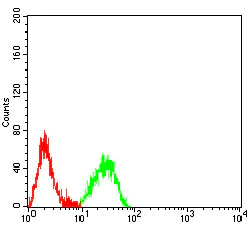
Flow Cytometry - Anti-CD161 antibody [4C6A11] (AB233785)
  • Flow Cyt

Supplier Data

Flow Cytometry - Anti-CD161 antibody [4C6A11] (AB233785)

Flow cytometric analysis of Raji (human Burkitt's lymphoma cell line) cells labeling CD161 with ab233785 at 1/200 dilution (green) compared with a negative control (red).

Key facts

Host species

Mouse

Clonality

Monoclonal

Clone number

4C6A11

Isotype

IgG2b

Carrier free

No

Reacts with

Human

Applications

Flow Cyt, WB

applications

Immunogen

Recombinant Fragment Protein within Human KLRB1 aa 50 to C-terminus. The exact immunogen used to generate this antibody is proprietary information.

Q12918

Reactivity data

{ "title": "Reactivity Data", "filters": { "stats": ["", "Species", "Dilution Info", "Notes"], "tabs": { "all-applications": {"fullname" : "All Applications", "shortname": "All Applications"}, "FlowCyt" : {"fullname" : "Flow Cytometry", "shortname":"Flow Cyt"}, "WB" : {"fullname" : "Western blot", "shortname":"WB"} }, "product-promise": { "all": "all", "testedAndGuaranteed": "tested", "guaranteed": "expected", "predicted": "predicted", "notRecommended": "not-recommended" } }, "values": { "Human": { "FlowCyt-species-checked": "testedAndGuaranteed", "FlowCyt-species-dilution-info": "1/200 - 1/400", "FlowCyt-species-notes": "<p></p>", "WB-species-checked": "testedAndGuaranteed", "WB-species-dilution-info": "1/500 - 1/2000", "WB-species-notes": "<p></p>" } } }

Properties and storage information

Form
Liquid
Purification technique
Affinity purification Protein G
Purification notes
Purified from tissue culture supernatant.
Storage buffer
Preservative: 0.05% Sodium azide Constituents: PBS
Shipped at conditions
Blue Ice
Appropriate short-term storage duration
1-2 weeks
Appropriate short-term storage conditions
+4°C
Appropriate long-term storage conditions
-20°C
Aliquoting information
Upon delivery aliquot
Storage information
Avoid freeze / thaw cycle

Supplementary information

This supplementary information is collated from multiple sources and compiled automatically.

CD161 also known as NKRP1A or KLRB1 is a type II transmembrane protein expressed primarily on natural killer (NK) cells and subsets of T cells. Weighing approximately 30-40 kDa CD161 functions as a C-type lectin receptor involved in the immune response. Its expression can be detected in various tissues including the liver and spleen. Researchers utilize tools such as mouse CD161 PE as well as CD161 APC antibodies for study of its cell surface expression and role in immune modulation.
Biological function summary

CD161 plays a role in immune system regulation by mediating NK cell and T cell activity. It does not operate as part of a complex but interacts with other cellular receptors to modulate immune responses. For example it serves as an inhibitory receptor often through engagement with its ligand LLT1 to temper immune responses and prevent overactivation. This balance is key to maintaining immune homeostasis and facilitates pathogen clearance while avoiding excessive tissue damage.

Pathways

CD161 is involved in the immune checkpoint pathways and is linked to inflammatory response signaling. These pathways play an important role in the immune system's ability to discern self from non-self determining the intensity and character of the body's defense mechanisms. Other proteins such as CTLA-4 and PD-1 also function within these pathways contributing to the regulation of immune cell activity and preventing autoimmunity.

CD161 is associated with inflammatory diseases and cancer. Its involvement in immune checkpoints implicates it in conditions such as autoimmune diseases where it may fail to properly regulate immune activity including multiple sclerosis. In cancer CD161 expression on T cells has been examined in the context of its inhibitory role potentially modulating the immune system's ability to target tumor cells effectively. In these scenarios its interaction with LLT1 and other immune checkpoint proteins influences the disease course and therapeutic outcomes.

Product protocols

For this product, it's our understanding that no specific protocols are required. You can visit:

Target data

Plays an inhibitory role on natural killer (NK) cells cytotoxicity. Activation results in specific acid sphingomyelinase/SMPD1 stimulation with subsequent marked elevation of intracellular ceramide. Activation also leads to AKT1/PKB and RPS6KA1/RSK1 kinases stimulation as well as markedly enhanced T-cell proliferation induced by anti-CD3. Acts as a lectin that binds to the terminal carbohydrate Gal-alpha(1,3)Gal epitope as well as to the N-acetyllactosamine epitope. Binds also to CLEC2D/LLT1 as a ligand and inhibits NK cell-mediated cytotoxicity as well as interferon-gamma secretion in target cells.
See full target information KLRB1

Alternative Names

CD161, CLEC5B, NKRP1A, KLRB1, Killer cell lectin-like receptor subfamily B member 1, C-type lectin domain family 5 member B, HNKR-P1a, Natural killer cell surface protein P1A, NKR-P1A

Publications (2)

Recent publications for all applications. Explore the full listand refine your search

Communications biology 7:1041 PubMed39179795

2024

PGRMC2 and HLA-G regulate immune homeostasis in a microphysiological model of human maternal-fetal membrane interface.

Applications

Unspecified application

Species

Unspecified reactive species

Ryan C V Lintao,Lauren S Richardson,Ananth Kumar Kammala,Jenieve Chapa,Dianne Aster Yunque-Yap,Kamil Khanipov,George Golovko,Leslie Michelle M Dalmacio,Ramkumar Menon

Biomolecules & biomedicine 24:848-856 PubMed38149831

2023

Hypomethylation of the promoter region contributes to the occurrence and development of ovarian endometriosis via the AKT/mTOR/4EBP1 signaling pathway.

Applications

Unspecified application

Species

Unspecified reactive species

Yuzhen Qin,Yishuai Li,Yali Hao,Yan Li,Shan Kang
View all publications

Product promise

We are committed to supporting your work with high-quality reagents, and we're here for you every step of the way. In the unlikely event that one of our products does not perform as expected, you're protected by our Product Promise.
For full details, please see our Terms & Conditions

Please note: All products are 'FOR RESEARCH USE ONLY. NOT FOR USE IN DIAGNOSTIC OR THERAPEUTIC PROCEDURES'.

For licensing inquiries, please contact partnerships@abcam.com