JavaScript is disabled in your browser. Please enable JavaScript to view this website.
AB111090

Anti-CD208 antibody

Be the first to review this product! Submit a review

|

(13 Publications)

Rabbit Polyclonal CD208 antibody. Suitable for IHC-P and reacts with Human samples. Cited in 13 publications. Immunogen corresponding to Synthetic Peptide within Human LAMP3.

View Alternative Names

CD208, DCLAMP, TSC403, LAMP3, Lysosome-associated membrane glycoprotein 3, LAMP-3, Lysosomal-associated membrane protein 3, DC-lysosome-associated membrane glycoprotein, Protein TSC403, DC LAMP
1 Images
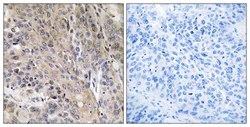
Immunohistochemistry (Formalin/PFA-fixed paraffin-embedded sections) - Anti-CD208 antibody (AB111090)
  • IHC-P

Unknown

Immunohistochemistry (Formalin/PFA-fixed paraffin-embedded sections) - Anti-CD208 antibody (AB111090)

ab111090 at 1/50 dilution staining CD208 in paraffin-embedded Human Lung carcinoma tissue by Immunohistochemistry. The image on the right is treated with the synthesized peptide.

Key facts

Host species

Rabbit

Clonality

Polyclonal

Isotype

IgG

Carrier free

No

Reacts with

Human

Applications

IHC-P

applications

Immunogen

Synthetic Peptide within Human LAMP3. The exact immunogen used to generate this antibody is proprietary information.

Q9UQV4

Reactivity data

{ "title": "Reactivity Data", "filters": { "stats": ["", "Species", "Dilution Info", "Notes"], "tabs": { "all-applications": {"fullname" : "All Applications", "shortname": "All Applications"}, "IHCP" : {"fullname" : "Immunohistochemistry (Formalin/PFA-fixed paraffin-embedded sections)", "shortname":"IHC-P"} }, "product-promise": { "all": "all", "testedAndGuaranteed": "tested", "guaranteed": "expected", "predicted": "predicted", "notRecommended": "not-recommended" } }, "values": { "Human": { "IHCP-species-checked": "testedAndGuaranteed", "IHCP-species-dilution-info": "1/50 - 1/100", "IHCP-species-notes": "<p></p>" } } }

Properties and storage information

Form
Liquid
Purification technique
Affinity purification Immunogen
Purification notes
ab111090 was affinity-purified from Rabbit antiserum by affinity-chromatography using epitope-specific immunogen.
Storage buffer
pH: 7.4 Preservative: 0.02% Sodium azide Constituents: PBS, 50% Glycerol (glycerin, glycerine), 0.88% Sodium chloride
Shipped at conditions
Blue Ice
Appropriate short-term storage conditions
+4°C
Appropriate long-term storage conditions
-20°C
Storage information
Stable for 12 months at -20°C

Supplementary information

This supplementary information is collated from multiple sources and compiled automatically.

The protein CD208 also known as DC-LAMP or LAMP-3 is integral to the immune system. It has an approximate mass of 60 kDa. CD208 is a type I transmembrane glycoprotein found mainly in the endosomal/lysosomal compartments of dendritic cells. The expression of CD208 is upregulated during the maturation of dendritic cells making it a reliable marker for these immune cells. Researchers often use CD208 to study dendritic cell biology and its role in immune responses.
Biological function summary

CD208 participates in the regulation of the immune response by facilitating antigen processing and presentation. This protein is a part of the lysosomal-associated membrane protein family which contributes to the recycling of MHC class II molecules. Through its involvement in the endocytic pathway CD208 aids in presenting antigens to T lymphocytes an important step in triggering adaptive immunity. The protein colocalizes with MHC class II which is essential for effective antigen presentation.

Pathways

CD208 has a significant role in the endosomal-lysosomal pathway where it interacts with other proteins involved in antigen processing. It also engages in the intracellular trafficking pathway that affects the presentation of peptides on MHC class II molecules. The interaction with proteins such as HLA-DR is vital for efficient antigen presentation to helper T cells. CD208 supports the proper delivery of peptide-loaded MHC molecules to the cell surface a necessity for a functional adaptive immune response.

CD208 has implications in autoimmune diseases and infectious diseases. Its expression is notably altered in conditions like lupus and certain infectious diseases. In systemic lupus erythematosus (SLE) abnormal CD208 expression correlates with the dysregulation of immune responses. Additionally during infectious diseases changes in CD208 expression can impact the activation and function of dendritic cells affecting disease progression. The interaction of CD208 with proteins like MHC class II molecules highlights its role in disease pathology and immune regulation.

Product protocols

For this product, it's our understanding that no specific protocols are required. You can visit:

Target data

Lysosomal membrane glycoprotein which plays a role in the unfolded protein response (UPR) that contributes to protein degradation and cell survival during proteasomal dysfunction (PubMed : 25681212). Plays a role in the process of fusion of the lysosome with the autophagosome, thereby modulating the autophagic process (PubMed : 24434718). Promotes hepatocellular lipogenesis through activation of the PI3K/Akt pathway (PubMed : 29056532). May also play a role in dendritic cell function and in adaptive immunity (PubMed : 9768752).. (Microbial infection) Plays a positive role in post-entry steps of influenza A virus replication, either virus uncoating, cytosolic transport, or nuclear import of viral components, and promotes nuclear accumulation of influenza nucleoprotein/NP at early stages of viral infection.. (Microbial infection) Supports the FURIN-mediated cleavage of mumps virus fusion protein F by interacting with both FURIN and the unprocessed form but not the processed form of the viral protein F.. (Microbial infection) Promotes the intracellular proliferation of Salmonella typhimuium.
See full target information LAMP3

Publications (13)

Recent publications for all applications. Explore the full list and refine your search

Cellular oncology (Dordrecht, Netherlands) 48:1127-1144 PubMed40498284

2025

SPTSSA facilitates gastric cancer progression with modulating PD-L1 in immunomicroenvironment through Wnt/β-catenin pathway.

Applications

Unspecified application

Species

Unspecified reactive species

Pingping Sun,Weiwei Qin,Haiyan Xu,Hang Yin,Lei Yang,Xiaojing Zhang,Xiaoxia Jin,Qiang Xu,Han Wu,Xiaoling Kuai,Lizhou Jia,Jianfei Huang,Yao Wang

Computational and structural biotechnology journal 23:1201-1213 PubMed38545600

2024

Multi-omics analysis reveals the unique landscape of DLD in the breast cancer tumor microenvironment and its implications for immune-related prognosis.

Applications

Unspecified application

Species

Unspecified reactive species

Lijun Xu,Lei Yang,Dan Zhang,Yunxi Wu,Jiali Shan,Huixia Zhu,Zhengyi Lian,Guying He,Chongyu Wang,Qingqing Wang

STAR protocols 4:101961 PubMed36633948

2023

Protocol for investigating tertiary lymphoid structures in human and murine fixed tissue sections using Opal™-TSA multiplex immunohistochemistry.

Applications

Unspecified application

Species

Unspecified reactive species

Luke T Quigley,Lokman Pang,Elnaz Tavancheh,Matthias Ernst,Andreas Behren,Jennifer Huynh,Jessica Da Gama Duarte

Clinical and translational medicine 12:e1072 PubMed36305631

2022

Characterization of the tumour microenvironment phenotypes in malignant tissues and pleural effusion from advanced osteoblastic osteosarcoma patients.

Applications

Unspecified application

Species

Unspecified reactive species

Zhichang Zhang,Weiping Ji,Jin Huang,Yawen Zhang,Yan Zhou,Jianjun Zhang,Yang Dong,Ting Yuan,Qingcheng Yang,Xiaomin Ding,Lina Tang,Hongtao Li,Junyi Yin,Yonggang Wang,Tong Ji,Jia Fei,Bing Zhang,Peizhan Chen,Haiyan Hu

IUBMB life 73:1334-1347 PubMed34415102

2021

Bromodomain-containing protein 9 is a prognostic biomarker associated with immune infiltrates and promotes tumor malignancy through activating notch signaling pathway in negative HIF-2α clear cell renal cell carcinoma.

Applications

Unspecified application

Species

Unspecified reactive species

Weijuan Lou,Ke Gao,Chenyue Xu,Qingquan Li

FASEB journal : official publication of the Federation of American Societies for Experimental Biology 33:10490-10504 PubMed31311326

2019

Long noncoding RNA HAGLR acts as a microRNA-143-5p sponge to regulate epithelial-mesenchymal transition and metastatic potential in esophageal cancer by regulating LAMP3.

Applications

Unspecified application

Species

Unspecified reactive species

Chengliang Yang,Sining Shen,Xiaoli Zheng,Ke Ye,Yanan Sun,Yufei Lu,Hong Ge

Breast cancer research : BCR 21:46 PubMed30922380

2019

Genomic signature of parity in the breast of premenopausal women.

Applications

Unspecified application

Species

Unspecified reactive species

Julia Santucci-Pereira,Anne Zeleniuch-Jacquotte,Yelena Afanasyeva,Hua Zhong,Michael Slifker,Suraj Peri,Eric A Ross,Ricardo López de Cicco,Yubo Zhai,Theresa Nguyen,Fathima Sheriff,Irma H Russo,Yanrong Su,Alan A Arslan,Pal Bordas,Per Lenner,Janet Åhman,Anna Stina Landström Eriksson,Robert Johansson,Göran Hallmans,Paolo Toniolo,Jose Russo

Clinical lymphoma, myeloma & leukemia 18:749-754 PubMed30082222

2018

LAMP1 Overexpression Predicts for Poor Prognosis in Diffuse Large B-cell Lymphoma.

Applications

Unspecified application

Species

Unspecified reactive species

Qingxiu Dang,Hong Zhou,Juan Qian,Li Yang,Jianfei Huang,Yaping Zhang,Wenyu Shi

Disease markers 2017:1218254 PubMed28607528

2017

Clinical Significance and Prognostic Value of the Expression of LAMP3 in Oral Squamous Cell Carcinoma.

Applications

IHC-P

Species

Human

Jun Lu,Hengcheng Ma,Shuijin Lian,Dan Huang,Min Lian,Ye Zhang,Jianfei Huang,Xingmei Feng

Tumour biology : the journal of the International Society for Oncodevelopmental Biology and Medicine 39:1010428317695014 PubMed28349821

2017

LAMP3 expression correlated with poor clinical outcome in human ovarian cancer.

Applications

Unspecified application

Species

Unspecified reactive species

Di Wang,Xuemin Cao,Yuquan Zhang,Yuanlin Liu,Chan Yao,Wenliang Ge,Yunzhao Xu
View all publications

Product promise

We are committed to supporting your work with high-quality reagents, and we're here for you every step of the way. In the unlikely event that one of our products does not perform as expected, you're protected by our Product Promise.
For full details, please see our Terms & Conditions

Please note: All products are 'FOR RESEARCH USE ONLY. NOT FOR USE IN DIAGNOSTIC OR THERAPEUTIC PROCEDURES'.

For licensing inquiries, please contact partnerships@abcam.com