Anti-CD68 antibody [PG-M1], prediluted
- Lab Essentials
- What is this?
5
(1 Review)
|
(3 Publications )
- IHC-P
Unknown
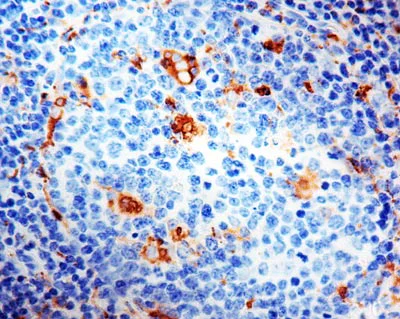
Immunohistochemistry (Formalin/PFA-fixed paraffin-embedded sections) - Anti-CD68 antibody [PG-M1], prediluted (AB844)
ab844 staining CD68 in formalin-fixed, paraffin-embedded Human tonsil tissue by Immunohistochemistry. Staining was detected using DAB.
Alternative Products

Primary Antibodies
AB222914
Alexa Fluor® 488 Anti-CD68 antibody [KP1]
Recombinant|Advanced Validation

- 4
- 2
Primary Antibodies
AB277938
Alexa Fluor® 594 Anti-CD68 antibody [EPR20545]
BOND RX™ Validated|RabMAb|Recombinant

- 0
- 0


Primary Antibodies
AB227458
Anti-CD68 antibody [EPR20545] - BSA and Azide free
BOND RX™ Validated|RabMAb|Advanced Validation|Recombinant

- 4
- 1
Primary Antibodies
AB213363
BOND RX™ Validated|RabMAb|Recombinant|Lab Essentials|20ul selling size|Advanced Validation

- 4
- 6
Complementary Products

Primary Antibodies
AB133616
BOND RX™ Validated|RabMAb|Recombinant|Lab Essentials|20ul selling size

- 5
- 20
Primary Antibodies
AB16669
Anti-CD3 epsilon antibody [SP7]
BOND RX™ Validated|RabMAb|Advanced Validation|Recombinant|Lab Essentials|20ul selling size

- 4
- 80

Primary Antibodies
AB16667
BOND RX™ Validated|KO Validated|RabMAb|Advanced Validation|Recombinant|20ul selling size

- 5
- 133
Reactivity data
Properties and storage information
Form
Storage buffer
Shipped at conditions
Appropriate short-term storage conditions
Appropriate long-term storage conditions
Storage information
Supplementary information
This supplementary information is collated from multiple sources and compiled automatically.
Biological function summary
CD68 facilitates functions associated with the innate immune response. It serves as an important part of macrophages which contribute to immune surveillance and tissue homeostasis. Though it primarily operates on its own in some contexts CD68 might assist in forming complexes with other receptors to modulate phagocytic activity. This target is significant in atherosclerotic plaque stability as macrophages engulf lipids and cell debris through processes facilitated by CD68.
Pathways
CD68 is involved in pathways connected to inflammation and phagocytosis. The CD68 protein works closely with other scavenger receptors like CD36 to mediate uptake of oxidized low-density lipoproteins (oxLDL) in the lipid metabolism pathway. Additionally CD68 engagement can influence the toll-like receptor (TLR) signaling pathways thereby linking innate immunity and inflammatory responses critical for host defense and disease progression.
Product protocols
- Visit the General protocols
- Visit the Troubleshooting
Target data
Alternative Names
Publications (3)
Recent publications for all applications. Explore the full listand refine your search
International journal of cell biology 2023:6840271 PubMed37305351
2023
Applications
Unspecified application
Species
Unspecified reactive species
Oncology letters 21:372 PubMed33777196
2021
Applications
Unspecified application
Species
Unspecified reactive species
The Journal of investigative dermatology 134:2598-2609 PubMed24714202
2014
Applications
IF
Species
Unspecified reactive species
Product promise
Please note: All products are 'FOR RESEARCH USE ONLY. NOT FOR USE IN DIAGNOSTIC OR THERAPEUTIC PROCEDURES'.
For licensing inquiries, please contact partnerships@abcam.com