Anti-CD99 antibody [M026] - Extracellular domain
Be the first to review this product! Submit a review
|
(1 Publication)
Mouse Monoclonal CD99 antibody. Extracellular domain. Suitable for ELISA, WB, ICC/IF and reacts with Recombinant fragment - Human, Human samples. Cited in 1 publication. Immunogen corresponding to Recombinant Fragment Protein within Human CD99.
View Alternative Names
CD99, MIC2, MIC2X, MIC2Y, CD99 antigen, 12E7, E2 antigen, Protein MIC2, T-cell surface glycoprotein E2
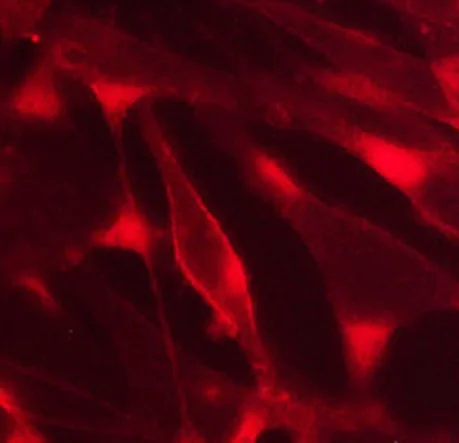
- ICC/IF
Supplier Data
Immunocytochemistry/ Immunofluorescence - Anti-CD99 antibody [M026] - Extracellular domain (AB253291)
Paraformaldehyde-fixed MeWo (human malignant melanoma cell line) cells labeling CD99 using ab253291 at a 1/100 dilution in ICC/IF. Goat anti-mouse DyLight® 594 secondary.
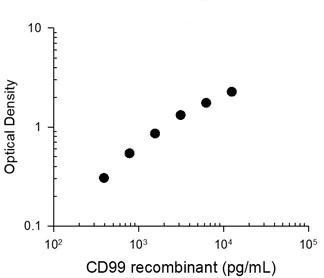
- ELISA
Supplier Data
ELISA - Anti-CD99 antibody [M026] - Extracellular domain (AB253291)
Representative Standard Curve using mouse monoclonal anti-CD99 (ab253291) for ELISA capture of human recombinant CD99 extracellular region with His-tag. Capture was detected by using an anti-His-tag antibody followed by appropriate secondary antibody conjugated to HRP.

- WB
Supplier Data
Western blot - Anti-CD99 antibody [M026] - Extracellular domain (AB253291)
Western blot membranes were incubated with diluted antibody in 5% non-fat milk, PBS, 0.04% Tween-20 for 1 hour at room temperature.
All lanes:
Western blot - Anti-CD99 antibody [M026] - Extracellular domain (ab253291) at 1/1000 dilution
Lane 1:
A549 (Human lung carcinoma cell line) cell lysate
Lane 2:
A431 (Human epidermoid carcinoma cell line) cell lysate
Lane 3:
LNCaP (Human prostate cancer cell line) cell lysate
Lane 4:
MDA-MB-231 (Human cell line) cell lysate
Lane 5:
MeWo (Human malignant melanoma cell line) cell lysate
Predicted band size: 19 kDa
false
Complementary Products

Primary Antibodies
AB281586
BOND RX™ Validated|20ul selling size|RabMAb|Recombinant

- 5
- 3
Primary Antibodies
AB183742
Anti-TLE 1 antibody [EPR9386(2)]
20ul selling size|BOND RX™ Validated|RabMAb|Recombinant|KO Validated

- 5
- 1
Primary Antibodies
AB124800
Anti-Myogenin antibody [EPR4789]
20ul selling size|RabMAb|Recombinant

- 5
- 3
Primary Antibodies
AB281583
BOND RX™ Validated|RabMAb|Recombinant|Lab Essentials|20ul selling size

- 5
- 5
Reactivity data
Properties and storage information
Form
Purification technique
Purification notes
Storage buffer
Shipped at conditions
Appropriate short-term storage duration
Appropriate short-term storage conditions
Appropriate long-term storage conditions
Aliquoting information
Storage information
Supplementary information
This supplementary information is collated from multiple sources and compiled automatically.
Biological function summary
CD99 functions as a modulator in cell adhesion and migration. It facilitates the separation of leukocytes from the endothelium during transendothelial migration impacting the immune response and inflammation. CD99 is not part of a complex itself but interacts with extracellular matrix (ECM) components to perform its role. It contributes to the regulation of cell death pathways showcasing its versatility in maintaining cellular homeostasis.
Pathways
CD99 primarily participates in the regulation of T-cell adhesion and transmigration pathways. It supports the E-selectin and integrins pathway which is important for T-cell migration to sites of inflammation. CD99 works in conjunction with proteins like ICAM-1 and VCAM-1 assisting these proteins in facilitating immune cell movement and interactions. Its involvement in these pathways highlights its significance in immune surveillance and response modulation.
Product protocols
- Visit the General protocols
- Visit the Troubleshooting
Target data
Publications (1)
Recent publications for all applications. Explore the full list and refine your search
Journal of neuroinflammation 18:172 PubMed34372877
2021
Applications
Unspecified application
Species
Unspecified reactive species
Product promise
Please note: All products are 'FOR RESEARCH USE ONLY. NOT FOR USE IN DIAGNOSTIC OR THERAPEUTIC PROCEDURES'.
For licensing inquiries, please contact partnerships@abcam.com