JavaScript is disabled in your browser. Please enable JavaScript to view this website.
AB237801

Anti-CEP70 antibody

Be the first to review this product! Submit a review

|

(1 Publication)

Rabbit Polyclonal CEP70 antibody. Suitable for WB, IHC-P, ICC/IF and reacts with Human, Mouse samples. Cited in 1 publication. Immunogen corresponding to Recombinant Fragment Protein within Human CEP70 aa 50-300.
2 Images
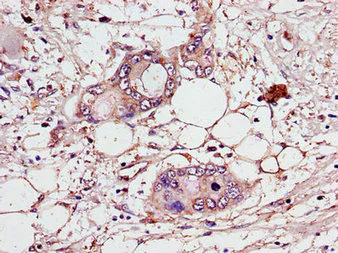
Immunohistochemistry (Formalin/PFA-fixed paraffin-embedded sections) - Anti-CEP70 antibody (AB237801)
  • IHC-P

Supplier Data

Immunohistochemistry (Formalin/PFA-fixed paraffin-embedded sections) - Anti-CEP70 antibody (AB237801)

Paraffin-embedded human pancreatic cancer tissue stained for CEP70 using ab237801 at 1/100 dilution in immunohistochemical analysis.
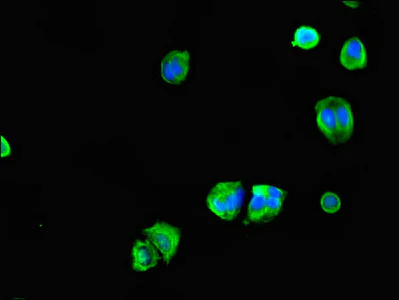
Immunocytochemistry/ Immunofluorescence - Anti-CEP70 antibody (AB237801)
  • ICC/IF

Supplier Data

Immunocytochemistry/ Immunofluorescence - Anti-CEP70 antibody (AB237801)

MCF7 (human breast adenocarcinoma cell line) cells stained for CEP70 (green) using ab237801 at 1/100 dilution in ICC/IF, followed by Alexa Fluor 488® conjugated Goat Anti-Rabbit IgG (H+L).

Key facts

Host species

Rabbit

Clonality

Polyclonal

Isotype

IgG

Carrier free

No

Reacts with

Mouse, Human

Applications

ICC/IF, WB, IHC-P

applications

Immunogen

Recombinant Fragment Protein within Human CEP70 aa 50-300. The exact immunogen used to generate this antibody is proprietary information.

Q8NHQ1

Reactivity data

{ "title": "Reactivity Data", "filters": { "stats": ["", "Species", "Dilution Info", "Notes"], "tabs": { "all-applications": {"fullname" : "All Applications", "shortname": "All Applications"}, "WB" : {"fullname" : "Western blot", "shortname":"WB"}, "IHCP" : {"fullname" : "Immunohistochemistry (Formalin/PFA-fixed paraffin-embedded sections)", "shortname":"IHC-P"}, "ICCIF" : {"fullname" : "Immunocytochemistry/ Immunofluorescence", "shortname":"ICC/IF"} }, "product-promise": { "all": "all", "testedAndGuaranteed": "tested", "guaranteed": "expected", "predicted": "predicted", "notRecommended": "not-recommended" } }, "values": { "Human": { "WB-species-checked": "testedAndGuaranteed", "WB-species-dilution-info": "1/1000 - 1/5000", "WB-species-notes": "<p></p>", "IHCP-species-checked": "testedAndGuaranteed", "IHCP-species-dilution-info": "1/20 - 1/200", "IHCP-species-notes": "<p></p>", "ICCIF-species-checked": "testedAndGuaranteed", "ICCIF-species-dilution-info": "1/50 - 1/200", "ICCIF-species-notes": "<p></p>" }, "Mouse": { "WB-species-checked": "testedAndGuaranteed", "WB-species-dilution-info": "1/1000 - 1/5000", "WB-species-notes": "<p></p>", "IHCP-species-checked": "guaranteed", "IHCP-species-dilution-info": "", "IHCP-species-notes": "", "ICCIF-species-checked": "guaranteed", "ICCIF-species-dilution-info": "", "ICCIF-species-notes": "" } } }

Properties and storage information

Form
Liquid
Purification technique
Affinity purification Protein G
Purification notes
Purity greater than 95%.
Storage buffer
pH: 7.4 Preservative: 0.03% Proclin 300 Constituents: PBS, 50% Glycerol (glycerin, glycerine)
Shipped at conditions
Blue Ice
Appropriate short-term storage duration
1-2 weeks
Appropriate short-term storage conditions
+4°C
Appropriate long-term storage conditions
-20°C
Aliquoting information
Upon delivery aliquot
Storage information
Avoid freeze / thaw cycle

Supplementary information

This supplementary information is collated from multiple sources and compiled automatically.

CEP70 also known as Centrosomal Protein 70kDa is a component of the centrosome and involved in microtubule organization. The protein has a molecular mass of approximately 70 kDa. It is expressed in several tissues with significant expression observed in the brain and testis. CEP70 plays an important role in maintaining the structural integrity and function of the centrosome contributing to cell cycle progression by ensuring accurate splitting during cell division.
Biological function summary

CEP70 contributes to the regulation of microtubule dynamics. It is known to localize at the centrosome and participates actively in the assembly of the bipolar spindle. CEP70 interacts within a complex network of proteins including CEP135 and γ-tubulin facilitating the stabilization of microtubules and supporting spindle microtubule nucleation. These interactions ensure proper chromosomal alignment and segregation during mitosis.

Pathways

Several cellular processes involve CEP70's integration into essential pathways like the mitotic spindle assembly and cell cycle regulation. It associates with proteins such as CEP135 and γ-tubulin influencing pathways that oversee cell cycle checkpoints and spindle formation. The efficient functioning of these pathways is important for proper cell division highlighting CEP70's role in maintaining genomic stability and preventing aneuploidy.

CEP70 has implications in conditions related to abnormal cell division such as certain cancers and microcephaly. In cancer alterations in CEP70 expression or function can contribute to unregulated cell proliferation owing to its influence on mitotic spindle dynamics. Furthermore CEP70's interaction with proteins like CEP135 is significant in understanding genetic disorders linked to centrosome dysfunctions including microcephaly where impaired centrosome activity affects brain development.

Product protocols

For this product, it's our understanding that no specific protocols are required. You can visit:

Target data

Plays a role in the organization of both preexisting and nascent microtubules in interphase cells. During mitosis, required for the organization and orientation of the mitotic spindle.
See full target information CEP70

Alternative Names

BITE, CEP70, Centrosomal protein of 70 kDa, Cep70, p10-binding protein

Publications (1)

Recent publications for all applications. Explore the full listand refine your search

Journal of translational medicine 22:5 PubMed38169393

2024

PIGT promotes cell growth, glycolysis, and metastasis in bladder cancer by modulating GLUT1 glycosylation and membrane trafficking.

Applications

Unspecified application

Species

Unspecified reactive species

Mingyue Tan,Qi Pan,Chao Yu,Xinyu Zhai,Jianyi Gu,Le Tao,Dongliang Xu
View all publications

Product promise

We are committed to supporting your work with high-quality reagents, and we're here for you every step of the way. In the unlikely event that one of our products does not perform as expected, you're protected by our Product Promise.
For full details, please see our Terms & Conditions

Please note: All products are 'FOR RESEARCH USE ONLY. NOT FOR USE IN DIAGNOSTIC OR THERAPEUTIC PROCEDURES'.

For licensing inquiries, please contact partnerships@abcam.com