JavaScript is disabled in your browser. Please enable JavaScript to view this website.
AB231977

Anti-COMP/Cartilage oligomeric matrix protein antibody

5

(2 Reviews)

|

(24 Publications )
Rabbit Polyclonal COMP/Cartilage oligomeric matrix protein antibody. Suitable for WB, IHC-P and reacts with Human, Recombinant full length protein - Human, Mouse samples. Cited in 24 publications. Immunogen corresponding to Recombinant Fragment Protein within Human COMP aa 100-250.
3 Images
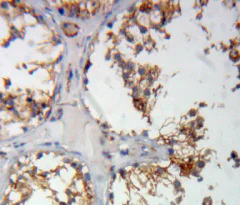
Immunohistochemistry (Formalin/PFA-fixed paraffin-embedded sections) - Anti-COMP/Cartilage oligomeric matrix protein antibody (AB231977)
  • IHC-P

Supplier Data

Immunohistochemistry (Formalin/PFA-fixed paraffin-embedded sections) - Anti-COMP/Cartilage oligomeric matrix protein antibody (AB231977)

Formalin-fixed, paraffin-embedded human testis tissue stained for COMP/Cartilage oligomeric matrix protein using ab231977 at 20 μg/mLin immunohistochemical analysis. DAB staining.
Western blot - Anti-COMP/Cartilage oligomeric matrix protein antibody (AB231977)
  • WB

Supplier Data

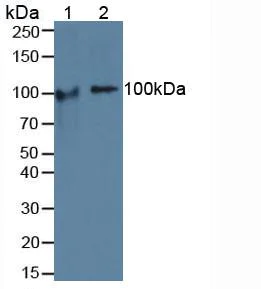
Western blot - Anti-COMP/Cartilage oligomeric matrix protein antibody (AB231977)

All lanes:

Western blot - Anti-COMP/Cartilage oligomeric matrix protein antibody (ab231977) at 3 µg/mL

Lane 1:

Human cartilage tissue lysate

Lane 2:

Mouse cartilage tissue lysate

Secondary

All lanes:

HRP-Linked Guinea pig Anti-Rabbit Ab at 1/2000 dilution

Predicted band size: 82 kDa

true
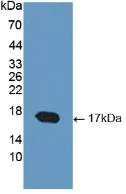
Western blot - Anti-COMP/Cartilage oligomeric matrix protein antibody (AB231977)
  • WB

Supplier Data

Western blot - Anti-COMP/Cartilage oligomeric matrix protein antibody (AB231977)

All lanes:

Western blot - Anti-COMP/Cartilage oligomeric matrix protein antibody (ab231977) at 3 µg/mL

All lanes:

Recombinant human COMP/Cartilage oligomeric matrix protein

Secondary

All lanes:

HRP-Linked Guinea pig Anti-Rabbit Ab at 1/2000 dilution

Predicted band size: 82 kDa

true

Key facts

Host species

Rabbit

Clonality

Polyclonal

Isotype

IgG

Carrier free

No

Reacts with

Mouse, Human

Applications

IHC-P, WB

applications

Immunogen

Recombinant Fragment Protein within Human COMP aa 100-250. The exact immunogen used to generate this antibody is proprietary information.

P49747

Reactivity data

{ "title": "Reactivity Data", "filters": { "stats": ["", "Species", "Dilution Info", "Notes"], "tabs": { "all-applications": {"fullname" : "All Applications", "shortname": "All Applications"}, "WB" : {"fullname" : "Western blot", "shortname":"WB"}, "IHCP" : {"fullname" : "Immunohistochemistry (Formalin/PFA-fixed paraffin-embedded sections)", "shortname":"IHC-P"} }, "product-promise": { "all": "all", "testedAndGuaranteed": "tested", "guaranteed": "expected", "predicted": "predicted", "notRecommended": "not-recommended" } }, "values": { "Human": { "WB-species-checked": "testedAndGuaranteed", "WB-species-dilution-info": "0.5-5 µg/mL", "WB-species-notes": "<p></p>", "IHCP-species-checked": "testedAndGuaranteed", "IHCP-species-dilution-info": "5-20 µg/mL", "IHCP-species-notes": "<p></p>" }, "Mouse": { "WB-species-checked": "testedAndGuaranteed", "WB-species-dilution-info": "0.5-5 µg/mL", "WB-species-notes": "<p></p>", "IHCP-species-checked": "guaranteed", "IHCP-species-dilution-info": "", "IHCP-species-notes": "" }, "Rat": { "WB-species-checked": "predicted", "WB-species-dilution-info": "", "WB-species-notes": "", "IHCP-species-checked": "predicted", "IHCP-species-dilution-info": "", "IHCP-species-notes": "" }, "Cow": { "WB-species-checked": "predicted", "WB-species-dilution-info": "", "WB-species-notes": "", "IHCP-species-checked": "predicted", "IHCP-species-dilution-info": "", "IHCP-species-notes": "" }, "Recombinant full length protein - Human": { "WB-species-checked": "testedAndGuaranteed", "WB-species-dilution-info": "0.5-5 µg/mL", "WB-species-notes": "<p></p>", "IHCP-species-checked": "notRecommended", "IHCP-species-dilution-info": "", "IHCP-species-notes": "" } } }

Properties and storage information

Form
Liquid
Purification technique
Affinity purification Immunogen
Purification notes
Antigen-specific affinity chromatography followed by Protein A affinity chromatography.
Storage buffer
pH: 7.4 Preservative: 0.02% Sodium azide Constituents: PBS, 55.77% Glycerol (glycerin, glycerine)
Shipped at conditions
Blue Ice
Appropriate short-term storage duration
1-2 weeks
Appropriate short-term storage conditions
+4°C
Appropriate long-term storage conditions
-20°C
Aliquoting information
Upon delivery aliquot
Storage information
Avoid freeze / thaw cycle

Supplementary information

This supplementary information is collated from multiple sources and compiled automatically.

The Cartilage Oligomeric Matrix Protein (COMP) also known as oligomeric protein or COMP cartilage protein is a structural component found in the extracellular matrix of cartilage tissues. This matrix protein has a mass of approximately 524 kDa and is predominantly expressed in cartilage particularly hyaline cartilage. COMP forms pentameric structures which make it an important supporting element in the stability and resilience of cartilage. Researchers often use techniques like COMP ELISA to quantify its levels in biological samples.
Biological function summary

COMP interacts with other extracellular matrix components to enhance structural integrity and function of cartilage tissue. It performs significant roles in the organization and maintenance of the matrix tethering fibrillar proteins and supporting cellular interaction. COMP is not typically part of a large complex but works closely with collagens and other matrix proteins to form a robust and flexible extracellular environment.

Pathways

COMP participates in pathways associated with cartilage formation and turnover. It engages in chondrocyte-mediated processes that are vital for endochondral ossification and cartilage repair. Within these pathways it interacts with proteins such as collagen type II and decorin which facilitate the organization and mineralization of cartilage matrix. These interactions highlight the protein's importance in maintaining cartilage architecture and function.

COMP plays a role in chondrodysplasias and osteoarthritis. Mutations in the COMP gene can lead to skeletal disorders like pseudoachondroplasia and multiple epiphyseal dysplasia causing growth and developmental anomalies. In osteoarthritis alterations in COMP levels may serve as an indicator of cartilage degradation. COMP's relationships with proteins like aggrecan and matrilin-3 in these contexts highlight its involvement in pathologies that affect cartilage structure and health.

Product protocols

For this product, it's our understanding that no specific protocols are required. You can visit:

Target data

Plays a role in the structural integrity of cartilage via its interaction with other extracellular matrix proteins such as the collagens and fibronectin. Can mediate the interaction of chondrocytes with the cartilage extracellular matrix through interaction with cell surface integrin receptors (PubMed : 16051604, PubMed : 16542502). Could play a role in the pathogenesis of osteoarthritis (PubMed : 16542502). Potent suppressor of apoptosis in both primary chondrocytes and transformed cells. Suppresses apoptosis by blocking the activation of caspase-3 and by inducing the IAP family of survival proteins (BIRC3, BIRC2, BIRC5 and XIAP) (PubMed : 17993464). Essential for maintaining a vascular smooth muscle cells (VSMCs) contractile/differentiated phenotype under physiological and pathological stimuli. Maintains this phenotype of VSMCs by interacting with ITGA7 (By similarity).
See full target information COMP

Alternative Names

Cartilage oligomeric matrix protein, COMP, Thrombospondin-5, TSP5

Publications (24)

Recent publications for all applications. Explore the full listand refine your search

Nature communications 16:5996 PubMed40595596

2025

The loss of OPA1 accelerates intervertebral disc degeneration and osteoarthritis in aged mice.

Applications

Unspecified application

Species

Unspecified reactive species

Vedavathi Madhu,Miriam Hernandaz-Meadows,Ashley Coleman,Kimheak Sao,Kameron Inguito,Owen Haslam,Paige K Boneski,Hiromi Sesaki,Ruteja A Barve,John A Collins,Makarand V Risbud

Science advances 11:eado6847 PubMed40267183

2025

Genetics- and age-driven neuroimmune and disc changes underscore herniation susceptibility and pain-associated behaviors in SM/J mice.

Applications

Unspecified application

Species

Unspecified reactive species

Emanuel J Novais,Olivia K Ottone,Eric V Brown,Vedavathi Madhu,Victoria A Tran,Pranay Ramteke,Abhijit S Dighe,Michael D Solga,Alexandra Manchel,Angelo C Lepore,Makarand V Risbud

The Journal of clinical investigation 134: PubMed39286973

2024

ADAMTS12 promotes fibrosis by restructuring extracellular matrix to enable activation of injury-responsive fibroblasts.

Applications

Unspecified application

Species

Unspecified reactive species

Konrad Hoeft,Lars Koch,Susanne Ziegler,Ling Zhang,Steffen Luetke,Maria C Tanzer,Debashish Mohanta,David Schumacher,Felix Schreibing,Qingqing Long,Hyojin Kim,Barbara M Klinkhammer,Carla Schikarski,Sidrah Maryam,Mathijs Baens,Juliane Hermann,Sarah Krieg,Fabian Peisker,Laura De Laporte,Gideon Jl Schaefer,Sylvia Menzel,Joachim Jankowski,Benjamin D Humphreys,Adam Wahida,Rebekka K Schneider,Matthias Versele,Peter Boor,Matthias Mann,Gerhard Sengle,Sikander Hayat,Rafael Kramann

iScience 27:110537 PubMed39193188

2024

Time- and cell-specific activation of BMP signaling restrains chondrocyte hypertrophy.

Applications

Unspecified application

Species

Unspecified reactive species

Stephen J Gadomski,Byron W H Mui,Raphael Gorodetsky,Sriram S Paravastu,Joseph Featherall,Li Li,Abigail Haffey,Jae-Chun Kim,Sergei A Kuznetsov,Kathryn Futrega,Astar Lazmi-Hailu,Randall K Merling,Daniel Martin,Andrew W McCaskie,Pamela G Robey

Nutrients 16: PubMed38931240

2024

Time-Dependent Effect of Eggshell Membrane on Monosodium-Iodoacetate-Induced Osteoarthritis: Early-Stage Inflammation Control and Late-Stage Cartilage Protection.

Applications

Unspecified application

Species

Unspecified reactive species

Min Yu,Cheoljin Park,Young Bae Son,So Eun Jo,Seong Hee Jeon,Ye Jin Kim,Sang Bae Han,Jin Tae Hong,Dong Ju Son

Frontiers in cell and developmental biology 12:1360376 PubMed38510179

2024

Increased HIF-2α activity in the nucleus pulposus causes intervertebral disc degeneration in the aging mouse spine.

Applications

Unspecified application

Species

Unspecified reactive species

Shira N Johnston,Maria Tsingas,Rahatul Ain,Ruteja A Barve,Makarand V Risbud

Frontiers in bioengineering and biotechnology 11:1155596 PubMed37469450

2023

Long non-coding RNA CASC2 regulates osteoblasts matrix mineralization.

Applications

Unspecified application

Species

Unspecified reactive species

Jaime Freitas,Sara Reis Moura,Mário Adolfo Barbosa,Susana G Santos,Maria Inês Almeida

Cell death & disease 14:447 PubMed37468461

2023

Loss of function mutation in Ank causes aberrant mineralization and acquisition of osteoblast-like-phenotype by the cells of the intervertebral disc.

Applications

Unspecified application

Species

Unspecified reactive species

Takashi Ohnishi,Victoria Tran,Kimheak Sao,Pranay Ramteke,William Querido,Ruteja A Barve,Koen van de Wetering,Makarand V Risbud

Biomolecules 13: PubMed36671447

2022

The Cancer-Associated Fibroblasts-Related Gene COMP Is a Novel Predictor for Prognosis and Immunotherapy Efficacy and Is Correlated with M2 Macrophage Infiltration in Colon Cancer.

Applications

Unspecified application

Species

Unspecified reactive species

He Ma,Qingqing Qiu,Dan Tan,Qiaofeng Chen,Yaping Liu,Bing Chen,Mingliang Wang

Journal of bone and mineral research : the official journal of the American Society for Bone and Mineral Research 37:2512-2530 PubMed36117450

2022

Conditional Deletion of HIF-2α in Mouse Nucleus Pulposus Reduces Fibrosis and Provides Mild and Transient Protection From Age-Dependent Structural Changes in Intervertebral Disc.

Applications

Unspecified application

Species

Unspecified reactive species

Shira N Johnston,Vedavathi Madhu,Irving M Shapiro,Makarand V Risbud
View all publications

Product promise

We are committed to supporting your work with high-quality reagents, and we're here for you every step of the way. In the unlikely event that one of our products does not perform as expected, you're protected by our Product Promise.
For full details, please see our Terms & Conditions

Please note: All products are 'FOR RESEARCH USE ONLY. NOT FOR USE IN DIAGNOSTIC OR THERAPEUTIC PROCEDURES'.

For licensing inquiries, please contact partnerships@abcam.com