JavaScript is disabled in your browser. Please enable JavaScript to view this website.
AB300668

Anti-COX2 / Cyclooxygenase 2 antibody [33/Cox-2]

Be the first to review this product! Submit a review

|

(5 Publications )
Mouse Recombinant Monoclonal COX2 / Cyclooxygenase 2 antibody. Suitable for WB, ICC/IF and reacts with Human, Mouse, Rat samples. Cited in 5 publications.
3 Images
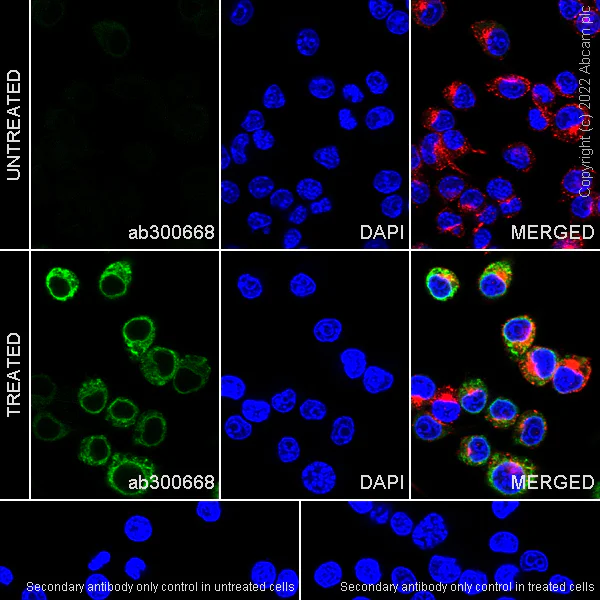
Immunocytochemistry/ Immunofluorescence - Anti-COX2 / Cyclooxygenase 2 antibody [33/Cox-2] (AB300668)
  • ICC/IF

Supplier Data

Immunocytochemistry/ Immunofluorescence - Anti-COX2 / Cyclooxygenase 2 antibody [33/Cox-2] (AB300668)

Immunofluorescent analysis of 4% Paraformaldehyde-fixed, 0.1% Triton X-100 permeabilized Raw 264.7 (mouse Abelson murine leukemia virus-induced tumor macrophage) cells labeling COX2 / Cyclooxygenase 2 with ab300668 at 1/50 diliution (19.94 µg/ml), followed by ab150117 Goat Anti-Mouse IgG H&L (Alexa Fluor® 488) preadsorbed antibody at 1/1000 dilution (2 µg/ml) (Green). Confocal image showing increased cytoplasmic staining in Raw 264.7 cells treated with lipopolysaccharide (1µg/ml) for 6 hours. ab202272 Recombinant Alexa Fluor® 594 Anti-alpha Tubulin antibody [EP1332Y] - Microtubule Marker (ab202272) was used to counterstain tubulin at 1/50 dilution (10 µg/mL) (Red). The nuclear counterstain was DAPI (Blue). Secondary antibody only control : Secondary antibody is ab150117 Goat Anti-Mouse IgG H&L (Alexa Fluor® 488) preadsorbed at 1/1000 dilution (2 µg/ml).
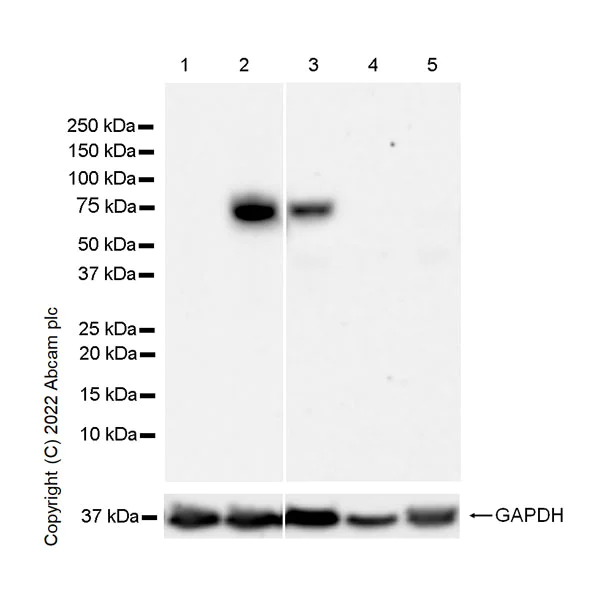
Western blot - Anti-COX2 / Cyclooxygenase 2 antibody [33/Cox-2] (AB300668)
  • WB

Supplier Data

Western blot - Anti-COX2 / Cyclooxygenase 2 antibody [33/Cox-2] (AB300668)

Blocking and diluting buffer and concentration : 5% NFDM/TBST. Negative controls : MCF7 (PMID : 24325753, PMID : 16997132), HCT116 (PMID : 14739610). The expression profile/ molecular weight observed is consistent with what has been described in the literature (PMID : 24260490 ). The blot of lane 3-4 was developed using a high sensitivity ECL substrate. Exposure time : Lane 1, 2 : 59 seconds; Lane 3-5 : 125 seconds.

All lanes:

Western blot - Anti-COX2 / Cyclooxygenase 2 antibody [33/Cox-2] (ab300668) at 1/1000 dilution

Lane 1:

Untreated RAW264.7 (mouse Abelson murine leukemia virus-induced tumor macrophage) whole cell lysate at 20 µg

Lane 2:

RAW264.7 treated with 1 µg/ml Lipopolysaccharides (LPS) for 6 hours, whole cell lysate at 20 µg

Lane 3:

U-87 MG (human glioblastoma-astrocytoma epithelial cell), whole cell lysate at 20 µg

Lane 4:

MCF7 (human breast adenocarcinoma epithelial cell), whole cell lysate at 20 µg

Lane 5:

HCT116 (human colorectal carcinoma epithelial cell), whole cell lysate at 20 µg

Secondary

All lanes:

Peroxidase-Conjugated Goat anti-Mouse IgG (H+L) (ZB-2305) at 1/10000 dilution

Observed band size: 69 kDa

true
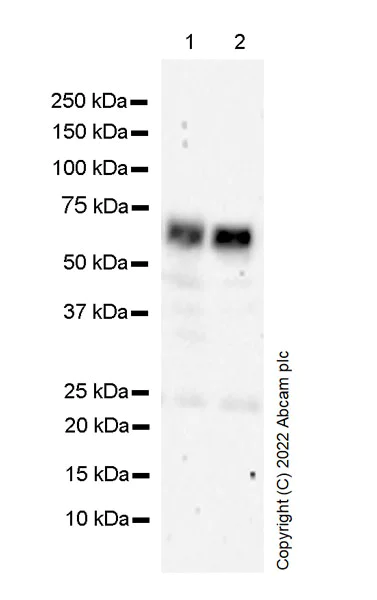
Western blot - Anti-COX2 / Cyclooxygenase 2 antibody [33/Cox-2] (AB300668)
  • WB

Supplier Data

Western blot - Anti-COX2 / Cyclooxygenase 2 antibody [33/Cox-2] (AB300668)

Blocking and diluting buffer and concentration : 5% NFDM/TBST. The blot was developed using a high sensitivity ECL substrate. Exposure time : 3 minutes.

All lanes:

Western blot - Anti-COX2 / Cyclooxygenase 2 antibody [33/Cox-2] (ab300668) at 1/1000 dilution

Lane 1:

Rat kidney tissue lysate at 20 µg

Lane 2:

Rat spleen tissue lysate at 20 µg

Secondary

All lanes:

Peroxidase-Conjugated Goat anti-Mouse IgG (H+L) (ZB-2305) at 1/10000 dilution

Observed band size: 69 kDa

true

Exposure time: 3min

  • Carrier free

    Anti-COX2 / Cyclooxygenase 2 antibody [33/Cox-2] - BSA and Azide free

Key facts

Host species

Mouse

Clonality

Monoclonal

Clone number

33/Cox-2 H1L1

Isotype

IgG1

Carrier free

No

Reacts with

Human, Mouse, Rat

Applications

ICC/IF, WB

applications

Immunogen

The exact immunogen used to generate this antibody is proprietary information.

Reactivity data

{ "title": "Reactivity Data", "filters": { "stats": ["", "Species", "Dilution Info", "Notes"], "tabs": { "all-applications": {"fullname" : "All Applications", "shortname": "All Applications"}, "WB" : {"fullname" : "Western blot", "shortname":"WB"}, "IHCP" : {"fullname" : "Immunohistochemistry (Formalin/PFA-fixed paraffin-embedded sections)", "shortname":"IHC-P"}, "ICCIF" : {"fullname" : "Immunocytochemistry/ Immunofluorescence", "shortname":"ICC/IF"} }, "product-promise": { "all": "all", "testedAndGuaranteed": "tested", "guaranteed": "expected", "predicted": "predicted", "notRecommended": "not-recommended" } }, "values": { "Human": { "WB-species-checked": "testedAndGuaranteed", "WB-species-dilution-info": "1/1000", "WB-species-notes": "<p></p>", "IHCP-species-checked": "notRecommended", "IHCP-species-dilution-info": "", "IHCP-species-notes": "<p></p> Perform heat-mediated antigen retrieval with citrate buffer pH 6 before commencing with IHC staining protocol.", "ICCIF-species-checked": "notRecommended", "ICCIF-species-dilution-info": "1/50", "ICCIF-species-notes": "<p></p>" }, "Mouse": { "WB-species-checked": "testedAndGuaranteed", "WB-species-dilution-info": "1/1000", "WB-species-notes": "<p></p>", "IHCP-species-checked": "notRecommended", "IHCP-species-dilution-info": "", "IHCP-species-notes": "<p></p> Perform heat-mediated antigen retrieval with citrate buffer pH 6 before commencing with IHC staining protocol.", "ICCIF-species-checked": "testedAndGuaranteed", "ICCIF-species-dilution-info": "1/50", "ICCIF-species-notes": "<p></p>" }, "Rat": { "WB-species-checked": "testedAndGuaranteed", "WB-species-dilution-info": "1/1000", "WB-species-notes": "<p></p>", "IHCP-species-checked": "notRecommended", "IHCP-species-dilution-info": "", "IHCP-species-notes": "<p></p> Perform heat-mediated antigen retrieval with citrate buffer pH 6 before commencing with IHC staining protocol.", "ICCIF-species-checked": "guaranteed", "ICCIF-species-dilution-info": "", "ICCIF-species-notes": "" } } }

Product details

What are the advantages of a recombinant monoclonal antibody?
This product is a recombinant monoclonal antibody, which offers several advantages including:

  • - High batch-to-batch consistency and reproducibility
  • - Improved sensitivity and specificity
  • - Long-term security of supply
  • - Animal-free batch production

For more information, read more on recombinant antibodies.

Want a custom formulation?
This antibody clone is manufactured by Abcam. If you require a custom buffer formulation or conjugation for your experiments, please contact orders@abcam.com

Properties and storage information

Form
Liquid
Purification technique
Affinity purification Protein A
Storage buffer
pH: 7.2 - 7.4 Preservative: 0.01% Sodium azide Constituents: PBS, 40% Glycerol (glycerin, glycerine), 0.05% BSA
Shipped at conditions
Blue Ice
Appropriate short-term storage duration
1-2 weeks
Appropriate short-term storage conditions
+4°C
Appropriate long-term storage conditions
-20°C
Aliquoting information
Upon delivery aliquot
Storage information
Avoid freeze / thaw cycle

Supplementary information

This supplementary information is collated from multiple sources and compiled automatically.

Cyclooxygenase 2 also known as COX2 is an enzyme involved in the conversion of arachidonic acid to prostaglandins which are lipid compounds with hormone-like effects. It has alternative names including prostaglandin-endoperoxide synthase 2. The molecular weight of COX2 is approximately 72 kDa. This enzyme is expressed in various tissues including the brain kidneys and areas of inflammation. COX2 expression increases during inflammatory responses and is induced by pro-inflammatory cytokines.
Biological function summary

COX2 plays a significant role in the inflammatory response and is part of the complex process of synthesizing prostaglandins. These compounds mediate inflammation and pain making COX2 an important target for understanding these processes. COX2 is not ubiquitously expressed but rather is induced in activated macrophages and other cells during inflammatory conditions. Its function is also important for normal physiological processes like ovulation and implantation.

Pathways

COX2 is essential in the prostaglandin biosynthesis pathway connecting it to the arachidonic acid metabolism pathway. Cyclooxygenase 2 works with phospholipase A2 which releases arachidonic acid from the phospholipid membrane. COX2 then converts this acid to prostaglandin H2 a precursor for other prostaglandins. COX1 the other isoform of cyclooxygenase is closely related to COX2 and while they have different expression patterns they share some functional similarities in these pathways.

COX2 is connected to inflammatory conditions like arthritis and cancer. Its expression often increases in various cancer types contributing to tumor growth and metastasis by promoting angiogenesis and suppressing immune responses. The enzyme is also linked to rheumatoid arthritis where its overexpression exacerbates inflammation. COX2 inhibitors like ketorolac tromethamine or naproxen structure mitigate symptoms by decreasing prostaglandin synthesis. These inhibitors also interact with COX1 but selective inhibition of COX2 targets inflammation more effectively with fewer gastric side effects associated with COX1 inhibition.

Product protocols

For this product, it's our understanding that no specific protocols are required. You can visit:

Target data

Dual cyclooxygenase and peroxidase in the biosynthesis pathway of prostanoids, a class of C20 oxylipins mainly derived from arachidonate ((5Z,8Z,11Z,14Z)-eicosatetraenoate, AA, C20 : 4(n-6)), with a particular role in the inflammatory response (PubMed : 11939906, PubMed : 16373578, PubMed : 19540099, PubMed : 22942274, PubMed : 26859324, PubMed : 27226593, PubMed : 7592599, PubMed : 7947975, PubMed : 9261177). The cyclooxygenase activity oxygenates AA to the hydroperoxy endoperoxide prostaglandin G2 (PGG2), and the peroxidase activity reduces PGG2 to the hydroxy endoperoxide prostaglandin H2 (PGH2), the precursor of all 2-series prostaglandins and thromboxanes (PubMed : 16373578, PubMed : 22942274, PubMed : 26859324, PubMed : 27226593, PubMed : 7592599, PubMed : 7947975, PubMed : 9261177). This complex transformation is initiated by abstraction of hydrogen at carbon 13 (with S-stereochemistry), followed by insertion of molecular O2 to form the endoperoxide bridge between carbon 9 and 11 that defines prostaglandins. The insertion of a second molecule of O2 (bis-oxygenase activity) yields a hydroperoxy group in PGG2 that is then reduced to PGH2 by two electrons (PubMed : 16373578, PubMed : 22942274, PubMed : 26859324, PubMed : 27226593, PubMed : 7592599, PubMed : 7947975, PubMed : 9261177). Similarly catalyzes successive cyclooxygenation and peroxidation of dihomo-gamma-linoleate (DGLA, C20 : 3(n-6)) and eicosapentaenoate (EPA, C20 : 5(n-3)) to corresponding PGH1 and PGH3, the precursors of 1- and 3-series prostaglandins (PubMed : 11939906, PubMed : 19540099). In an alternative pathway of prostanoid biosynthesis, converts 2-arachidonoyl lysophopholipids to prostanoid lysophopholipids, which are then hydrolyzed by intracellular phospholipases to release free prostanoids (PubMed : 27642067). Metabolizes 2-arachidonoyl glycerol yielding the glyceryl ester of PGH2, a process that can contribute to pain response (PubMed : 22942274). Generates lipid mediators from n-3 and n-6 polyunsaturated fatty acids (PUFAs) via a lipoxygenase-type mechanism. Oxygenates PUFAs to hydroperoxy compounds and then reduces them to corresponding alcohols (PubMed : 11034610, PubMed : 11192938, PubMed : 9048568, PubMed : 9261177). Plays a role in the generation of resolution phase interaction products (resolvins) during both sterile and infectious inflammation (PubMed : 12391014). Metabolizes docosahexaenoate (DHA, C22 : 6(n-3)) to 17R-HDHA, a precursor of the D-series resolvins (RvDs) (PubMed : 12391014). As a component of the biosynthetic pathway of E-series resolvins (RvEs), converts eicosapentaenoate (EPA, C20 : 5(n-3)) primarily to 18S-HEPE that is further metabolized by ALOX5 and LTA4H to generate 18S-RvE1 and 18S-RvE2 (PubMed : 21206090). In vascular endothelial cells, converts docosapentaenoate (DPA, C22 : 5(n-3)) to 13R-HDPA, a precursor for 13-series resolvins (RvTs) shown to activate macrophage phagocytosis during bacterial infection (PubMed : 26236990). In activated leukocytes, contributes to oxygenation of hydroxyeicosatetraenoates (HETE) to diHETES (5,15-diHETE and 5,11-diHETE) (PubMed : 22068350, PubMed : 26282205). Can also use linoleate (LA, (9Z,12Z)-octadecadienoate, C18 : 2(n-6)) as substrate and produce hydroxyoctadecadienoates (HODEs) in a regio- and stereospecific manner, being (9R)-HODE ((9R)-hydroxy-(10E,12Z)-octadecadienoate) and (13S)-HODE ((13S)-hydroxy-(9Z,11E)-octadecadienoate) its major products (By similarity). During neuroinflammation, plays a role in neuronal secretion of specialized preresolving mediators (SPMs) 15R-lipoxin A4 that regulates phagocytic microglia (By similarity).
See full target information PTGS2

Alternative Names

COX2, PTGS2, Prostaglandin G/H synthase 2, Cyclooxygenase-2, PHS II, Prostaglandin H2 synthase 2, Prostaglandin-endoperoxide synthase 2, COX-2, PGH synthase 2, PGHS-2, Cox-2, Cox2, Ptgs2, Prostaglandin G/H synthase 2, Cyclooxygenase-2, PHS II, Prostaglandin H2 synthase 2, Prostaglandin-endoperoxide synthase 2, COX-2, PGH synthase 2, PGHS-2

Publications (5)

Recent publications for all applications. Explore the full listand refine your search

Hereditas 162:81 PubMed40380246

2025

Curcumin alleviates LPS-induced WI-38 cell inflammation injury by regulating PTGS2 expression.

Applications

Unspecified application

Species

Unspecified reactive species

Hongli Xiao,Wangsheng Ma,Lin Zha,Yanmin Xiao,Hui Li

Advanced biology 9:e2400437 PubMed39960128

2025

The Role of Luteolin in Inhibiting Prostaglandin-Endoperoxide Synthase 2 to Relieve Neointimal Hyperplasia in Arteriovenous Fistula.

Applications

Unspecified application

Species

Unspecified reactive species

Ruibin Zhang,Wei Li,Jihua Yang,Xiujie Fan,Huili Fan,Wei Li

Journal of xenobiotics 15: PubMed39846548

2025

Antidiabetic Effects of Quercetin and Silk Sericin in Attenuating Dysregulation of Hepatic Gluconeogenesis in Diabetic Rats Through Potential Modulation of PI3K/Akt/FOXO1 Signaling: In Vivo and In Silico Studies.

Applications

Unspecified application

Species

Unspecified reactive species

Heba M Abdou,Ghada M Abd Elmageed,Hussein K Hussein,Imane Yamari,Samir Chtita,Lamia M El-Samad,Mohamed A Hassan

Heliyon 10:e33083 PubMed39021929

2024

Puerarin modulates proliferation, inflammation and ECM metabolism in human nucleus pulposus mesenchymal stem cells via the lncRNA LINC01535.

Applications

Unspecified application

Species

Unspecified reactive species

Penglei Cui,Yueyang Sheng,Chengai Wu,Da He

Immunity, inflammation and disease 11:e985 PubMed37773725

2023

KDM2B regulates inflammation and oxidative stress of sepsis via targeting NF-κB and AP-1 pathways.

Applications

Unspecified application

Species

Unspecified reactive species

Xin Li,Xinyu Tian,Dongliang Zhang
View all publications

Product promise

We are committed to supporting your work with high-quality reagents, and we're here for you every step of the way. In the unlikely event that one of our products does not perform as expected, you're protected by our Product Promise.
For full details, please see our Terms & Conditions

Please note: All products are 'FOR RESEARCH USE ONLY. NOT FOR USE IN DIAGNOSTIC OR THERAPEUTIC PROCEDURES'.

For licensing inquiries, please contact partnerships@abcam.com