Anti-COX5A antibody [EPR14208(B)]
- BOND RX™ Validated
- RabMAb
- Recombinant
- What is this?
Be the first to review this product! Submit a review
|
(8 Publications )
- IHC-P
Unknown
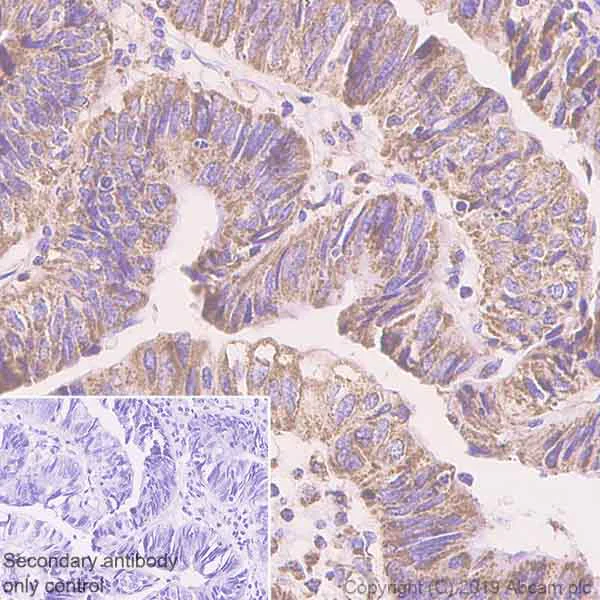
Immunohistochemistry (Formalin/PFA-fixed paraffin-embedded sections) - Anti-COX5A antibody [EPR14208(B)] (AB180129)
Immunohistochemistry (Formalin/PFA-fixed paraffin-embedded sections) analysis of human colon carcinoma tissue sections labeling COX5A with purified ab180129 at 1/3000 dilution (0.5 μg/mL). Heat mediated antigen retrieval using Bond™ Epitope Retrieval Solution 1 (pH 6.0). Rabbit specific IHC polymer detection kit HRP/DAB (ab209101) was used as the secondary antibody. Negative control : PBS instead of the primary antibody. Hematoxylin was used as a counterstain.
- IHC-P
Unknown
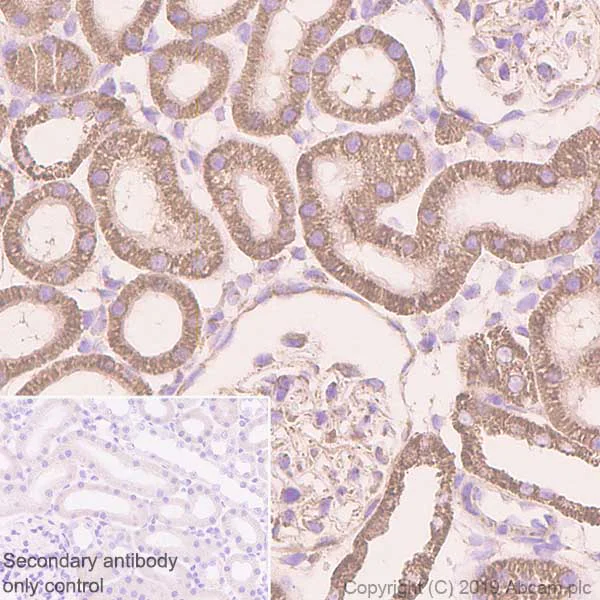
Immunohistochemistry (Formalin/PFA-fixed paraffin-embedded sections) - Anti-COX5A antibody [EPR14208(B)] (AB180129)
Immunohistochemistry (Formalin/PFA-fixed paraffin-embedded sections) analysis of mouse kidney tissue sections labeling COX5A with purified ab180129 at 1/3000 dilution (0.5 μg/mL). Heat mediated antigen retrieval using Bond™ Epitope Retrieval Solution 1 (pH 6.0). Rabbit specific IHC polymer detection kit HRP/DAB (ab209101) was used as the secondary antibody. Negative control : PBS instead of the primary antibody. Hematoxylin was used as a counterstain.
- IHC-P
Unknown
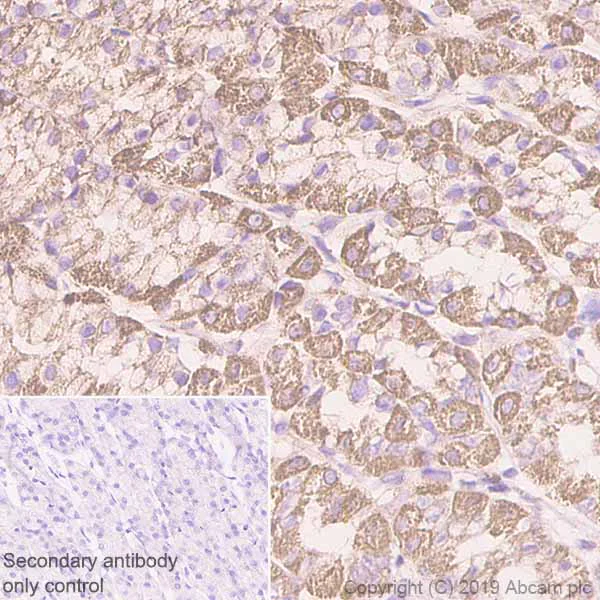
Immunohistochemistry (Formalin/PFA-fixed paraffin-embedded sections) - Anti-COX5A antibody [EPR14208(B)] (AB180129)
Immunohistochemistry (Formalin/PFA-fixed paraffin-embedded sections) analysis of rat stomach tissue sections labeling COX5A with purified ab180129 at 1/3000 dilution (0.5 μg/mL). Heat mediated antigen retrieval using Bond™ Epitope Retrieval Solution 1 (pH 6.0). Rabbit specific IHC polymer detection kit HRP/DAB (ab209101) was used as the secondary antibody. Negative control : PBS instead of the primary antibody. Hematoxylin was used as a counterstain.
- IP
Unknown
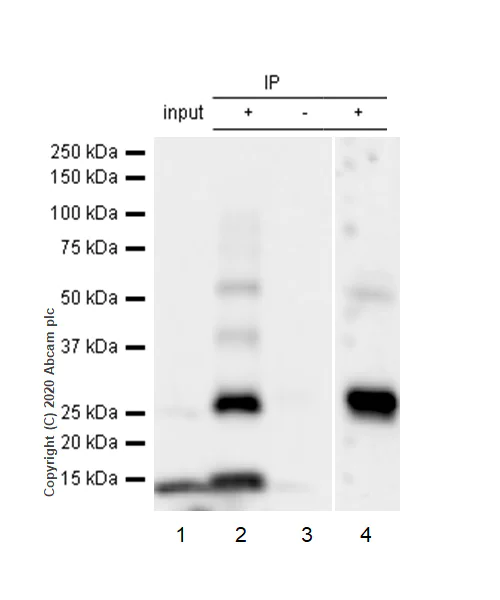
Immunoprecipitation - Anti-COX5A antibody [EPR14208(B)] (AB180129)
Purified ab180129 at 1/80 dilution (2ug) immunoprecipitating COX5A in Mouse heart lysate.
Lane 1 (input) : Mouse heart lysate (10μg)
Lane 2 (+) : ab180129 + Mouse heart lysate.
Lane 3 (-) : Rabbit monoclonal IgG (ab172730) instead of ab180129 in Mouse heart lysate.
Lane 4 : Mouse heart lysate captured by ab180129 and detected by anti-Ubiquitin antibody (ab134953).
VeriBlot for IP Detection Reagent (HRP) (ab131366) (1/1000) was used for Western blotting.
Blocking Buffer and concentration : 5% NFDM/TBST.
Diluting buffer and concentration : 5% NFDM/TBST.
Observed band size : 13 kDa
The ladder band pattern could be ubiquitylated Cox5a as validated by anti-Ubiquitin antibody (ab134953, Lane4)
All lanes:
Immunoprecipitation - Anti-COX5A antibody [EPR14208(B)] (ab180129)
Predicted band size: 17 kDa
false
- WB
Unknown
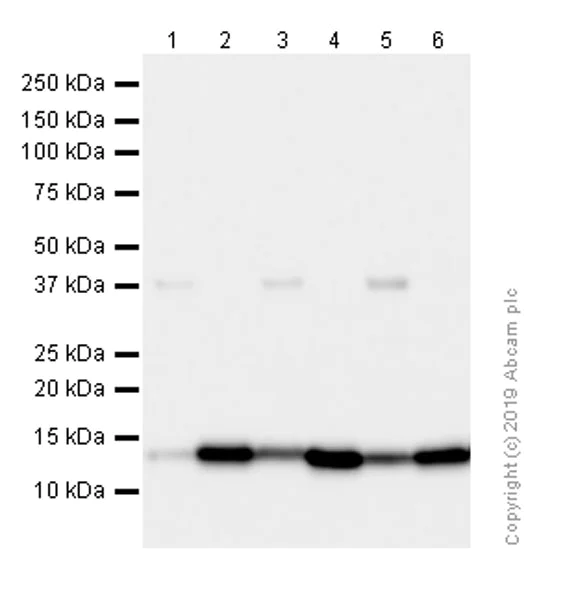
Western blot - Anti-COX5A antibody [EPR14208(B)] (AB180129)
Blocking/Diluting buffer : 5% NFDM/TBST.
The molecular weight observed is consistent with what has been described in PMID : 28082314
All lanes:
Western blot - Anti-COX5A antibody [EPR14208(B)] (ab180129) at 1/5000 dilution
Lane 1:
HeLa (Human cervix adenocarcinoma epithelial cell) whole cell lysates at 20 µg
Lane 2:
Human heart lysates at 20 µg
Lane 3:
Mouse brain lysates at 20 µg
Lane 4:
Mouse heart lysates at 20 µg
Lane 5:
Rat brain lysates at 20 µg
Lane 6:
Rat heart lysates at 20 µg
Secondary
All lanes:
Goat Anti-Rabbit IgG (HRP) with minimal cross-reactivity with human IgG at 1/2000 dilution
Predicted band size: 17 kDa
Observed band size: 13 kDa
false
- WB
CiteAb
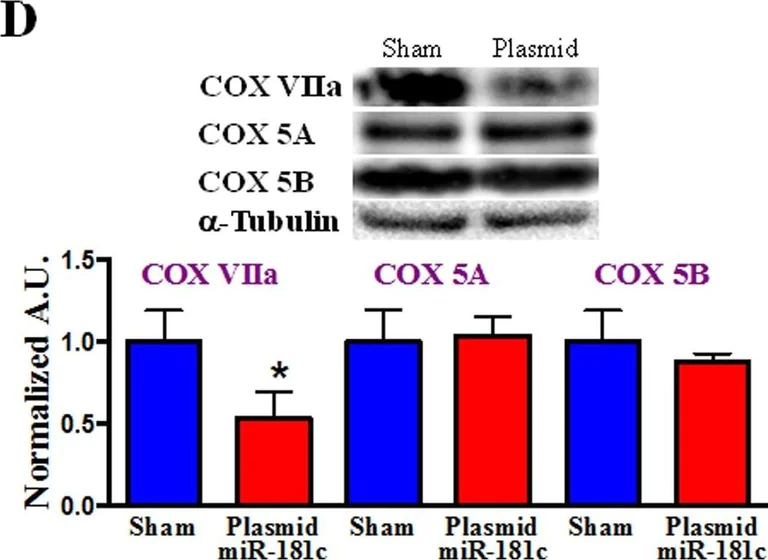
Western blot - Anti-COX5A antibody [EPR14208(B)] (AB180129)
COX5A western blot using anti-COX5A antibody [EPR14208(B)] ab180129. Publication image and figure legend from Das, S., Bedja, D., et al., 2014, PLoS One, PubMed 24810628.
ab180129 was used in this publication in western blot. This may not be the same as the application(s) guaranteed by Abcam. For a full list of applications guaranteed by Abcam for ab180129 please see the product overview.
Mitochondrial Complex IV Remodeling after miR-181c Treatment.(A) qPCR data show that overexpression of miR-181c significantly reduces the mRNA levels of all mitochondrial complex IV genes with 3 weeks treatment. The treatment protocol has no effect on other mitochondrial genes, such as ND2 (complex I) and ATPase 8 (complex V). Content of mRNA was first normalized to 12S rRNA, a mitochondrial gene, as 12S rRNA expression did not change with miR-181c overexpresssion. Then we normalized the data to the sham group. *p<0.05 vs. sham (n = 6). (B) Western blot shows that miR-181c overexpression significantly reduces the protein content of both mt-COX1 and mt-COX2. VDAC was used as a loading control. The data were normalized to the sham group. *p<0.05 vs. sham (n = 6). (C) Western blot shows that miR-181c overexpression has no effect on Transcription Factor A, Mitochondria (TFAM), either in the total heart homogenate (left panel) or the heart-derived mitochondrial fraction (right panel). TFAM plays an important role in mitochondrial gene transcription, by activating 3 different promoter regions in the D-loop area of the mitochondrial genome. TFAM also translocates from the cytosol to the mitochondria as part of the mitochondrial gene transcription process. α-tubulin (for total heart homogenate) and VDAC (mitochondrial fraction) were used as loading controls. The data were normalized to the sham group (n = 3). (D) Western blot shows the changes of other isoforms of mitochondrial respiratory chain complex IV. We have observed a significant decrease in the protein content of COX VIIa in the miR-181c overexpression groups, but no effect on COX 5A and COX 5B. α-tubulin was used as the loading control. The data were normalized to the sham group (n = 3).
false
Related conjugates and formulations (1)
-
Anti-COX5A antibody [EPR14208(B)] - BSA and Azide free
Alternative Products
Complementary Products
Primary Antibodies
AB203832
Anti-UQCRC2 antibody [EPR13051]
RabMAb|Recombinant|20ul selling size

- 5
- 1

Primary Antibodies
AB14748
Anti-ATP5A antibody [15H4C4] - Mitochondrial Marker
BOND RX™ Validated|Lab Essentials
- 5
- 27
Reactivity data
Product details
Patented technology
Our RabMAb® technology is a patented hybridoma-based technology for making rabbit monoclonal antibodies. For details on our patents, please refer to RabMAb® patents.
What are the advantages of a recombinant monoclonal antibody?
This product is a recombinant monoclonal antibody, which offers several advantages including:
- - High batch-to-batch consistency and reproducibility
- - Improved sensitivity and specificity
- - Long-term security of supply
- - Animal-free batch production
For more information, read more on recombinant antibodies.
Properties and storage information
Form
Purification technique
Storage buffer
Shipped at conditions
Appropriate short-term storage duration
Appropriate short-term storage conditions
Appropriate long-term storage conditions
Aliquoting information
Storage information
Supplementary information
This supplementary information is collated from multiple sources and compiled automatically.
Biological function summary
COX5A functions as a component of the cytochrome c oxidase complex also known as Complex IV in the mitochondrial electron transport chain. This complex catalyzes the reduction of oxygen to water facilitating ATP synthesis by oxidative phosphorylation. The assembly of cytochrome c oxidase involves several subunits and COX5A contributes to the structural integrity and regulation of this complex. It helps maintain efficient electron flow and energy conversion supporting high-energy demand processes within cells.
Pathways
COX5A is an important player in the oxidative phosphorylation pathway. This pathway is critical for ATP production linking electron transfer with proton transport and chemiosmotic coupling. COX5A interacts with proteins like cytochrome c and other subunits of Complex IV to ensure proper function and energy conversion. The protein is also involved in cellular responses to hypoxia where it helps modulate oxygen utilization.
Product protocols
- Visit the General protocols
- Visit the Troubleshooting
Target data
Alternative Names
Publications (8)
Recent publications for all applications. Explore the full listand refine your search
Proceedings of the National Academy of Sciences of the United States of America 121:e2401996121 PubMed40591563
2025
Applications
Unspecified application
Species
Unspecified reactive species
Advanced science (Weinheim, Baden-Wurttemberg, Germany) 12:e2404620 PubMed39716856
2024
Applications
Unspecified application
Species
Unspecified reactive species
Oxidative medicine and cellular longevity 2022:7767431 PubMed39282151
2022
Applications
Unspecified application
Species
Unspecified reactive species
Journal of cerebral blood flow and metabolism : official journal of the International Society of Cerebral Blood Flow and Metabolism 41:2546-2560 PubMed33818185
2021
Applications
Unspecified application
Species
Unspecified reactive species
Science advances 7: PubMed33811077
2021
Applications
Unspecified application
Species
Unspecified reactive species
Nucleic acids research 48:12727-12745 PubMed33245769
2020
Applications
Unspecified application
Species
Unspecified reactive species
Frontiers in neuroscience 13:584 PubMed31258460
2019
Applications
Unspecified application
Species
Unspecified reactive species
PloS one 9:e96820 PubMed24810628
2014
Applications
WB
Species
Rat
Product promise
Please note: All products are 'FOR RESEARCH USE ONLY. NOT FOR USE IN DIAGNOSTIC OR THERAPEUTIC PROCEDURES'.
For licensing inquiries, please contact partnerships@abcam.com