Anti-CRISPR-Cas9 antibody [EPR19619-18] - BSA and Azide free
- RabMAb
- Recombinant
- What is this?
Be the first to review this product! Submit a review
|
(0 Publication)
- IHC-P
Lab
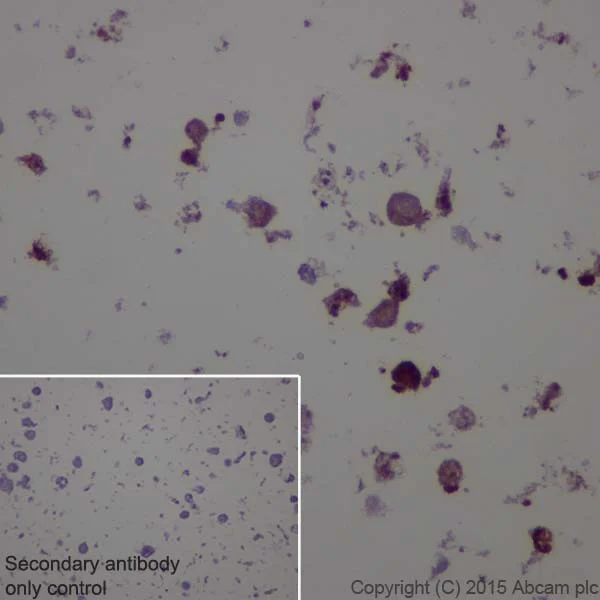
Immunohistochemistry (Formalin/PFA-fixed paraffin-embedded sections) - Anti-CRISPR-Cas9 antibody [EPR19619-18] - BSA and Azide free (AB251382)
Immunohistochemical analysis of formalin-fixed, paraffin-embedded 293T cells transfected with Streptococcus Thermophilus Cas9 (pcDNA3.1(+)-Myc-His) with ab202637 at 1/100 dilution. Goat Anti-Rabbit IgG H&L (HRP), ab97051 at 1/500 dillution was used as the secondary antibody. Counterstained with Hematoxylin. Secondary only negative control also shown. Heat mediated antigen retrieval using Tris/EDTA Buffer, pH 9.0 was performed.
Positive staining on the 293T cells transfected with Streptococcus Thermophilus Cas9.
This data was developed using the same antibody clone in a different buffer formulation containing PBS, BSA, glycerol, and sodium azide (ab202637).
- IHC-P
Lab
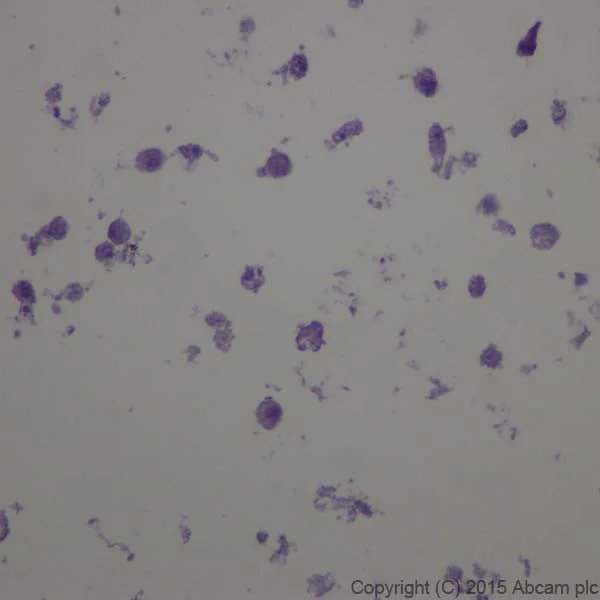
Immunohistochemistry (Formalin/PFA-fixed paraffin-embedded sections) - Anti-CRISPR-Cas9 antibody [EPR19619-18] - BSA and Azide free (AB251382)
Immunohistochemical analysis of formalin-fixed, paraffin-embedded 293T cells transfected blank pcDNA3.1(+)-Myc-His vector with ab202637 at 1/100 dilution. Goat Anti-Rabbit IgG H&L (HRP), ab97051 at 1/500 dillution was used as the secondary antibody. Counterstained with Hematoxylin. Secondary only negative control also shown. Heat mediated antigen retrieval using Tris/EDTA Buffer, pH 9.0 was performed.
Negative on the 293T cells transfected blank pcDNA3.1(+)-Myc-His vector.
This data was developed using the same antibody clone in a different buffer formulation containing PBS, BSA, glycerol, and sodium azide (ab202637).
- IP
Supplier Data
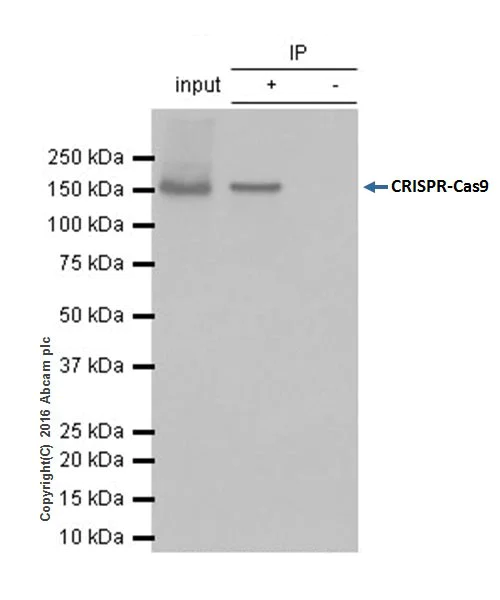
Immunoprecipitation - Anti-CRISPR-Cas9 antibody [EPR19619-18] - BSA and Azide free (AB251382)
CRISPR-Cas9 was immunoprecipitated from 1mg of 293T (Human epithelial cell line from embryonic kidney) cells transfected with Streptococcus thermophilus CRISPR-Cas9-myc whole cell lysate with ab202637 at 1/30 dilution.
Western blot was performed from the immunoprecipitate using ab202637 at 1/1000 dilution.
VeriBlot for IP Detection Reagent (HRP) (ab131366), was used for detection at 1/10000 dilution.
Lane 1 : 293T cells transfected with Streptococcus thermophilus CRISPR-Cas9-myc whole cell lysate, 10μg (Input).
Lane 2 : ab202637 IP in 293T cells transfected with Streptococcus thermophilus CRISPR-Cas9-myc whole cell lysate.
Lane 3 : Rabbit IgG,monoclonal [EPR25A] - Isotype Control (ab172730) instead of ab202637 in 293T cells transfected with Streptococcus thermophilus CRISPR-Cas9-myc whole cell lysate.
Blocking and dilution buffer and concentration : 5% NFDM/TBST.
Exposure time : 1 second.
This data was developed using the same antibody clone in a different buffer formulation containing PBS, BSA, glycerol, and sodium azide (ab202637).
All lanes:
Immunoprecipitation - Anti-CRISPR-Cas9 antibody [EPR19619-18] (<a href='/en-us/products/primary-antibodies/crispr-cas9-antibody-epr19619-18-ab202637'>ab202637</a>)
false
Related conjugates and formulations (1)
-
Anti-CRISPR-Cas9 antibody [EPR19619-18]
Complementary Products
Primary Antibodies
AB183734
RabMAb|Recombinant|Lab Essentials|20ul selling size
- 5
- 24
Primary Antibodies
AB237365
Alexa Fluor® 647 Anti-CD8 alpha antibody [EPR21769]
BOND RX™ Validated|RabMAb|Recombinant

- 0
- 0
Reactivity data
Product details
ab251382 is the carrier-free version of ab202637.
Patented technology
Our RabMAb® technology is a patented hybridoma-based technology for making rabbit monoclonal antibodies. For details on our patents, please refer to RabMAb® patents.
What are the advantages of a recombinant monoclonal antibody?
This product is a recombinant monoclonal antibody, which offers several advantages including:
- - High batch-to-batch consistency and reproducibility
- - Improved sensitivity and specificity
- - Long-term security of supply
- - Animal-free batch production
For more information, read more on recombinant antibodies.
Conjugation ready
Our carrier-free antibodies are typically supplied in a PBS-only formulation, purified and free of BSA, sodium azide and glycerol. This conjugation-ready format is designed for use with fluorochromes, metal isotopes, oligonucleotides, and enzymes, which makes them ideal for antibody labelling, functional and cell-based assays, flow-based assays (e.g. mass cytometry) and Multiplex Imaging applications.
Use our conjugation kits for antibody conjugates that are ready-to-use in as little as 20 minutes with 1 minute hands-on-time and 100% antibody recovery: available for fluorescent dyes, HRP, biotin and gold.
Compatibility
This product is compatible with the Maxpar® Antibody Labeling Kit from Fluidigm, without the need for antibody preparation. Maxpar® is a trademark of Fluidigm Canada Inc.
Properties and storage information
Form
Storage buffer
Shipped at conditions
Appropriate short-term storage conditions
Appropriate long-term storage conditions
Storage information
Supplementary information
This supplementary information is collated from multiple sources and compiled automatically.
Biological function summary
The Cas9 protein functions as an integral part of the CRISPR-Cas9 complex which includes a guide RNA to direct the protein to specific DNA sequences. This complex enables precise cuts at targeted locations within the genome. The Cas9 protein size allows it to fit effectively within cells facilitating genome editing in areas such as research agriculture and therapeutics. The complexity of CRISPR-Cas9 also includes the interaction with other cellular components that assist in DNA repair post-cleavage.
Pathways
CRISPR-Cas9 plays a role in DNA repair pathways particularly non-homologous end joining and homologous recombination. After Cas9-induced DNA breaks these pathways become active to repair the cleaved DNA. The gene editing process facilitated by CRISPR-Cas9 often involves interaction with DNA repair proteins like ku70/80 and Rad51 in response to induced breaks. This allows for either the incorporation of new genetic material or the modification of existing genes.
Product protocols
- Visit the General protocols
- Visit the Troubleshooting
Target data
Additional targets
Alternative Names
Product promise
Please note: All products are 'FOR RESEARCH USE ONLY. NOT FOR USE IN DIAGNOSTIC OR THERAPEUTIC PROCEDURES'.
For licensing inquiries, please contact partnerships@abcam.com