JavaScript is disabled in your browser. Please enable JavaScript to view this website.
AB36622

Anti-CXCL14 antibody

5

(2 Reviews)

|

(8 Publications )
Rabbit Polyclonal CXCL14 antibody. Suitable for WB and reacts with Human samples. Cited in 8 publications.
2 Images
Western blot - Anti-CXCL14 antibody (AB36622)
  • WB

Project

Western blot - Anti-CXCL14 antibody (AB36622)

All lanes:

Western blot - Anti-CXCL14 antibody (ab36622) at 1 µg/mL

All lanes:

Human Cxcl14/BRAK recombinant protein at 0.1 µg

Secondary

All lanes:

IRDye 680 Conjugated Goat Anti-Rabbit IgG (H+L) at 1/10000 dilution

Predicted band size: 13 kDa

Observed band size: 12 kDa

false

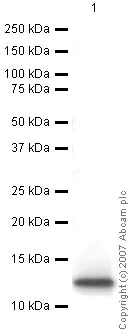
Western blot - Anti-CXCL14 antibody (AB36622)
  • WB

Unknown

Western blot - Anti-CXCL14 antibody (AB36622)

All lanes:

Western blot - Anti-CXCL14 antibody (ab36622) at 1 µg/mL

All lanes:

Western blot - Recombinant human CXCL14 protein (<a href='/en-us/products/proteins-peptides/recombinant-human-cxcl14-protein-ab50043'>ab50043</a>) at 0.1 µg

Secondary

All lanes:

Western blot - Goat Anti-Rabbit IgG H&L (HRP) preadsorbed (<a href='/en-us/products/secondary-antibodies/goat-rabbit-igg-h-l-hrp-preadsorbed-ab97080'>ab97080</a>) at 1/5000 dilution

Predicted band size: 13 kDa

true

Exposure time: 12min

Key facts

Host species

Rabbit

Clonality

Polyclonal

Isotype

IgG

Carrier free

No

Reacts with

Human

Applications

WB

applications

Immunogen

The exact immunogen used to generate this antibody is proprietary information.

Reactivity data

{ "title": "Reactivity Data", "filters": { "stats": ["", "Species", "Dilution Info", "Notes"], "tabs": { "all-applications": {"fullname" : "All Applications", "shortname": "All Applications"}, "WB" : {"fullname" : "Western blot", "shortname":"WB"} }, "product-promise": { "all": "all", "testedAndGuaranteed": "tested", "guaranteed": "expected", "predicted": "predicted", "notRecommended": "not-recommended" } }, "values": { "Human": { "WB-species-checked": "testedAndGuaranteed", "WB-species-dilution-info": "1 µg/mL", "WB-species-notes": "<p></p>" }, "Rat": { "WB-species-checked": "predicted", "WB-species-dilution-info": "", "WB-species-notes": "" }, "Cow": { "WB-species-checked": "predicted", "WB-species-dilution-info": "", "WB-species-notes": "" }, "Pig": { "WB-species-checked": "predicted", "WB-species-dilution-info": "", "WB-species-notes": "" } } }

Properties and storage information

Form
Liquid
Purification technique
Affinity purification Immunogen
Storage buffer
pH: 7.4 Preservative: 0.02% Sodium azide Constituents: PBS, 1% BSA
Shipped at conditions
Blue Ice
Appropriate short-term storage duration
1-2 weeks
Appropriate short-term storage conditions
+4°C
Appropriate long-term storage conditions
-20°C
Aliquoting information
Upon delivery aliquot
Storage information
Avoid freeze / thaw cycle

Supplementary information

This supplementary information is collated from multiple sources and compiled automatically.

The CXCL14 protein also known as BRAK is a small cytokine belonging to the CXC chemokine family. It has a molecular mass of 8.9 kDa and is expressed in various tissues with high levels in the kidney lung skin and reproductive tissues. It does not normally circulate in the blood but rather acts in tissues. The protein plays a role in immune system regulation by being involved in the migration of immune cells.
Biological function summary

CXCL14 influences cell signaling pathways that regulate immune responses and tissue homeostasis. It engages in the attraction of immune cells like monocytes and dendritic cells to specific tissues. While CXCL14 is not part of a larger complex its function in modulating local immune environments is significant. This protein’s role in immune surveillance contributes to both normal physiological conditions and response to pathology.

Pathways

Interactions of CXCL14 involve key signaling cascades. The protein is part of pathways that regulate inflammation and cell movement including the MAPK and PI3K signaling pathways. Related proteins such as CXCR4 and CCR2 interact within these pathways to coordinate cell signaling and chemotaxis. These interactions facilitate communication between cells and regulate responses essential for maintaining tissue integrity.

CXCL14 links with conditions like cancer and obesity. Studies suggest that CXCL14 may play a dual role in cancer acting as a tumor suppressor in certain contexts by influencing immune cell infiltration into tumors. In obesity altered expression patterns of CXCL14 have been observed highlighting potential roles in adipose tissue regulation. Proteins like CXCR4 are also connected with CXCL14 in these disease contexts suggesting complex interdependencies within the cellular communication network.

Product protocols

For this product, it's our understanding that no specific protocols are required. You can visit:

Target data

Potent chemoattractant for neutrophils, and weaker for dendritic cells. Not chemotactic for T-cells, B-cells, monocytes, natural killer cells or granulocytes. Does not inhibit proliferation of myeloid progenitors in colony formation assays.
See full target information CXCL14

Alternative Names

MIP2G, NJAC, SCYB14, PSEC0212, UNQ240/PRO273, CXCL14, C-X-C motif chemokine 14, Chemokine BRAK, MIP-2G, Small-inducible cytokine B14

Publications (8)

Recent publications for all applications. Explore the full list and refine your search

Toxicology 504:153804 PubMed38614205

2024

The p21 perinecrotic hepatocytes produce the chemokine CXCL14 after a severe acetaminophen overdose promoting hepatocyte injury and delaying regeneration.

Applications

Unspecified application

Species

Unspecified reactive species

David S Umbaugh,Nga T Nguyen,Sawyer H Smith,Anup Ramachandran,Hartmut Jaeschke

Chinese medical journal 133:2177-2185 PubMed32826607

2020

MicroRNA-34c promotes neuronal recovery in rats with spinal cord injury through the C-X-C motif ligand 14/Janus kinase 2/signal transducer and activator of transcription-3 axis.

Applications

Unspecified application

Species

Unspecified reactive species

Juan Shen,Feng Gao,Lin Zhao,Qin Hao,Yan-Ling Yang

Nature communications 11:2768 PubMed32488016

2020

Cellular census of human fibrosis defines functionally distinct stromal cell types and states.

Applications

Unspecified application

Species

Unspecified reactive species

Thomas B Layton,Lynn Williams,Fiona McCann,Mingjun Zhang,Marco Fritzsche,Huw Colin-York,Marisa Cabrita,Michael T H Ng,Marc Feldmann,Stephen N Sansom,Dominic Furniss,Weilin Xie,Jagdeep Nanchahal

The Journal of investigative dermatology 140:1327-1334 PubMed31881212

2019

Reduction in Human Epidermal Langerhans Cells with Age Is Associated with Decline in CXCL14-Mediated Recruitment of CD14 Monocytes.

Applications

Unspecified application

Species

Unspecified reactive species

Tatsuya Hasegawa,Zhaoyi Feng,Zhiyu Yan,Kenneth H Ngo,Junichi Hosoi,Shadmehr Demehri

The Journal of investigative dermatology 140:764-773.e4 PubMed31676413

2019

Defining Transcriptional Signatures of Human Hair Follicle Cell States.

Applications

Unspecified application

Species

Unspecified reactive species

Rie Takahashi,Adrienne Grzenda,Thomas F Allison,Jeffrey Rawnsley,Samuel J Balin,Shan Sabri,Kathrin Plath,William E Lowry

Cell cycle (Georgetown, Tex.) 18:3251-3262 PubMed31640472

2019

hypermethylation promotes heart failure by inhibiting CXCL14 expression.

Applications

Unspecified application

Species

Unspecified reactive species

Longhuan Zeng,Nanyuan Gu,Jiayi Chen,Guangyong Jin,Yongke Zheng

BMC cancer 16:951 PubMed28003019

2016

Agonists and knockdown of estrogen receptor β differentially affect invasion of triple-negative breast cancer cells in vitro.

Applications

Unspecified application

Species

Unspecified reactive species

Susanne Schüler-Toprak,Julia Häring,Elisabeth C Inwald,Christoph Moehle,Olaf Ortmann,Oliver Treeck

PloS one 7:e40779 PubMed22815815

2012

Microarray analysis of rat sensory ganglia after local inflammation implicates novel cytokines in pain.

Applications

IHC-FoFr

Species

Rat

Judith A Strong,Wenrui Xie,Dennis E Coyle,Jun-Ming Zhang
View all publications

Product promise

We are committed to supporting your work with high-quality reagents, and we're here for you every step of the way. In the unlikely event that one of our products does not perform as expected, you're protected by our Product Promise.
For full details, please see our Terms & Conditions

Please note: All products are 'FOR RESEARCH USE ONLY. NOT FOR USE IN DIAGNOSTIC OR THERAPEUTIC PROCEDURES'.

For licensing inquiries, please contact partnerships@abcam.com