JavaScript is disabled in your browser. Please enable JavaScript to view this website.
AB89254

Anti-CXCR2/CD182 antibody [MM0222-7J40]

Be the first to review this product! Submit a review

|

(6 Publications )
Mouse Monoclonal CXCR2 antibody. Carrier free. Suitable for Flow Cyt, WB, FuncS (Neut/Block) and reacts with Human samples. Cited in 6 publications. Immunogen corresponding to Recombinant Full Length Protein corresponding to Human CXCR2/CD182.
1 Images
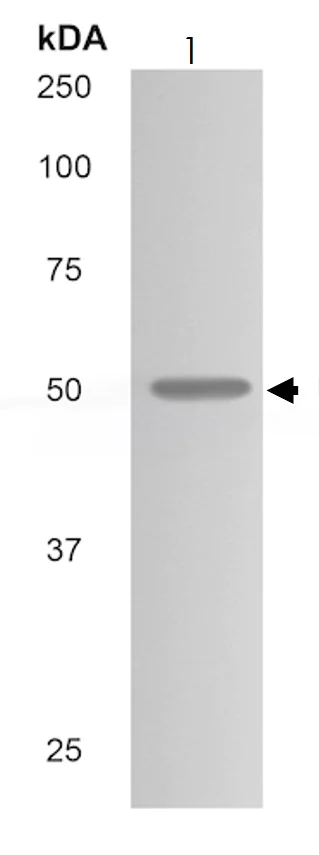
Western blot - Anti-CXCR2/CD182 antibody [MM0222-7J40] (AB89254)
  • WB

Supplier Data

Western blot - Anti-CXCR2/CD182 antibody [MM0222-7J40] (AB89254)

All lanes:

Western blot - Anti-CXCR2/CD182 antibody [MM0222-7J40] (ab89254) at 1/500 dilution

All lanes:

Human placenta tissue lysate

Predicted band size: 40 kDa

Observed band size: 50 kDa

false

Key facts

Host species

Mouse

Clonality

Monoclonal

Clone number

MM0222-7J40

Isotype

IgG2a

Carrier free

Yes

Reacts with

Human

Applications

FuncS (Neut/Block), WB, Flow Cyt

applications

Immunogen

Recombinant Full Length Protein corresponding to Human CXCR2/CD182.

P25025

Reactivity data

{ "title": "Reactivity Data", "filters": { "stats": ["", "Species", "Dilution Info", "Notes"], "tabs": { "all-applications": {"fullname" : "All Applications", "shortname": "All Applications"}, "FlowCyt" : {"fullname" : "Flow Cytometry", "shortname":"Flow Cyt"}, "WB" : {"fullname" : "Western blot", "shortname":"WB"}, "FuncSNeutBlock" : {"fullname" : "Functional Studies (Neut/Block)", "shortname":"FuncS (Neut/Block)"} }, "product-promise": { "all": "all", "testedAndGuaranteed": "tested", "guaranteed": "expected", "predicted": "predicted", "notRecommended": "not-recommended" } }, "values": { "Human": { "FlowCyt-species-checked": "guaranteed", "FlowCyt-species-dilution-info": "", "FlowCyt-species-notes": "<p></p>", "WB-species-checked": "testedAndGuaranteed", "WB-species-dilution-info": "1/500 - 1/1000", "WB-species-notes": "<p></p>", "FuncSNeutBlock-species-checked": "guaranteed", "FuncSNeutBlock-species-dilution-info": "", "FuncSNeutBlock-species-notes": "<p></p>" } } }

Properties and storage information

Form
Liquid
Purification technique
Affinity purification Protein G
Purification notes
The IgG fraction of culture supernatant was purified by Protein G affinity chromatography.
Storage buffer
Constituents: PBS
Shipped at conditions
Blue Ice
Appropriate short-term storage conditions
+4°C
Appropriate long-term storage conditions
-20°C
Aliquoting information
Upon delivery aliquot
Storage information
Avoid freeze / thaw cycle

Supplementary information

This supplementary information is collated from multiple sources and compiled automatically.

CXCR2 also called C-X-C chemokine receptor type 2 is a G protein-coupled receptor with a mass of approximately 53 kDa. It primarily binds to chemokines like CXCL1 CXCL2 CXCL3 CXCL5 CXCL6 CXCL7 and CXCL8 (also known as IL-8). CXCR2 is expressed in a variety of cells but is found especially in neutrophils where it plays a role in mediating immune response. Additionally it shows expression in some epithelial and endothelial cells contributing to its specialized functions in various tissues.
Biological function summary

CXCR2 plays significant roles in mediating inflammatory responses and is part of the chemokine receptor family. It functions by promoting chemotaxis of neutrophils to sites of inflammation infection or injury. This receptor operates with other chemokine receptors in the recruitment and migration of different immune cells helping coordinate an effective immune response. CXCR2 does not function alone and often interacts with other cell surface receptors and signaling molecules during immune responses.

Pathways

CXCR2 contributes prominently to the chemokine signaling pathway and the inflammatory response pathway. It interacts closely with proteins like CXCR1 another chemokine receptor to perform its functions. These interactions can activate downstream signaling cascades involving MAPK and PI3K pathways which are important for various cellular responses like proliferation survival and migration.

CXCR2 has associations with inflammatory diseases such as chronic obstructive pulmonary disease (COPD) and rheumatoid arthritis. In these conditions excessive activation or expression of CXCR2 can lead to pathological inflammation. CXCR2 coordinates with proteins like IL-8 contributing to the chemotaxis of inflammatory cells in affected tissues and this coordination often exacerbates the inflammatory process in these diseases.

Product protocols

For this product, it's our understanding that no specific protocols are required. You can visit:

Target data

Receptor for interleukin-8 which is a powerful neutrophil chemotactic factor (PubMed : 1891716). Binding of IL-8 to the receptor causes activation of neutrophils. This response is mediated via a G-protein that activates a phosphatidylinositol-calcium second messenger system (PubMed : 8662698). Binds to IL-8 with high affinity. Also binds with high affinity to CXCL3, GRO/MGSA and NAP-2 (PubMed : 1891716). Involved in the homeostatic wound healing response to tissue injury, a multistep cascade that guides neutrophil migration to necrotic sites while avoiding collateral damage of healthy tissues. Signals intravascular neutrophil chemotaxis to the injury site.
See full target information CXCR2/CD182

Alternative Names

CD182, IL8RB, CXCR2, C-X-C chemokine receptor type 2, CXC-R2, CXCR-2, CDw128b, GRO/MGSA receptor, High affinity interleukin-8 receptor B, IL-8 receptor type 2, IL-8R B

Publications (6)

Recent publications for all applications. Explore the full listand refine your search

Journal of experimental & clinical cancer research : CR 43:318 PubMed39639338

2024

Inhibition of the chemokine receptors CXCR1 and CXCR2 synergizes with docetaxel for effective tumor control and remodeling of the immune microenvironment of HPV-negative head and neck cancer models.

Applications

Unspecified application

Species

Unspecified reactive species

Lucas A Horn,Hanne Lind,Kristen Fousek,Haiyan Qin,Nika Rajabian,Shantel Angstadt,Nicole Hsiao-Sanchez,Miriam M Medina-Enriquez,Marcus D Kelly,Clint T Allen,Sarah M Hammoudeh,Roberto Weigert,Dean Y Maeda,John A Zebala,Claudia Palena

Theranostics 14:3486-3508 PubMed38948064

2024

Deciphering mA methylation in monocyte-mediated cardiac fibrosis and monocyte-hitchhiked erythrocyte microvesicle biohybrid therapy.

Applications

Unspecified application

Species

Unspecified reactive species

Jiawen Li,Li Wei,Kaifeng Hu,Yunxiang He,Guidong Gong,Qisong Liu,Yue Zhang,Kaiyu Zhou,Junling Guo,Yimin Hua,Jun Tang,Yifei Li

Biochemical genetics 63:698-712 PubMed38509423

2024

Design of an In Vitro Model for Epithelial-to-Mesenchymal Transition in Gastric Cancer.

Applications

Unspecified application

Species

Unspecified reactive species

Yuanhui Zhang,Ling Bi,Quanyao Li,Liqiu Yao,Xiao Wang,Hui Liu,Jun Shi

Biomedicines 11: PubMed37509721

2023

Tumor-Associated Macrophages Affect the Tumor Microenvironment and Radioresistance via the Upregulation of CXCL6/CXCR2 in Hepatocellular Carcinoma.

Applications

Unspecified application

Species

Unspecified reactive species

Hsin-Lun Lee,Yi-Chieh Tsai,Narpati Wesa Pikatan,Chi-Tai Yeh,Vijesh Kumar Yadav,Ming-Yao Chen,Jo-Ting Tsai

Cell death & disease 14:215 PubMed36973255

2023

HOXB3 drives WNT-activation associated progression in castration-resistant prostate cancer.

Applications

Unspecified application

Species

Unspecified reactive species

Shimiao Zhu,Zhao Yang,Zheng Zhang,Hongli Zhang,Songyang Li,Tao Wu,Xuanrong Chen,Jianing Guo,Aixiang Wang,Hao Tian,Jianpeng Yu,Changwen Zhang,Lei Su,Zhiqun Shang,Changyi Quan,Yuanjie Niu

Journal of neuro-oncology 153:33-42 PubMed33835371

2021

Dura promotes metastatic potential in prostate cancer through the CXCR2 pathway.

Applications

Unspecified application

Species

Unspecified reactive species

Michael J Strong,Sabrina Rocco,Russell Taichman,Gregory A Clines,Nicholas J Szerlip
View all publications

Product promise

We are committed to supporting your work with high-quality reagents, and we're here for you every step of the way. In the unlikely event that one of our products does not perform as expected, you're protected by our Product Promise.
For full details, please see our Terms & Conditions

Please note: All products are 'FOR RESEARCH USE ONLY. NOT FOR USE IN DIAGNOSTIC OR THERAPEUTIC PROCEDURES'.

For licensing inquiries, please contact partnerships@abcam.com