JavaScript is disabled in your browser. Please enable JavaScript to view this website.
AB89255

Anti-CXCR3 antibody [MM0223-7K22]

Be the first to review this product! Submit a review

|

(1 Publication)
Mouse Monoclonal CXCR3 antibody. Carrier free. Suitable for Flow Cyt, WB, FuncS (Neut/Block), IHC-Fr and reacts with Human samples. Cited in 1 publication. Immunogen corresponding to Recombinant Full Length Protein corresponding to Human CXCR3.
1 Images
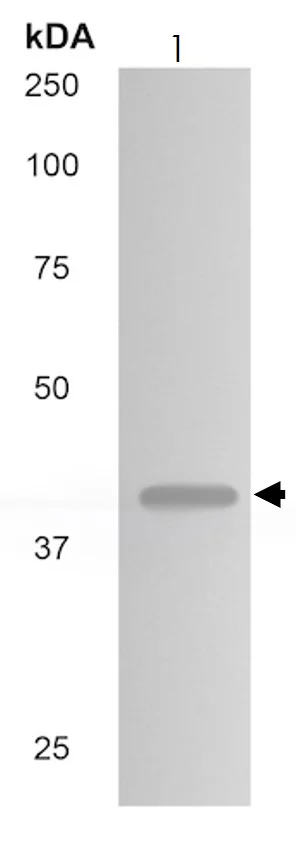
Western blot - Anti-CXCR3 antibody [MM0223-7K22] (AB89255)
  • WB

Supplier Data

Western blot - Anti-CXCR3 antibody [MM0223-7K22] (AB89255)

All lanes:

Western blot - Anti-CXCR3 antibody [MM0223-7K22] (ab89255) at 1/500 dilution

All lanes:

Human placenta tissue lysate

Predicted band size: 40 kDa

Observed band size: 41 kDa

false

Key facts

Host species

Mouse

Clonality

Monoclonal

Clone number

MM0223-7K22

Isotype

IgG1

Carrier free

Yes

Reacts with

Human

Applications

FuncS (Neut/Block), IHC-Fr, Flow Cyt, WB

applications

Immunogen

Recombinant Full Length Protein corresponding to Human CXCR3.

P49682

Reactivity data

{ "title": "Reactivity Data", "filters": { "stats": ["", "Species", "Dilution Info", "Notes"], "tabs": { "all-applications": {"fullname" : "All Applications", "shortname": "All Applications"}, "FlowCyt" : {"fullname" : "Flow Cytometry", "shortname":"Flow Cyt"}, "WB" : {"fullname" : "Western blot", "shortname":"WB"}, "FuncSNeutBlock" : {"fullname" : "Functional Studies (Neut/Block)", "shortname":"FuncS (Neut/Block)"}, "IHCFr" : {"fullname" : "Immunohistochemistry (Frozen sections)", "shortname":"IHC-Fr"} }, "product-promise": { "all": "all", "testedAndGuaranteed": "tested", "guaranteed": "expected", "predicted": "predicted", "notRecommended": "not-recommended" } }, "values": { "Human": { "FlowCyt-species-checked": "guaranteed", "FlowCyt-species-dilution-info": "", "FlowCyt-species-notes": "<p><a href='/en-us/products/primary-antibodies/mouse-igg1-kappa-monoclonal-15-6e10a7-isotype-control-ab170190'>ab170190</a> - Mouse monoclonal IgG1, is suitable for use as an isotype control with this antibody.</p>", "WB-species-checked": "testedAndGuaranteed", "WB-species-dilution-info": "1/500 - 1/1000", "WB-species-notes": "<p></p>", "FuncSNeutBlock-species-checked": "guaranteed", "FuncSNeutBlock-species-dilution-info": "", "FuncSNeutBlock-species-notes": "<p></p>", "IHCFr-species-checked": "guaranteed", "IHCFr-species-dilution-info": "", "IHCFr-species-notes": "<p></p>" } } }

Properties and storage information

Form
Liquid
Purification technique
Affinity purification Protein G
Purification notes
The IgG fraction of culture supernatant was purified by Protein G affinity chromatography.
Storage buffer
Constituents: PBS
Shipped at conditions
Blue Ice
Appropriate short-term storage conditions
+4°C
Appropriate long-term storage conditions
-20°C
Aliquoting information
Upon delivery aliquot
Storage information
Avoid freeze / thaw cycle

Supplementary information

This supplementary information is collated from multiple sources and compiled automatically.

The chemokine receptor CXCR3 also known as CD183 is a protein that plays an important role in immune responses. This receptor is a part of the G protein-coupled receptor (GPCR) family and weighs approximately 41 kDa. CXCR3 is expressed on activated T cells some B cells natural killer (NK) cells and certain subsets of dendritic cells. Its expression is mostly found in inflamed tissues and in conditions where the immune system is active such as infections or autoimmune diseases.
Biological function summary

CXCR3 is involved in directing the migration of immune cells to sites of inflammation. This receptor binds to specific chemokines—CXCL9 CXCL10 and CXCL11—that are produced in response to cytokines like IFN-gamma. CXCR3 does not function as part of a larger protein complex; instead it operates independently facilitating the trafficking and activation of its expressing cells. Its activity is pivotal in immune responses assisting in rapid mobilization and targeting of effector cells to needed areas.

Pathways

CXCR3 is a component of the chemokine signaling pathway which is important for leukocyte chemotaxis. Within this pathway CXCR3 interacts with other receptors and proteins that modulate immune responses such as CXCR4 and CCR5 which also mediate chemotactic migration of leukocytes. Moreover it plays a role in the Jak-STAT signaling pathway impacting gene transcription and cell survival particularly in response to inflammatory signals.

CXCR3 is closely associated with autoimmune diseases like multiple sclerosis and rheumatoid arthritis due to its role in inflammation and immune cell recruitment. The receptor is also involved in cancer where its dysregulation can impact tumor growth and metastasis. CXCR3 through its interaction with chemokines like CXCL10 can influence the tumor microenvironment by affecting the infiltration and function of immune cells. Understanding these interactions can provide insights into therapeutic strategies targeting CXCR3 in these conditions.

Product protocols

For this product, it's our understanding that no specific protocols are required. You can visit:

Target data

Isoform 1. Receptor for the C-X-C chemokine CXCL9, CXCL10 and CXCL11 and mediates the proliferation, survival and angiogenic activity of human mesangial cells (HMC) through a heterotrimeric G-protein signaling pathway (PubMed : 12782716). Binds to CCL21. Probably promotes cell chemotaxis response. Upon activation by PF4, induces activated T-lymphocytes migration mediated via downstream Ras/extracellular signal-regulated kinase (ERK) signaling.. Isoform 2. Receptor for the C-X-C chemokine CXCL4 and also mediates the inhibitory activities of CXCL9, CXCL10 and CXCL11 on the proliferation, survival and angiogenic activity of human microvascular endothelial cells (HMVEC) through a cAMP-mediated signaling pathway (PubMed : 12782716). Does not promote cell chemotaxis respons. Interaction with CXCL4 or CXCL10 leads to activation of the p38MAPK pathway and contributes to inhibition of angiogenesis. Overexpression in renal cancer cells down-regulates expression of the anti-apoptotic protein HMOX1 and promotes apoptosis.. Isoform 3. Mediates the activity of CXCL11.
See full target information CXCR3

Alternative Names

CD183, GPR9, CXCR3, C-X-C chemokine receptor type 3, CXC-R3, CXCR-3, CKR-L2, G protein-coupled receptor 9, Interferon-inducible protein 10 receptor, IP-10 receptor

Publications (1)

Recent publications for all applications. Explore the full listand refine your search

Theranostics 14:3486-3508 PubMed38948064

2024

Deciphering mA methylation in monocyte-mediated cardiac fibrosis and monocyte-hitchhiked erythrocyte microvesicle biohybrid therapy.

Applications

Unspecified application

Species

Unspecified reactive species

Jiawen Li,Li Wei,Kaifeng Hu,Yunxiang He,Guidong Gong,Qisong Liu,Yue Zhang,Kaiyu Zhou,Junling Guo,Yimin Hua,Jun Tang,Yifei Li
View all publications

Product promise

We are committed to supporting your work with high-quality reagents, and we're here for you every step of the way. In the unlikely event that one of our products does not perform as expected, you're protected by our Product Promise.
For full details, please see our Terms & Conditions

Please note: All products are 'FOR RESEARCH USE ONLY. NOT FOR USE IN DIAGNOSTIC OR THERAPEUTIC PROCEDURES'.

For licensing inquiries, please contact partnerships@abcam.com