JavaScript is disabled in your browser. Please enable JavaScript to view this website.
AB218419

Anti-DC-SIGN antibody [C209/1781]

Be the first to review this product! Submit a review

|

(4 Publications )

Mouse Monoclonal DC-SIGN antibody. Suitable for WB, IHC-P and reacts with Human samples. Cited in 4 publications. Immunogen corresponding to Recombinant Fragment Protein within Human CD209.

View Alternative Names

CD209, CLEC4L, CD209 antigen, C-type lectin domain family 4 member L, Dendritic cell-specific ICAM-3-grabbing non-integrin 1, DC-SIGN, DC-SIGN1
4 Images
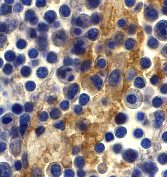
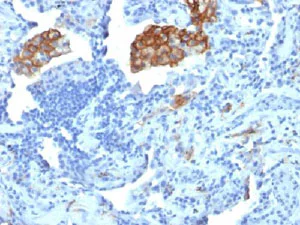
Immunohistochemistry (Formalin/PFA-fixed paraffin-embedded sections) - Anti-DC-SIGN antibody [C209/1781] (AB218419)
  • IHC-P

Supplier Data

Immunohistochemistry (Formalin/PFA-fixed paraffin-embedded sections) - Anti-DC-SIGN antibody [C209/1781] (AB218419)

Immunohistochemical analysis of paraffin embedded, formalin fixed human lung carcinoma tissue labeling DC-SIGN using ab218419 at 1 μg/mL.
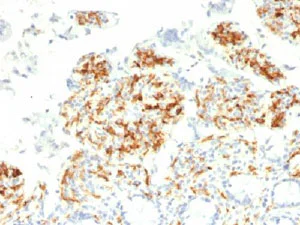
Immunohistochemistry (Formalin/PFA-fixed paraffin-embedded sections) - Anti-DC-SIGN antibody [C209/1781] (AB218419)
  • IHC-P

Supplier Data

Immunohistochemistry (Formalin/PFA-fixed paraffin-embedded sections) - Anti-DC-SIGN antibody [C209/1781] (AB218419)

Immunohistochemical analysis of paraffin embedded, formalin fixed human small intestine tissue labeling DC-SIGN using ab218419 at 1 μg/mL.
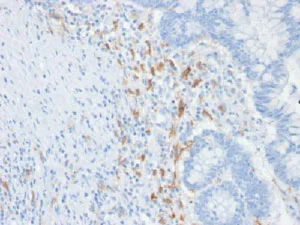
Immunohistochemistry (Formalin/PFA-fixed paraffin-embedded sections) - Anti-DC-SIGN antibody [C209/1781] (AB218419)
  • IHC-P

Supplier Data

Immunohistochemistry (Formalin/PFA-fixed paraffin-embedded sections) - Anti-DC-SIGN antibody [C209/1781] (AB218419)

Immunohistochemical analysis of paraffin embedded, formalin fixed human colon carcinoma tissue labeling DC-SIGN using ab218419 at 1 μg/mL.
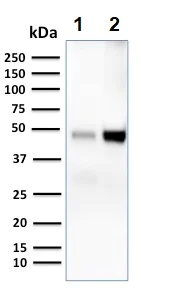
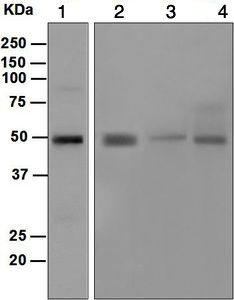
Western blot - Anti-DC-SIGN antibody [C209/1781] (AB218419)
  • WB

Supplier Data

Western blot - Anti-DC-SIGN antibody [C209/1781] (AB218419)

Western blot analysis labeling DC-SIGN with ab218419 at 1 ug/ml.

All lanes:

Western blot - Anti-DC-SIGN antibody [C209/1781] (ab218419) at 1 µg/mL

Lane 1:

Human liver tissue lysate

Lane 2:

Human spleen tissue lysate

Predicted band size: 46 kDa

false

Key facts

Host species

Mouse

Clonality

Monoclonal

Clone number

C209/1781

Isotype

IgG2b

Light chain type

kappa

Carrier free

No

Reacts with

Human

Applications

IHC-P, WB

applications

Immunogen

Recombinant Fragment Protein within Human CD209. The exact immunogen used to generate this antibody is proprietary information.

Q9NNX6

Reactivity data

{ "title": "Reactivity Data", "filters": { "stats": ["", "Species", "Dilution Info", "Notes"], "tabs": { "all-applications": {"fullname" : "All Applications", "shortname": "All Applications"}, "WB" : {"fullname" : "Western blot", "shortname":"WB"}, "IHCP" : {"fullname" : "Immunohistochemistry (Formalin/PFA-fixed paraffin-embedded sections)", "shortname":"IHC-P"} }, "product-promise": { "all": "all", "testedAndGuaranteed": "tested", "guaranteed": "expected", "predicted": "predicted", "notRecommended": "not-recommended" } }, "values": { "Human": { "WB-species-checked": "testedAndGuaranteed", "WB-species-dilution-info": "1-2 µg/mL", "WB-species-notes": "<p></p>", "IHCP-species-checked": "testedAndGuaranteed", "IHCP-species-dilution-info": "1-2 µg/mL", "IHCP-species-notes": "<p></p> Perform heat-mediated antigen retrieval with Tris/EDTA buffer pH 9.0 before commencing with IHC staining protocol." } } }

Properties and storage information

Form
Liquid
Purification technique
Affinity purification Protein A
Storage buffer
pH: 7.2 - 7.4 Preservative: 0.05% Sodium azide Constituents: PBS, 0.05% BSA
Shipped at conditions
Blue Ice
Appropriate short-term storage duration
1-2 weeks
Appropriate short-term storage conditions
+4°C
Appropriate long-term storage conditions
-20°C
Aliquoting information
Upon delivery aliquot
Storage information
Avoid freeze / thaw cycle

Product protocols

For this product, it's our understanding that no specific protocols are required. You can visit:

Target data

Pathogen-recognition receptor expressed on the surface of immature dendritic cells (DCs) and involved in initiation of primary immune response. Thought to mediate the endocytosis of pathogens which are subsequently degraded in lysosomal compartments. The receptor returns to the cell membrane surface and the pathogen-derived antigens are presented to resting T-cells via MHC class II proteins to initiate the adaptive immune response.. On dendritic cells (DCs) it is a high affinity receptor for ICAM2 and ICAM3 by binding to mannose-like carbohydrates (PubMed : 10721994, PubMed : 10721995, PubMed : 11017109, PubMed : 12574325). May act as a DC rolling receptor that mediates transendothelial migration of DC presursors from blood to tissues by binding endothelial ICAM2 (PubMed : 11017109). Forms a first contact between DC and resting T cell, througth ICAM3 binding, facilitating the downstream DC-T cell clustering process and DC-induced proliferation of resting T Cells (PubMed : 10721994, PubMed : 10721995).. (Microbial infection) Acts as an attachment receptor for HIV-1 and HIV-2.. (Microbial infection) Acts as an attachment receptor for Ebolavirus.. (Microbial infection) Acts as an attachment receptor for Cytomegalovirus.. (Microbial infection) Acts as an attachment receptor for HCV.. (Microbial infection) Acts as an attachment receptor for Dengue virus.. (Microbial infection) Acts as an attachment receptor for Measles virus.. (Microbial infection) Acts as an attachment receptor for Herpes simplex virus 1.. (Microbial infection) Acts as an attachment receptor for Influenzavirus A.. (Microbial infection) Acts as an attachment receptor for SARS-CoV.. (Microbial infection) Acts as an attachment receptor for Japanese encephalitis virus.. (Microbial infection) Acts as an attachment receptor for Lassa virus (PubMed : 23966408). Acts as an attachment receptor for Marburg virusn.. (Microbial infection) Acts as an attachment receptor for Respiratory syncytial virus.. (Microbial infection) Acts as an attachment receptor for Rift valley fever virus and uukuniemi virus.. (Microbial infection) Acts as an attachment receptor for West-nile virus.. (Microbial infection) Probably recognizes in a calcium-dependent manner high mannose N-linked oligosaccharides in a variety of bacterial pathogen antigens, including Leishmania pifanoi LPG, Lewis-x antigen in Helicobacter pylori LPS, mannose in Klebsiella pneumonae LPS, di-mannose and tri-mannose in Mycobacterium tuberculosis ManLAM and Lewis-x antigen in Schistosoma mansoni SEA (PubMed : 16379498). Recognition of M.tuberculosis by dendritic cells occurs partially via this molecule (PubMed : 16092920, PubMed : 21203928).
See full target information CD209

Publications (4)

Recent publications for all applications. Explore the full list and refine your search

Frontiers in microbiology 15:1452739 PubMed39749135

2025

Limitations of a proper SFTSV mouse model using human C-type lectin receptors.

Applications

Unspecified application

Species

Unspecified reactive species

You-Min Kim,Hyo-Jin Ro,Jae Hoon Lee,Yaechan Song,Han-Woong Lee,Nam-Hyuk Cho

Cancer immunology, immunotherapy : CII 73:86 PubMed38554160

2024

SFRP1 decreases WNT-Mediated M2 macrophage marker expression in breast tissue.

Applications

Unspecified application

Species

Unspecified reactive species

Kelly J Gregory,Holly Mason,Jesse Casaubon,Sallie S Schneider

Journal of virology 96:e0101122 PubMed36094316

2022

HIV-1 Preintegration Complex Preferentially Integrates the Viral DNA into Nucleosomes Containing Trimethylated Histone 3-Lysine 36 Modification and Flanking Linker DNA.

Applications

Unspecified application

Species

Unspecified reactive species

Nicklas Sapp,Nathaniel Burge,Khan Cox,Prem Prakash,Muthukumar Balasubramaniam,Santosh Thapa,Devin Christensen,Min Li,Jared Linderberger,Mamuka Kvaratskhelia,Jui Pandhare,Robert Craigie,Michael G Poirier,Chandravanu Dash

Frontiers in immunology 13:837391 PubMed35386706

2022

The Distributional Characteristics of M2 Macrophages in the Placental Chorionic Villi are Altered Among the Term Pregnant Women With Uncontrolled Type 2 Diabetes Mellitus.

Applications

Unspecified application

Species

Unspecified reactive species

Muqiu Zhang,Dong Cui,Huixia Yang
View all publications

Product promise

We are committed to supporting your work with high-quality reagents, and we're here for you every step of the way. In the unlikely event that one of our products does not perform as expected, you're protected by our Product Promise.
For full details, please see our Terms & Conditions

Please note: All products are 'FOR RESEARCH USE ONLY. NOT FOR USE IN DIAGNOSTIC OR THERAPEUTIC PROCEDURES'.

For licensing inquiries, please contact partnerships@abcam.com