Anti-DDX6 antibody [EPR12146]
- RabMAb
- Recombinant
- KO Validated
- What is this?
5
(1 Review)
|
(5 Publications )
- IHC-P
Supplier Data
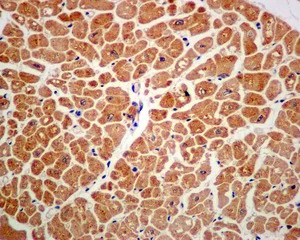
Immunohistochemistry (Formalin/PFA-fixed paraffin-embedded sections) - Anti-DDX6 antibody [EPR12146] (AB174277)
Immunohistochemical analysis of paraffin embedded Human heart tissue labeling DDX6 with ab174277 at 1/100.
Perform heat mediated antigen retrieval with citrate buffer pH 6 before commencing with IHC staining protocol.
- WB
Supplier Data
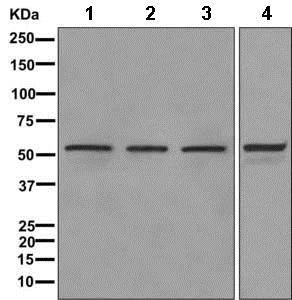
Western blot - Anti-DDX6 antibody [EPR12146] (AB174277)
All lanes:
Western blot - Anti-DDX6 antibody [EPR12146] (ab174277) at 1/1000 dilution
Lane 1:
293T cell lysate at 10 µg
Lane 2:
HepG2 cell lysate at 10 µg
Lane 3:
HeLa cell lysate at 10 µg
Lane 4:
K562 cell lysate at 10 µg
Predicted band size: 54 kDa
Observed band size: 54 kDa
false
- WB
Lab
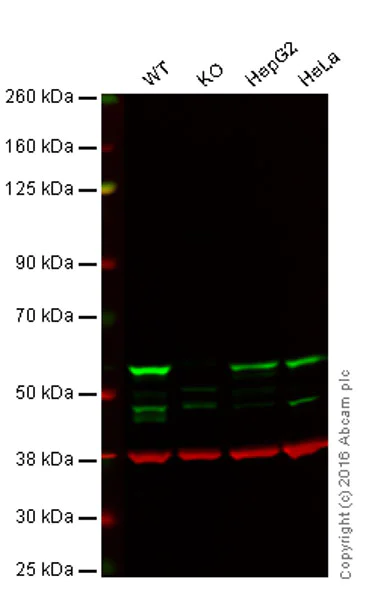
Western blot - Anti-DDX6 antibody [EPR12146] (AB174277)
Lane 1 : Wild-type HAP1 cell lysate (20 μg)
Lane 2 : DDX6 knockout HAP1 cell lysate (20 μg)
Lane 3 : HepG2 cell lysate (20 μg)
Lane 4 : HeLa cell lysate (20 μg)
Lanes 1 - 4 : Merged signal (red and green). Green - ab174277 observed at 55 kDa. Red - loading control, ab8245, observed at 37 kDa.
ab174277 was shown to recognize DDX6 when DDX6 knockout samples were used, along with additional cross-reactive bands. Wild-type and DDX6 knockout samples were subjected to SDS-PAGE. ab174277 and ab8245 (loading control to GAPDH) were diluted at 1/500 and 1/10 000 respectively and incubated overnight at 4°C. Blots were developed with Goat anti-Rabbit IgG H&L (IRDye® 800CW) preadsorbed (ab216773) and Goat anti-Mouse IgG H&L (IRDye® 680RD) preadsorbed (ab216776) secondary antibodies at 1/10 000 dilution for 1 h at room temperature before imaging.
All lanes:
Western blot - Anti-DDX6 antibody [EPR12146] (ab174277)
Predicted band size: 54 kDa
false
Related conjugates and formulations (1)
-
Anti-DDX6 antibody [EPR12146] - BSA and Azide free
Alternative Products


Complementary Products

Primary Antibodies
AB181150
Anti-G3BP antibody [EPR13986(B)]
RabMAb|Recombinant|KO Validated|20ul selling size

- 5
- 1
Primary Antibodies
AB183734
RabMAb|Recombinant|Lab Essentials|20ul selling size

- 5
- 24

Reactivity data
Product details
Patented technology
Our RabMAb® technology is a patented hybridoma-based technology for making rabbit monoclonal antibodies. For details on our patents, please refer to RabMAb® patents.
What are the advantages of a recombinant monoclonal antibody?
This product is a recombinant monoclonal antibody, which offers several advantages including:
- - High batch-to-batch consistency and reproducibility
- - Improved sensitivity and specificity
- - Long-term security of supply
- - Animal-free batch production
For more information, read more on recombinant antibodies.
Properties and storage information
Form
Purification technique
Storage buffer
Shipped at conditions
Appropriate short-term storage duration
Appropriate short-term storage conditions
Appropriate long-term storage conditions
Aliquoting information
Storage information
Supplementary information
This supplementary information is collated from multiple sources and compiled automatically.
Biological function summary
DDX6 functions as part of the RNA-induced silencing complex (RISC) and is involved in messenger ribonucleoprotein (mRNP) granule formation. These granules include P-bodies and stress granules which are essential for mRNA metabolism and storage. DDX6 collaborates with other proteins such as EDC3 and DCP1 to regulate mRNA turnover and decay. Its role in post-transcriptional control impacts gene expression regulation at multiple levels.
Pathways
The involvement of DDX6 in the RNA interference (RNAi) and nonsense-mediated mRNA decay (NMD) pathways is significant. In the RNAi pathway it interacts with proteins like AGO2 to mediate gene silencing by microRNAs. DDX6 also participates in the NMD pathway by targeting aberrant mRNAs for degradation assisting proteins like UPF1. These pathways demonstrate the important role of DDX6 in maintaining cellular RNA homeostasis and preventing the accumulation of defective RNAs.
Product protocols
- Visit the General protocols
- Visit the Troubleshooting
Target data
Alternative Names
Publications (5)
Recent publications for all applications. Explore the full list and refine your search
Nature communications 16:8051 PubMed40877279
2025
Applications
Unspecified application
Species
Unspecified reactive species
Nature communications 15:10044 PubMed39567493
2024
Applications
Unspecified application
Species
Unspecified reactive species
Nature microbiology 9:1256-1270 PubMed38649412
2024
Applications
Unspecified application
Species
Unspecified reactive species
Cell genomics 3:100303 PubMed37228754
2023
Applications
Unspecified application
Species
Unspecified reactive species
Nature chemical biology 13:174-180 PubMed27918561
2016
Applications
Unspecified application
Species
Unspecified reactive species
Product promise
Please note: All products are 'FOR RESEARCH USE ONLY. NOT FOR USE IN DIAGNOSTIC OR THERAPEUTIC PROCEDURES'.
For licensing inquiries, please contact partnerships@abcam.com