JavaScript is disabled in your browser. Please enable JavaScript to view this website.
AB96613

Anti-DMC1 antibody

1

(1 Review)

|

(2 Publications )

Rabbit Polyclonal DMC1 antibody. Suitable for WB, IHC-P and reacts with Human samples. Cited in 2 publications. Immunogen corresponding to Synthetic Peptide within Human DMC1 aa 1-200.

View Alternative Names

DMC1H, LIM15, DMC1, Meiotic recombination protein DMC1/LIM15 homolog
2 Images
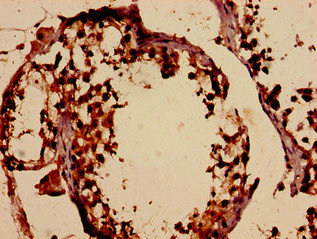
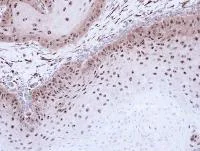
Immunohistochemistry (Formalin/PFA-fixed paraffin-embedded sections) - Anti-DMC1 antibody (AB96613)
  • IHC-P

Unknown

Immunohistochemistry (Formalin/PFA-fixed paraffin-embedded sections) - Anti-DMC1 antibody (AB96613)

Immunohistochemical analysis of paraffin-embedded Cal27 xenograft , using ab96613 at 1/500 dilution.
Western blot - Anti-DMC1 antibody (AB96613)
  • WB

Unknown

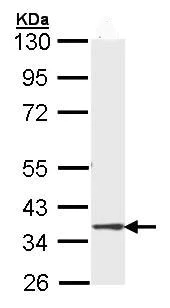
Western blot - Anti-DMC1 antibody (AB96613)

10% SDS PAGE

All lanes:

Western blot - Anti-DMC1 antibody (ab96613) at 1/1000 dilution

All lanes:

MOLT4 whole cell lysate at 30 µg

Predicted band size: 38 kDa

false

Key facts

Host species

Rabbit

Clonality

Polyclonal

Isotype

IgG

Carrier free

No

Reacts with

Human

Applications

WB, IHC-P

applications

Immunogen

Synthetic Peptide within Human DMC1 aa 1-200. The exact immunogen used to generate this antibody is proprietary information.

Q14565

Reactivity data

{ "title": "Reactivity Data", "filters": { "stats": ["", "Species", "Dilution Info", "Notes"], "tabs": { "all-applications": {"fullname" : "All Applications", "shortname": "All Applications"}, "WB" : {"fullname" : "Western blot", "shortname":"WB"}, "IHCP" : {"fullname" : "Immunohistochemistry (Formalin/PFA-fixed paraffin-embedded sections)", "shortname":"IHC-P"} }, "product-promise": { "all": "all", "testedAndGuaranteed": "tested", "guaranteed": "expected", "predicted": "predicted", "notRecommended": "not-recommended" } }, "values": { "Human": { "WB-species-checked": "testedAndGuaranteed", "WB-species-dilution-info": "1/500 - 1/3000", "WB-species-notes": "<p></p>", "IHCP-species-checked": "testedAndGuaranteed", "IHCP-species-dilution-info": "1/100 - 1/500", "IHCP-species-notes": "<p></p>" }, "Mouse": { "WB-species-checked": "notRecommended", "WB-species-dilution-info": "", "WB-species-notes": "", "IHCP-species-checked": "notRecommended", "IHCP-species-dilution-info": "", "IHCP-species-notes": "" }, "Rat": { "WB-species-checked": "notRecommended", "WB-species-dilution-info": "", "WB-species-notes": "", "IHCP-species-checked": "notRecommended", "IHCP-species-dilution-info": "", "IHCP-species-notes": "" }, "Arabidopsis thaliana": { "WB-species-checked": "notRecommended", "WB-species-dilution-info": "", "WB-species-notes": "<p></p>", "IHCP-species-checked": "notRecommended", "IHCP-species-dilution-info": "", "IHCP-species-notes": "<p></p>" } } }

Properties and storage information

Form
Liquid
Purification technique
Affinity purification Immunogen
Storage buffer
pH: 7 Preservative: 0.01% Thimerosal (merthiolate) Constituents: 20% Glycerol (glycerin, glycerine), 1.21% Tris, 0.75% Glycine
Shipped at conditions
Blue Ice
Appropriate short-term storage conditions
+4°C
Appropriate long-term storage conditions
-20°C
Aliquoting information
Upon delivery aliquot
Storage information
Avoid freeze / thaw cycle

Supplementary information

This supplementary information is collated from multiple sources and compiled automatically.

DMC1 also known as DNA Meiotic Recombinase 1 is an important protein involved in homologous recombination during meiosis. It plays a mechanical role by facilitating the exchange of genetic material between parental chromosomes. DMC1 is a 37-kilodalton protein and belongs to the recombinase family. The protein is mainly expressed in germ cells of both males and females particularly in those undergoing meiosis where it controls the DNA strand exchange process important for genetic diversity.
Biological function summary

DMC1 ensures accurate and efficient repair of double-strand breaks during meiosis a critical function for chromosome segregation and gamete viability. It works in concert with other proteins like RAD51 to form a nucleoprotein filament on the single-stranded DNA that promotes homologous pairing and strand exchange. This coordinated action is essential for forming synaptonemal complexes which stabilize homologous chromosomes during prophase I of meiosis.

Pathways

DMC1's role is integral to the homologous recombination repair pathway. It interplays specifically with RAD51 and other recombinases to regulate genetic recombination events. The protein contributes to DNA damage response pathways and is critical for the maintenance and integrity of genetic information during cell division.

Mutations or regulatory dysfunctions in DMC1 have been associated with infertility particularly in disorders affecting spermatogenesis and oogenesis. The protein’s malfunction can disrupt meiotic progression leading to aneuploidies and miscarriages. Additionally DMC1 mutations may connect to cancer pathways as faulty homologous recombination increases genomic instability often observed in various types of cancers highlighting potential therapeutic interactions with proteins like BRCA1 and BRCA2.

Product protocols

For this product, it's our understanding that no specific protocols are required. You can visit:

Target data

Participates in meiotic recombination, specifically in homologous strand assimilation, which is required for the resolution of meiotic double-strand breaks.
See full target information DMC1

Publications (2)

Recent publications for all applications. Explore the full list and refine your search

Reproduction (Cambridge, England) 152:431-7 PubMed27492080

2016

Transcription factor ZFP38 is essential for meiosis prophase I in male mice.

Applications

Unspecified application

Species

Unspecified reactive species

Zechen Yan,Dandan Fan,Qingjun Meng,Jinjian Yang,Wei Zhao,Fei Guo,Dongjian Song,Ruiming Guo,Ke Sun,Jiaxiang Wang

Nature medicine 18:413-21 PubMed22366948

2012

Oocyte formation by mitotically active germ cells purified from ovaries of reproductive-age women.

Applications

Unspecified application

Species

Unspecified reactive species

Yvonne A R White,Dori C Woods,Yasushi Takai,Osamu Ishihara,Hiroyuki Seki,Jonathan L Tilly
View all publications

Product promise

We are committed to supporting your work with high-quality reagents, and we're here for you every step of the way. In the unlikely event that one of our products does not perform as expected, you're protected by our Product Promise.
For full details, please see our Terms & Conditions

Please note: All products are 'FOR RESEARCH USE ONLY. NOT FOR USE IN DIAGNOSTIC OR THERAPEUTIC PROCEDURES'.

For licensing inquiries, please contact partnerships@abcam.com