JavaScript is disabled in your browser. Please enable JavaScript to view this website.
AB168854

Anti-DNA PKcs antibody

Be the first to review this product! Submit a review

|

(8 Publications )

Goat Polyclonal DNA PKcs antibody. Suitable for IHC-P, IP, WB and reacts with Human samples. Cited in 8 publications. Immunogen corresponding to Synthetic Peptide within Human PRKDC aa 4050 to C-terminus.

View Alternative Names

HYRC, HYRC1, PRKDC, DNA-dependent protein kinase catalytic subunit, DNA-PK catalytic subunit, DNA-PKcs, DNPK1, Ser-473 kinase, p460, S473K
2 Images
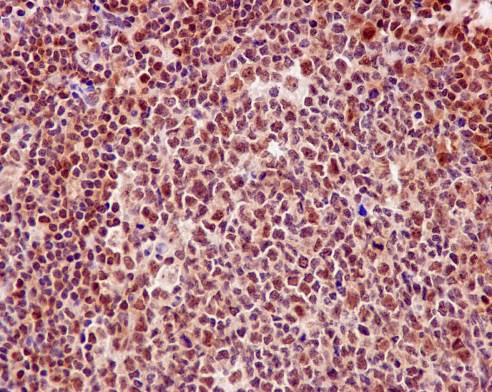
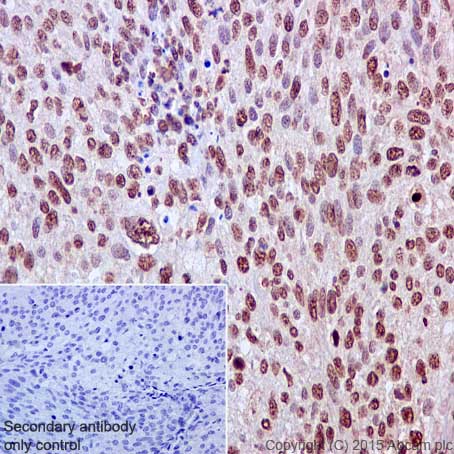
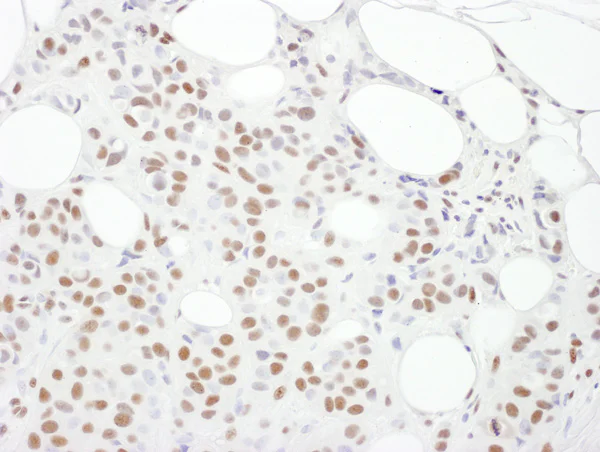
Immunohistochemistry (Formalin/PFA-fixed paraffin-embedded sections) - Anti-DNA PKcs antibody (AB168854)
  • IHC-P

Unknown

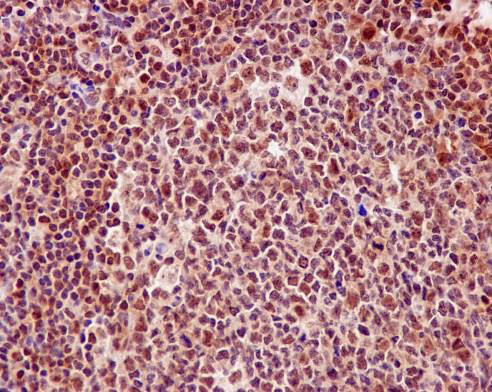
Immunohistochemistry (Formalin/PFA-fixed paraffin-embedded sections) - Anti-DNA PKcs antibody (AB168854)

Immunohistochemistry (Formalin/PFA-fixed paraffin-embedded sections) analysis of human breast carcinoma tissue labelling DNA PKcs with ab168854 at 1/5000 (0.2µg/ml). Detection : DAB.
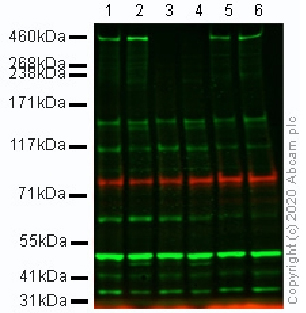
Western blot - Anti-DNA PKcs antibody (AB168854)
  • WB

Unknown

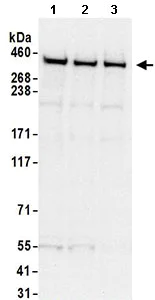
Western blot - Anti-DNA PKcs antibody (AB168854)

All lanes:

Western blot - Anti-DNA PKcs antibody (ab168854) at 0.1 µg/mL

Lane 1:

293T whole cell lysate at 50 µg

Lane 2:

HeLa whole cell lysate at 50 µg

Lane 3:

Jurkat whole cell lysate at 50 µg

Predicted band size: 469 kDa

true

Exposure time: 10s

Key facts

Host species

Goat

Clonality

Polyclonal

Isotype

IgG

Carrier free

No

Reacts with

Human

Applications

IP, IHC-P, WB

applications

Immunogen

Synthetic Peptide within Human PRKDC aa 4050 to C-terminus. The exact immunogen used to generate this antibody is proprietary information.

P78527

Reactivity data

{ "title": "Reactivity Data", "filters": { "stats": ["", "Species", "Dilution Info", "Notes"], "tabs": { "all-applications": {"fullname" : "All Applications", "shortname": "All Applications"}, "IHCP" : {"fullname" : "Immunohistochemistry (Formalin/PFA-fixed paraffin-embedded sections)", "shortname":"IHC-P"}, "IP" : {"fullname" : "Immunoprecipitation", "shortname":"IP"}, "WB" : {"fullname" : "Western blot", "shortname":"WB"} }, "product-promise": { "all": "all", "testedAndGuaranteed": "tested", "guaranteed": "expected", "predicted": "predicted", "notRecommended": "not-recommended" } }, "values": { "Human": { "IHCP-species-checked": "testedAndGuaranteed", "IHCP-species-dilution-info": "1/1000 - 1/5000", "IHCP-species-notes": "<p></p> Perform heat-mediated antigen retrieval with citrate buffer pH 6 before commencing with IHC staining protocol.", "IP-species-checked": "testedAndGuaranteed", "IP-species-dilution-info": "2-10 µg/mg of lysate", "IP-species-notes": "<p></p>", "WB-species-checked": "testedAndGuaranteed", "WB-species-dilution-info": "1/2000 - 1/10000", "WB-species-notes": "<p></p>" }, "Mouse": { "IHCP-species-checked": "predicted", "IHCP-species-dilution-info": "", "IHCP-species-notes": "", "IP-species-checked": "predicted", "IP-species-dilution-info": "", "IP-species-notes": "", "WB-species-checked": "predicted", "WB-species-dilution-info": "", "WB-species-notes": "" }, "Rat": { "IHCP-species-checked": "predicted", "IHCP-species-dilution-info": "", "IHCP-species-notes": "", "IP-species-checked": "predicted", "IP-species-dilution-info": "", "IP-species-notes": "", "WB-species-checked": "predicted", "WB-species-dilution-info": "", "WB-species-notes": "" }, "Bat": { "IHCP-species-checked": "predicted", "IHCP-species-dilution-info": "", "IHCP-species-notes": "", "IP-species-checked": "predicted", "IP-species-dilution-info": "", "IP-species-notes": "", "WB-species-checked": "predicted", "WB-species-dilution-info": "", "WB-species-notes": "" }, "Chimpanzee": { "IHCP-species-checked": "predicted", "IHCP-species-dilution-info": "", "IHCP-species-notes": "", "IP-species-checked": "predicted", "IP-species-dilution-info": "", "IP-species-notes": "", "WB-species-checked": "predicted", "WB-species-dilution-info": "", "WB-species-notes": "" }, "Chinese hamster": { "IHCP-species-checked": "predicted", "IHCP-species-dilution-info": "", "IHCP-species-notes": "", "IP-species-checked": "predicted", "IP-species-dilution-info": "", "IP-species-notes": "", "WB-species-checked": "predicted", "WB-species-dilution-info": "", "WB-species-notes": "" }, "Cow": { "IHCP-species-checked": "predicted", "IHCP-species-dilution-info": "", "IHCP-species-notes": "", "IP-species-checked": "predicted", "IP-species-dilution-info": "", "IP-species-notes": "", "WB-species-checked": "predicted", "WB-species-dilution-info": "", "WB-species-notes": "" }, "Gorilla": { "IHCP-species-checked": "predicted", "IHCP-species-dilution-info": "", "IHCP-species-notes": "", "IP-species-checked": "predicted", "IP-species-dilution-info": "", "IP-species-notes": "", "WB-species-checked": "predicted", "WB-species-dilution-info": "", "WB-species-notes": "" }, "Guinea pig": { "IHCP-species-checked": "predicted", "IHCP-species-dilution-info": "", "IHCP-species-notes": "", "IP-species-checked": "predicted", "IP-species-dilution-info": "", "IP-species-notes": "", "WB-species-checked": "predicted", "WB-species-dilution-info": "", "WB-species-notes": "" }, "Orangutan": { "IHCP-species-checked": "predicted", "IHCP-species-dilution-info": "", "IHCP-species-notes": "", "IP-species-checked": "predicted", "IP-species-dilution-info": "", "IP-species-notes": "", "WB-species-checked": "predicted", "WB-species-dilution-info": "", "WB-species-notes": "" }, "Pig": { "IHCP-species-checked": "predicted", "IHCP-species-dilution-info": "", "IHCP-species-notes": "", "IP-species-checked": "predicted", "IP-species-dilution-info": "", "IP-species-notes": "", "WB-species-checked": "predicted", "WB-species-dilution-info": "", "WB-species-notes": "" }, "Rhesus monkey": { "IHCP-species-checked": "predicted", "IHCP-species-dilution-info": "", "IHCP-species-notes": "", "IP-species-checked": "predicted", "IP-species-dilution-info": "", "IP-species-notes": "", "WB-species-checked": "predicted", "WB-species-dilution-info": "", "WB-species-notes": "" } } }

Properties and storage information

Form
Liquid
Purification technique
Affinity purification Immunogen
Purification notes
ab168854 was affinity purified using an epitope specific to DNA PKcs immobilized on solid support.
Storage buffer
pH: 7 - 8 Preservative: 0.09% Sodium azide Constituents: 99% Tris citrate/phosphate
Shipped at conditions
Blue Ice
Appropriate short-term storage duration
1-2 weeks
Appropriate short-term storage conditions
+4°C
Appropriate long-term storage conditions
+4°C
Aliquoting information
Upon delivery aliquot

Supplementary information

This supplementary information is collated from multiple sources and compiled automatically.

DNA-dependent protein kinase catalytic subunit often abbreviated as DNA-PKcs or PKcs is an important component in the cellular machinery responsible for DNA repair. This protein weighs approximately 470 kDa and is predominantly expressed in various tissue types with higher levels found in lymphoid tissues. The DNA-PKcs functions as a serine/threonine protein kinase and becomes active upon binding to DNA contributing to its role in maintaining genome integrity.
Biological function summary

DNA-PKcs plays an essential role in the non-homologous end joining (NHEJ) repair pathway which repairs double-strand breaks in DNA. DNA-PKcs forms a complex with the Ku70/80 heterodimer serving as a critical component of the DNA repair mechanism. This complex recognizes DNA ends facilitates their synapsis and activates other enzymes involved in ligating the broken DNA strands therefore promoting cellular survival following DNA damage.

Pathways

DNA-PKcs deeply integrates into the DNA damage response pathway. It collaborates closely with proteins such as ATM (ataxia-telangiectasia mutated) to sense DNA damage and initiate repair. DNA-PKcs is involved in V(D)J recombination vital for the generation of diverse antibodies in immune cells. Its activity is essential for coordinating with other proteins including XRCC4 and Ligase IV to ensure efficient DNA repair processes are executed.

Defects in DNA-PKcs are linked to severe combined immunodeficiency (SCID) due to its central role in V(D)J recombination. Dysfunction in its pathway also relates to cancer where impaired DNA repair mechanisms substantially increase genomic instability leading to tumorigenesis. DNA-PKcs interacts with other proteins like BRCA1 and p53 in tumors where its overexpression or mutations can contribute to resistance against radiation and chemotherapeutic agents. These interactions highlight the importance of DNA-PK inhibitors as potential therapeutic strategies in oncology.

Product protocols

For this product, it's our understanding that no specific protocols are required. You can visit:

Target data

Serine/threonine-protein kinase that acts as a molecular sensor for DNA damage (PubMed : 11955432, PubMed : 12649176, PubMed : 14734805, PubMed : 33854234). Involved in DNA non-homologous end joining (NHEJ) required for double-strand break (DSB) repair and V(D)J recombination (PubMed : 11955432, PubMed : 12649176, PubMed : 14734805, PubMed : 33854234, PubMed : 34352203). Must be bound to DNA to express its catalytic properties (PubMed : 11955432). Promotes processing of hairpin DNA structures in V(D)J recombination by activation of the hairpin endonuclease artemis (DCLRE1C) (PubMed : 11955432). Recruited by XRCC5 and XRCC6 to DNA ends and is required to (1) protect and align broken ends of DNA, thereby preventing their degradation, (2) and sequester the DSB for repair by NHEJ (PubMed : 11955432, PubMed : 12649176, PubMed : 14734805, PubMed : 15574326, PubMed : 33854234). Act as a scaffold protein to aid the localization of DNA repair proteins to the site of damage (PubMed : 11955432, PubMed : 12649176, PubMed : 14734805, PubMed : 15574326). The assembly of the DNA-PK complex at DNA ends is also required for the NHEJ ligation step (PubMed : 11955432, PubMed : 12649176, PubMed : 14734805, PubMed : 15574326). Found at the ends of chromosomes, suggesting a further role in the maintenance of telomeric stability and the prevention of chromosomal end fusion (By similarity). Also involved in modulation of transcription (PubMed : 11955432, PubMed : 12649176, PubMed : 14734805, PubMed : 15574326). As part of the DNA-PK complex, involved in the early steps of ribosome assembly by promoting the processing of precursor rRNA into mature 18S rRNA in the small-subunit processome (PubMed : 32103174). Binding to U3 small nucleolar RNA, recruits PRKDC and XRCC5/Ku86 to the small-subunit processome (PubMed : 32103174). Recognizes the substrate consensus sequence [ST]-Q (PubMed : 11955432, PubMed : 12649176, PubMed : 14734805, PubMed : 15574326). Phosphorylates 'Ser-139' of histone variant H2AX, thereby regulating DNA damage response mechanism (PubMed : 14627815, PubMed : 16046194). Phosphorylates ASF1A, DCLRE1C, c-Abl/ABL1, histone H1, HSPCA, c-jun/JUN, p53/TP53, PARP1, POU2F1, DHX9, FH, SRF, NHEJ1/XLF, XRCC1, XRCC4, XRCC5, XRCC6, WRN, MYC and RFA2 (PubMed : 10026262, PubMed : 10467406, PubMed : 11889123, PubMed : 12509254, PubMed : 14599745, PubMed : 14612514, PubMed : 14704337, PubMed : 15177042, PubMed : 1597196, PubMed : 16397295, PubMed : 18644470, PubMed : 2247066, PubMed : 2507541, PubMed : 26237645, PubMed : 26666690, PubMed : 28712728, PubMed : 29478807, PubMed : 30247612, PubMed : 8407951, PubMed : 8464713, PubMed : 9139719, PubMed : 9362500). Can phosphorylate C1D not only in the presence of linear DNA but also in the presence of supercoiled DNA (PubMed : 9679063). Ability to phosphorylate p53/TP53 in the presence of supercoiled DNA is dependent on C1D (PubMed : 9363941). Contributes to the determination of the circadian period length by antagonizing phosphorylation of CRY1 'Ser-588' and increasing CRY1 protein stability, most likely through an indirect mechanism (By similarity). Plays a role in the regulation of DNA virus-mediated innate immune response by assembling into the HDP-RNP complex, a complex that serves as a platform for IRF3 phosphorylation and subsequent innate immune response activation through the cGAS-STING pathway (PubMed : 28712728). Also regulates the cGAS-STING pathway by catalyzing phosphorylation of CGAS, thereby impairing CGAS oligomerization and activation (PubMed : 33273464). Also regulates the cGAS-STING pathway by mediating phosphorylation of PARP1 (PubMed : 35460603).
See full target information PRKDC

Publications (8)

Recent publications for all applications. Explore the full list and refine your search

Cancer gene therapy 30:608-621 PubMed36494579

2022

FAP is critical for ovarian cancer cell survival by sustaining NF-κB activation through recruitment of PRKDC in lipid rafts.

Applications

Unspecified application

Species

Unspecified reactive species

Bin Li,Zuo Ding,Ozlem Calbay,Yue Li,Tao Li,Lingtao Jin,Shuang Huang

Cell death & disease 13:1008 PubMed36446779

2022

mA-modified circFNDC3B inhibits colorectal cancer stemness and metastasis via RNF41-dependent ASB6 degradation.

Applications

Unspecified application

Species

Unspecified reactive species

Wei Zeng,Jin-Feng Zhu,Jian Guo,Gen-Jie Huang,Li-Sha Ai,Yu Zeng,Wang-Jun Liao

Cell death & disease 13:404 PubMed35468873

2022

PRKDC promotes hepatitis B virus transcription through enhancing the binding of RNA Pol II to cccDNA.

Applications

Unspecified application

Species

Unspecified reactive species

Yao Fan,Yi Liang,Yu Liu,Hui Fan

Clinical cancer research : an official journal of the American Association for Cancer Research 28:1446-1459 PubMed35078861

2022

A Novel Role for DNA-PK in Metabolism by Regulating Glycolysis in Castration-Resistant Prostate Cancer.

Applications

Unspecified application

Species

Unspecified reactive species

Emanuela Dylgjeri,Vishal Kothari,Ayesha A Shafi,Galina Semenova,Peter T Gallagher,Yi F Guan,Angel Pang,Jonathan F Goodwin,Swati Irani,Jennifer J McCann,Amy C Mandigo,Saswati Chand,Christopher M McNair,Irina Vasilevskaya,Matthew J Schiewer,Costas D Lallas,Peter A McCue,Leonard G Gomella,Erin L Seifert,Jason S Carroll,Lisa M Butler,Jeff Holst,William K Kelly,Karen E Knudsen

Cell death and differentiation 27:3337-3353 PubMed32587379

2020

LRIK interacts with the Ku70-Ku80 heterodimer enhancing the efficiency of NHEJ repair.

Applications

Unspecified application

Species

Unspecified reactive species

Dan Wang,Zheng Zhou,Erzhong Wu,Can Ouyang,Guifeng Wei,Yunfei Wang,Dandan He,Ya Cui,Dongdong Zhang,Xiaomin Chen,Simon H Reed,Jianjun Luo,Runsheng Chen

Nature communications 11:1335 PubMed32165639

2020

Cancer immune control needs senescence induction by interferon-dependent cell cycle regulator pathways in tumours.

Applications

Unspecified application

Species

Unspecified reactive species

Ellen Brenner,Barbara F Schörg,Fatima Ahmetlić,Thomas Wieder,Franz Joachim Hilke,Nadine Simon,Christopher Schroeder,German Demidov,Tanja Riedel,Birgit Fehrenbacher,Martin Schaller,Andrea Forschner,Thomas Eigentler,Heike Niessner,Tobias Sinnberg,Katharina S Böhm,Nadine Hömberg,Heidi Braumüller,Daniel Dauch,Stefan Zwirner,Lars Zender,Dominik Sonanini,Albert Geishauser,Jürgen Bauer,Martin Eichner,Katja J Jarick,Andreas Beilhack,Saskia Biskup,Dennis Döcker,Dirk Schadendorf,Leticia Quintanilla-Martinez,Bernd J Pichler,Manfred Kneilling,Ralph Mocikat,Martin Röcken

Oncology reports 43:1397-1412 PubMed32323799

2020

PLCε knockdown enhances the radiosensitivity of castration‑resistant prostate cancer via the AR/PARP1/DNA‑PKcs axis.

Applications

Unspecified application

Species

Unspecified reactive species

Jun Pu,Ting Li,Nanjing Liu,Chunli Luo,Zhen Quan,Luo Li,Xiaohou Wu

Biochemical pharmacology 169:113641 PubMed31541630

2019

Hypoxia-selective radiosensitisation by SN38023, a bioreductive prodrug of DNA-dependent protein kinase inhibitor IC87361.

Applications

Unspecified application

Species

Unspecified reactive species

Way Wua Wong,Rosanna K Jackson,Lydia P Liew,Benjamin D Dickson,Gary J Cheng,Barbara Lipert,Yongchuan Gu,Francis W Hunter,William R Wilson,Michael P Hay
View all publications

Product promise

We are committed to supporting your work with high-quality reagents, and we're here for you every step of the way. In the unlikely event that one of our products does not perform as expected, you're protected by our Product Promise.
For full details, please see our Terms & Conditions

Please note: All products are 'FOR RESEARCH USE ONLY. NOT FOR USE IN DIAGNOSTIC OR THERAPEUTIC PROCEDURES'.

For licensing inquiries, please contact partnerships@abcam.com