Anti-Dysbindin antibody [EPR7041] - BSA and Azide free
- RabMAb
- Recombinant
- What is this?
Be the first to review this product! Submit a review
|
(1 Publication)
- IHC-P
Unknown
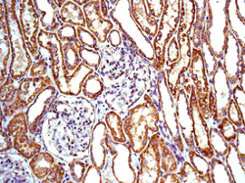
Immunohistochemistry (Formalin/PFA-fixed paraffin-embedded sections) - Anti-Dysbindin antibody [EPR7041] - BSA and Azide free (AB248597)
This data was developed using ab133652, the same antibody clone in a different buffer formulation.
Immunohistochemical analysis of Dysbindin in paraffin embedded Human kidney tissue labelled with ab133652 at a 1/100 dilution.
Perform heat mediated antigen retrieval before commencing with IHC staining protocol.
- WB
Unknown
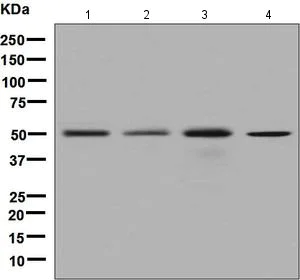
Western blot - Anti-Dysbindin antibody [EPR7041] - BSA and Azide free (AB248597)
This data was developed using ab133652, the same antibody clone in a different buffer formulation.
All lanes:
Western blot - Anti-Dysbindin antibody [EPR7041] (<a href='/en-us/products/primary-antibodies/dysbindin-antibody-epr7041-ab133652'>ab133652</a>) at 1/1000 dilution
Lane 1:
293T (Human embryonic kidney epithelial cell) cell lysate at 10 µg
Lane 2:
HeLa cell lysate at 10 µg
Lane 3:
Jurkat cell lysate at 10 µg
Lane 4:
Human fetal lung tissue lysate at 10 µg
Secondary
All lanes:
Goat anti-Rabbit HRP at 1/2000 dilution
Predicted band size: 39 kDa
false

- OI-RD Scanning
Unknown
OI-RD Scanning - Anti-Dysbindin antibody [EPR7041] - BSA and Azide free (AB248597)
We have systematically measured KD (the equilibrium dissociation constant between the antibody and its antigen), of more than 840 recombinant antibodies to assess not only their individual KD values but also to see the average affinity of antibody. Based on the comparison with published literature values for mouse monoclonal antibodies, Recombinant antibodies appear to be on average 1-2 order of magnitude higher affinity.
Related conjugates and formulations (1)
-
Anti-Dysbindin antibody [EPR7041]
Complementary Products



Primary Antibodies
AB32537
BOND RX™ Validated|KO Validated|RabMAb|Recombinant|Lab Essentials|20ul selling size

- 5
- 4
Reactivity data
Product details
ab248597 is the carrier-free version of ab133652.
Patented technology
Our RabMAb® technology is a patented hybridoma-based technology for making rabbit monoclonal antibodies. For details on our patents, please refer to RabMAb® patents.
What are the advantages of a recombinant monoclonal antibody?
This product is a recombinant monoclonal antibody, which offers several advantages including:
- - High batch-to-batch consistency and reproducibility
- - Improved sensitivity and specificity
- - Long-term security of supply
- - Animal-free batch production
For more information, read more on recombinant antibodies.
Conjugation ready
Our carrier-free antibodies are typically supplied in a PBS-only formulation, purified and free of BSA, sodium azide and glycerol. This conjugation-ready format is designed for use with fluorochromes, metal isotopes, oligonucleotides, and enzymes, which makes them ideal for antibody labelling, functional and cell-based assays, flow-based assays (e.g. mass cytometry) and Multiplex Imaging applications.
Use our conjugation kits for antibody conjugates that are ready-to-use in as little as 20 minutes with 1 minute hands-on-time and 100% antibody recovery: available for fluorescent dyes, HRP, biotin and gold.
Compatibility
This product is compatible with the Maxpar® Antibody Labeling Kit from Fluidigm, without the need for antibody preparation. Maxpar® is a trademark of Fluidigm Canada Inc.
Properties and storage information
Form
Purification technique
Storage buffer
Shipped at conditions
Appropriate short-term storage conditions
Appropriate long-term storage conditions
Storage information
Supplementary information
This supplementary information is collated from multiple sources and compiled automatically.
Biological function summary
Multiple cellular processes involve dysbindin including synaptic transmission and intracellular signaling. Dysbindin is a component of the Biogenesis of Lysosome-related Organelles Complex 1 (BLOC-1) which is important for the biogenesis and trafficking of lysosome-related organelles. Its role in ensuring proper lysosomal function is linked to the regulation of synaptic vesicle release influencing neurotransmitter availability in synaptic clefts.
Pathways
Several important biological networks engage dysbindin particularly affecting neural and cellular functions. It participates in the synaptic vesicle cycle and pigment cell pathways. Dysbindin’s functional relationship with proteins such as Snapin and Pallidin illustrates its connection to BLOC-1-related pathways indicating its integrative role in synaptic endosome trafficking and pigment gene expression processes.
Product protocols
- Visit the General protocols
- Visit the Troubleshooting
Target data
Alternative Names
Publications (1)
Recent publications for all applications. Explore the full listand refine your search
Immunity, inflammation and disease 10:e727 PubMed36301031
2022
Applications
Unspecified application
Species
Unspecified reactive species
Product promise
Please note: All products are 'FOR RESEARCH USE ONLY. NOT FOR USE IN DIAGNOSTIC OR THERAPEUTIC PROCEDURES'.
For licensing inquiries, please contact partnerships@abcam.com