JavaScript is disabled in your browser. Please enable JavaScript to view this website.
AB76195

Anti-EGFR (phospho Y1101) antibody [M199]

0

(1 Review)

|

(8 Publications )

Mouse Monoclonal EGFR phospho Y1101 antibody. Suitable for WB, ICC/IF and reacts with Human samples. Cited in 8 publications. Immunogen corresponding to Synthetic Peptide within Human EGFR pY1101 conjugated to Keyhole Limpet Haemocyanin.
2 Images
Immunocytochemistry/ Immunofluorescence - Anti-EGFR (phospho Y1101) antibody [M199] (AB76195)
  • ICC/IF

Unknown

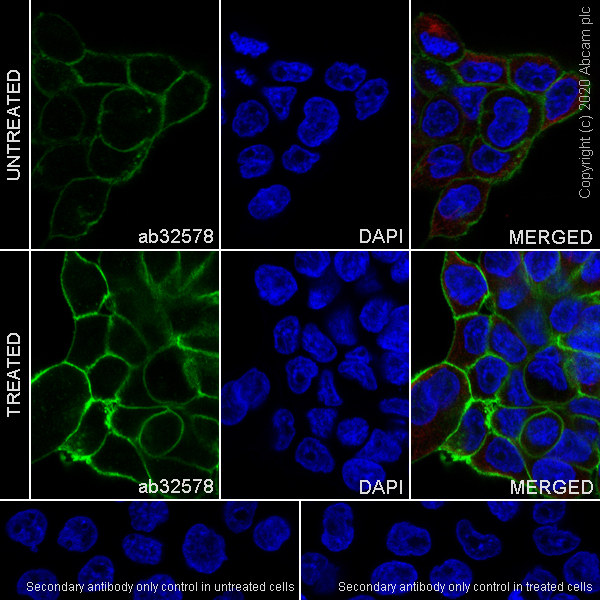
Immunocytochemistry/ Immunofluorescence - Anti-EGFR (phospho Y1101) antibody [M199] (AB76195)

ab76195 at 1/200 dilution staining EGFR in A431 cells, untreated (left) or treated with EGF (100ng/ml) for 5 min (right) by Immunoflurescence.

Western blot - Anti-EGFR (phospho Y1101) antibody [M199] (AB76195)
  • WB

Unknown

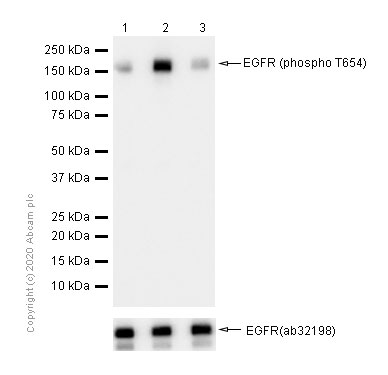
Western blot - Anti-EGFR (phospho Y1101) antibody [M199] (AB76195)

All lanes:

Western blot - Anti-EGFR (phospho Y1101) antibody [M199] (ab76195) at 1/1000 dilution

Lane 1:

A431 cells, untreated

Lane 2:

A431 cells treated with EGF (100 ng/ml) for 5 minutes

Predicted band size: 134 kDa

Observed band size: 180 kDa

false

Key facts

Host species

Mouse

Clonality

Monoclonal

Clone number

M199

Isotype

IgG1

Carrier free

No

Reacts with

Human

Applications

ICC/IF, WB

applications

Immunogen

Synthetic Peptide within Human EGFR pY1101 conjugated to Keyhole Limpet Haemocyanin. The exact immunogen used to generate this antibody is proprietary information.

P00533

Reactivity data

{ "title": "Reactivity Data", "filters": { "stats": ["", "Species", "Dilution Info", "Notes"], "tabs": { "all-applications": {"fullname" : "All Applications", "shortname": "All Applications"}, "WB" : {"fullname" : "Western blot", "shortname":"WB"}, "ICCIF" : {"fullname" : "Immunocytochemistry/ Immunofluorescence", "shortname":"ICC/IF"} }, "product-promise": { "all": "all", "testedAndGuaranteed": "tested", "guaranteed": "expected", "predicted": "predicted", "notRecommended": "not-recommended" } }, "values": { "Human": { "WB-species-checked": "testedAndGuaranteed", "WB-species-dilution-info": "1/1000", "WB-species-notes": "<p></p>", "ICCIF-species-checked": "testedAndGuaranteed", "ICCIF-species-dilution-info": "1/200", "ICCIF-species-notes": "<p></p>" }, "Mouse": { "WB-species-checked": "predicted", "WB-species-dilution-info": "", "WB-species-notes": "", "ICCIF-species-checked": "predicted", "ICCIF-species-dilution-info": "", "ICCIF-species-notes": "" }, "Rat": { "WB-species-checked": "predicted", "WB-species-dilution-info": "", "WB-species-notes": "", "ICCIF-species-checked": "predicted", "ICCIF-species-dilution-info": "", "ICCIF-species-notes": "" } } }

Properties and storage information

Form
Liquid
Purification technique
Affinity purification Protein G
Storage buffer
Preservative: 0.05% Sodium azide Constituents: PBS, 50% Glycerol (glycerin, glycerine), 0.1% BSA
Shipped at conditions
Blue Ice
Appropriate short-term storage conditions
+4°C
Appropriate long-term storage conditions
-20°C
Storage information
Stable for 12 months at -20°C

Supplementary information

This supplementary information is collated from multiple sources and compiled automatically.

EGFR or Epidermal Growth Factor Receptor is a transmembrane glycoprotein that acts as a receptor for members of the epidermal growth factor family. Known alternatively as ErbB1 or HER1 this receptor has an approximate molecular weight of 170 kDa. EGFR is expressed in various cell types notably on epithelial cells and can influence multiple cellular processes through its kinase activity. It participates in the regulation of cell growth multiplication and survival by activating its kinase domain upon ligand binding.
Biological function summary

The EGFR protein plays an important role in cellular communication and signaling processes. EGFR pairs with other receptor family members to form active dimers or even higher-order complexes which in turn initiate intracellular signaling cascades. Through these complexes EGFR influences many processes including cell differentiation and repair. This function of EGFR makes it an integral part of mammalian biology affecting how cells respond to their environment by mediating changes in gene expression.

Pathways

EGFR is a central player in the MAPK and PI3K/Akt signaling pathways. Alongside other protein partners like KRAS and PI3 kinase it contributes to transmitting signals from the cell surface to the nucleus affecting gene transcription and cell behavior. These pathways are important for normal cell growth and division and aberrations in these pathways can lead to excessive or insufficient cell proliferation.

EGFR is pertinent to cancer biology including non-small cell lung cancer and glioblastoma where mutations or overexpression of the receptor frequently occur. It connects to proteins such as PTEN and BRAF which influence tumor progression and response to targeted therapies. EGFR's involvement in these disorders highlights its significance as a therapeutic target since it can be manipulated to alter disease progression.

Product protocols

For this product, it's our understanding that no specific protocols are required. You can visit:

Target data

Receptor tyrosine kinase binding ligands of the EGF family and activating several signaling cascades to convert extracellular cues into appropriate cellular responses (PubMed : 10805725, PubMed : 27153536, PubMed : 2790960, PubMed : 35538033). Known ligands include EGF, TGFA/TGF-alpha, AREG, epigen/EPGN, BTC/betacellulin, epiregulin/EREG and HBEGF/heparin-binding EGF (PubMed : 12297049, PubMed : 15611079, PubMed : 17909029, PubMed : 20837704, PubMed : 27153536, PubMed : 2790960, PubMed : 7679104, PubMed : 8144591, PubMed : 9419975). Ligand binding triggers receptor homo- and/or heterodimerization and autophosphorylation on key cytoplasmic residues. The phosphorylated receptor recruits adapter proteins like GRB2 which in turn activates complex downstream signaling cascades. Activates at least 4 major downstream signaling cascades including the RAS-RAF-MEK-ERK, PI3 kinase-AKT, PLCgamma-PKC and STATs modules (PubMed : 27153536). May also activate the NF-kappa-B signaling cascade (PubMed : 11116146). Also directly phosphorylates other proteins like RGS16, activating its GTPase activity and probably coupling the EGF receptor signaling to the G protein-coupled receptor signaling (PubMed : 11602604). Also phosphorylates MUC1 and increases its interaction with SRC and CTNNB1/beta-catenin (PubMed : 11483589). Positively regulates cell migration via interaction with CCDC88A/GIV which retains EGFR at the cell membrane following ligand stimulation, promoting EGFR signaling which triggers cell migration (PubMed : 20462955). Plays a role in enhancing learning and memory performance (By similarity). Plays a role in mammalian pain signaling (long-lasting hypersensitivity) (By similarity).. Isoform 2 may act as an antagonist of EGF action.. (Microbial infection) Acts as a receptor for hepatitis C virus (HCV) in hepatocytes and facilitates its cell entry. Mediates HCV entry by promoting the formation of the CD81-CLDN1 receptor complexes that are essential for HCV entry and by enhancing membrane fusion of cells expressing HCV envelope glycoproteins.
See full target information EGFR pY1101

Alternative Names

ERBB, ERBB1, HER1, EGFR, Epidermal growth factor receptor, Proto-oncogene c-ErbB-1, Receptor tyrosine-protein kinase erbB-1

Publications (8)

Recent publications for all applications. Explore the full list and refine your search

Redox biology 77:103396 PubMed39426288

2024

NoxO1 regulates EGFR signaling by its interaction with Erbin.

Applications

Unspecified application

Species

Unspecified reactive species

Dana Maureen Hebchen,Tim Schader,Manuela Spaeth,Niklas Müller,Johannes Graumann,Katrin Schröder

Science advances 10:eadj7251 PubMed38536914

2024

EGFR targeting PhosTACs as a dual inhibitory approach reveals differential downstream signaling.

Applications

Unspecified application

Species

Unspecified reactive species

Zhenyi Hu,Po-Han Chen,Wenxue Li,Mackenzie Krone,Sijin Zheng,Jacques Saarbach,Ines Urquizo Velasco,John Hines,Yansheng Liu,Craig M Crews

International archives of allergy and immunology 184:1010-1021 PubMed37336194

2023

The ERBB2 Exonic Variant Pro1170Ala Modulates Mitogen-Activated Protein Kinase Signaling Cascades and Associates with Allergic Asthma.

Applications

Unspecified application

Species

Unspecified reactive species

Yang Yie Sio,Wei Liang Gan,Wing Shan Ng,Sri Anusha Matta,Yee-How Say,Keng Foo Teh,Yi Ru Wong,Smyrna Moti Rawanan Shah,Kavita Reginald,Fook Tim Chew

Oncology letters 14:6031-6039 PubMed29113242

2017

Eupatolide inhibits the TGF-β1-induced migration of breast cancer cells via downregulation of SMAD3 phosphorylation and transcriptional repression of ALK5.

Applications

Unspecified application

Species

Unspecified reactive species

Ariundavaa Boldbaatar,Sunyi Lee,Sora Han,Ae Lee Jeong,Hye In Ka,Sumiyasuren Buyanravjikh,Jeong Hyung Lee,Jong-Seok Lim,Myung Sok Lee,Young Yang

eLife 5:e11835 PubMed27071344

2016

Time-resolved multimodal analysis of Src Homology 2 (SH2) domain binding in signaling by receptor tyrosine kinases.

Applications

Unspecified application

Species

Unspecified reactive species

Joshua A Jadwin,Dongmyung Oh,Timothy G Curran,Mari Ogiue-Ikeda,Lin Jia,Forest M White,Kazuya Machida,Ji Yu,Bruce J Mayer

Oncotarget 7:914-28 PubMed26575422

2015

Intra-tumor AvidinOX allows efficacy of low dose systemic biotinylated Cetuximab in a model of head and neck cancer.

Applications

WB

Species

Human

Loredana Vesci,Ferdinando Maria Milazzo,Anna Maria Anastasi,Fiorella Petronzelli,Caterina Chiapparino,Valeria Carollo,Giuseppe Roscilli,Emanuele Marra,Laura Luberto,Luigi Aurisicchio,Maria Lucrezia Pacello,Luigi Giusto Spagnoli,Rita De Santis

Molecular cancer therapeutics 13:1356-68 PubMed24634415

2014

Nuclear epidermal growth factor receptor is a functional molecular target in triple-negative breast cancer.

Applications

Unspecified application

Species

Unspecified reactive species

Toni M Brand,Mari Iida,Emily F Dunn,Neha Luthar,Kellie T Kostopoulos,Kelsey L Corrigan,Matthew J Wleklinski,David Yang,Kari B Wisinski,Ravi Salgia,Deric L Wheeler

Oncogene 32:759-67 PubMed22430206

2012

Yes and Lyn play a role in nuclear translocation of the epidermal growth factor receptor.

Applications

Unspecified application

Species

Unspecified reactive species

M Iida,T M Brand,D A Campbell,C Li,D L Wheeler
View all publications

Product promise

We are committed to supporting your work with high-quality reagents, and we're here for you every step of the way. In the unlikely event that one of our products does not perform as expected, you're protected by our Product Promise.
For full details, please see our Terms & Conditions

Please note: All products are 'FOR RESEARCH USE ONLY. NOT FOR USE IN DIAGNOSTIC OR THERAPEUTIC PROCEDURES'.

For licensing inquiries, please contact partnerships@abcam.com