Anti-EGFR (phospho Y845) antibody [EPR2149Y] - BSA and Azide free
- RabMAb
- Recombinant
- What is this?
Be the first to review this product! Submit a review
|
(1 Publication)
- ICC/IF
Unknown
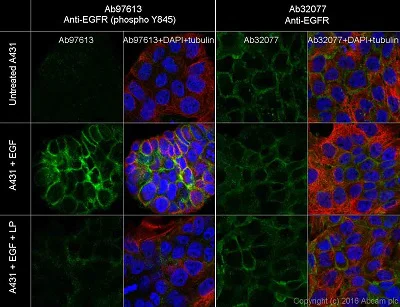
Immunocytochemistry/ Immunofluorescence - Anti-EGFR (phospho Y845) antibody [EPR2149Y] - BSA and Azide free (AB240934)
Immunofluorescent analysis of 4% paraformaldehyde-fixed,0.1% Triton X-100 permeabilized A431 (Human epidermoid carcinoma cell line) cell lines labeling EGFR with ab97613 (purified) at 1/50 dilution,followed by Goat anti-Rabbit IgG H & L (Alexa Fluor® 488) (ab150077) secondary antibody at 1/1000 dilution
Cells were counterstained with ab195889 (Anti-alpha Tubulin antibody [DM1A] ) - Microtubule Marker (Alexa Fluor® 594)
The nuclear counterstain is DAPI (blue).
The green staining on the membrane was increased in the EGF (100 ng/ml, 10 min) treated A431 cells when compared with A431 cells without treatment. After LP treatment, the green signaling was obviously decreased.
For the pan antibody, there was no great difference after EGF (100 ng/ml, 10 min) or EGF (100 ng/ml, 10 min) + LP treatment. The data showed mostly membranous staining.
This data was developed using the same antibody clone in a different buffer formulation containing PBS, BSA, glycerol, and sodium azide (ab97613)
- Flow Cyt (Intra)
Unknown
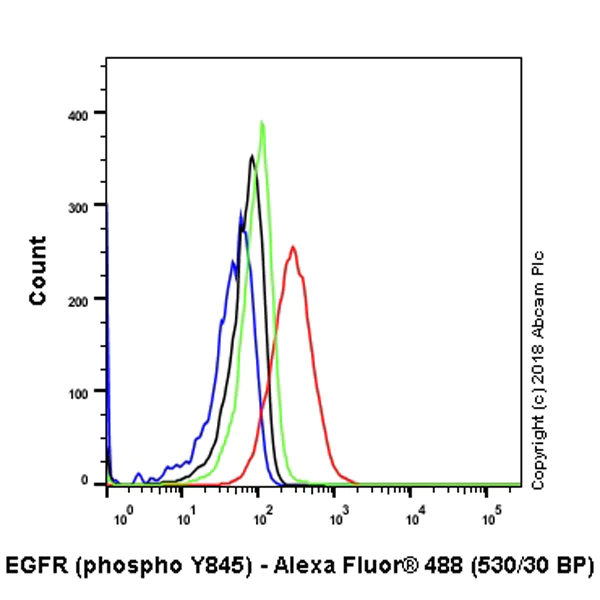
Flow Cytometry (Intracellular) - Anti-EGFR (phospho Y845) antibody [EPR2149Y] - BSA and Azide free (AB240934)
Intracellular Flow Cytometry analysis of A431 (Human epidermoid carcinoma epithelial cell) treated with 100ng/ml EGF for 10 minutes cells labeling EGFR with purified ab97613 at 1/400 dilution (1μg/ml) (red). Cells were fixed with 4% Paraformaldehyde and permeabilised with 90% Methanol. A Goat anti rabbit IgG (Alexa Fluor® 488, ab150077) secondary antibody was used at 1/2000. Isotype control - Rabbit monoclonal IgG (Black). Unlabeled control - Cell without incubation with primary antibody and secondary antibody (Blue). Untreated A431 cells (Green).
This data was developed using the same antibody clone in a different buffer formulation containing PBS, BSA, glycerol, and sodium azide (ab97613).
- Dot
Unknown
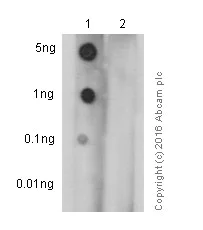
Dot Blot - Anti-EGFR (phospho Y845) antibody [EPR2149Y] - BSA and Azide free (AB240934)
Dot Blot analysis.
Lane 1 : EGFR (pY845) phospho peptide.
Lane 2 : EGFR non-phospho peptide labeling EGFR (phospho Y845) with ab97613 (unpurified) at 1/1000 dilution.
5% NFDM/TBST was used as the diluting and blocking buffer. ab97051 Goat Anti-Rabbit IgG, (H+L), Peroxidase conjugated was used as the secondary antibody at 1/100000 dilution. Exposure time : 3 minutes.
This data was developed using the same antibody clone in a different buffer formulation containing PBS, BSA, glycerol, and sodium azide (ab97613)
Related conjugates and formulations (3)
-
Anti-EGFR (phospho Y845) antibody [EPR2149Y]
-
519 Alexa Fluor® 488
Alexa Fluor® 488 Anti-EGFR (phospho Y845) antibody [EPR2149Y]
-
665 Alexa Fluor® 647
Alexa Fluor® 647 Anti-EGFR (phospho Y845) antibody [EPR2149Y]
Alternative Products
Primary Antibodies
AB32578
Anti-EGFR (phospho Y1173) antibody [E124]
RabMAb|Recombinant|Lab Essentials|20ul selling size

- 0
- 0
Primary Antibodies
AB40815
Anti-EGFR (phospho Y1068) antibody [EP774Y]
RabMAb|Recombinant|Lab Essentials|20ul selling size

- 4
- 14
Primary Antibodies
AB76153
RabMAb|Recombinant|Lab Essentials|20ul selling size|KO Validated

- 0
- 0
Primary Antibodies
AB32430
Anti-EGFR (phospho Y1068) antibody [Y38]
RabMAb|Recombinant|Lab Essentials|20ul selling size

- 0
- 0
Primary Antibodies
AB32077
BOND RX™ Validated|KO Validated|RabMAb|Recombinant|Lab Essentials|20ul selling size

- 5
- 4
Primary Antibodies
AB32562
BOND RX™ Validated|RabMAb|Recombinant|Lab Essentials|20ul selling size

- 0
- 0
Primary Antibodies
AB227737
Anti-EGFR (deleted E746 + L747 + R748 + E749 + A750) antibody [SP111]
RabMAb|Recombinant|Lab Essentials|20ul selling size

- 0
- 0
Complementary Products


Primary Antibodies
AB52894
BOND RX™ Validated|KO Validated|RabMAb|Lab Essentials|20ul selling size|Recombinant

- 5
- 24
Primary Antibodies
AB40815
Anti-EGFR (phospho Y1068) antibody [EP774Y]
RabMAb|Recombinant|Lab Essentials|20ul selling size
- 4
- 14
Primary Antibodies
AB316155
Anti-EGFR (phospho Y1045) antibody [EPR28381-88]
Recombinant|KO Validated|Lab Essentials|20ul selling size|RabMAb

- 0
- 0
Primary Antibodies
AB76300
Anti-EGFR (phospho S1046 + S1047) antibody [EP2259Y]
RabMAb|Recombinant|Lab Essentials|20ul selling size

- 5
- 1
Reactivity data
Product details
ab240934 is the carrier-free version of ab97613.
Species reactivity
Mouse, Rat: We have preliminary internal testing data to indicate this antibody may not react with these species.
Please contact us for more information.
Patented technology
Our RabMAb® technology is a patented hybridoma-based technology for making rabbit monoclonal antibodies. For details on our patents, please refer to RabMAb® patents.
What are the advantages of a recombinant monoclonal antibody?
This product is a recombinant monoclonal antibody, which offers several advantages including:
- - High batch-to-batch consistency and reproducibility
- - Improved sensitivity and specificity
- - Long-term security of supply
- - Animal-free batch production
For more information, read more on recombinant antibodies.
Conjugation ready
Our carrier-free antibodies are typically supplied in a PBS-only formulation, purified and free of BSA, sodium azide and glycerol. This conjugation-ready format is designed for use with fluorochromes, metal isotopes, oligonucleotides, and enzymes, which makes them ideal for antibody labelling, functional and cell-based assays, flow-based assays (e.g. mass cytometry) and Multiplex Imaging applications.
Use our conjugation kits for antibody conjugates that are ready-to-use in as little as 20 minutes with 1 minute hands-on-time and 100% antibody recovery: available for fluorescent dyes, HRP, biotin and gold.
Compatibility
This product is compatible with the Maxpar® Antibody Labeling Kit from Fluidigm, without the need for antibody preparation. Maxpar® is a trademark of Fluidigm Canada Inc.
Properties and storage information
Form
Purification technique
Storage buffer
Shipped at conditions
Appropriate short-term storage conditions
Appropriate long-term storage conditions
Storage information
Supplementary information
This supplementary information is collated from multiple sources and compiled automatically.
Biological function summary
The EGFR protein plays an important role in cellular communication and signaling processes. EGFR pairs with other receptor family members to form active dimers or even higher-order complexes which in turn initiate intracellular signaling cascades. Through these complexes EGFR influences many processes including cell differentiation and repair. This function of EGFR makes it an integral part of mammalian biology affecting how cells respond to their environment by mediating changes in gene expression.
Pathways
EGFR is a central player in the MAPK and PI3K/Akt signaling pathways. Alongside other protein partners like KRAS and PI3 kinase it contributes to transmitting signals from the cell surface to the nucleus affecting gene transcription and cell behavior. These pathways are important for normal cell growth and division and aberrations in these pathways can lead to excessive or insufficient cell proliferation.
Product protocols
- Visit the General protocols
- Visit the Troubleshooting
Target data
Alternative Names
Publications (1)
Recent publications for all applications. Explore the full listand refine your search
Oncology letters 21:486 PubMed33968202
2021
Applications
Unspecified application
Species
Unspecified reactive species
Product promise
Please note: All products are 'FOR RESEARCH USE ONLY. NOT FOR USE IN DIAGNOSTIC OR THERAPEUTIC PROCEDURES'.
For licensing inquiries, please contact partnerships@abcam.com