Anti-eIF4B antibody - N-terminal
Be the first to review this product! Submit a review
|
(1 Publication)
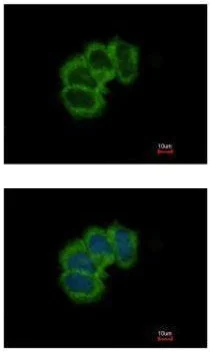
- ICC/IF
Supplier Data
Immunocytochemistry/ Immunofluorescence - Anti-eIF4B antibody - N-terminal (AB228800)
Paraformaldehyde-fixed MCF7 (human breast adenocarcinoma cell line) cells stained for eIF4B (green) using ab228800 at 1/500 dilution in ICC/IF.
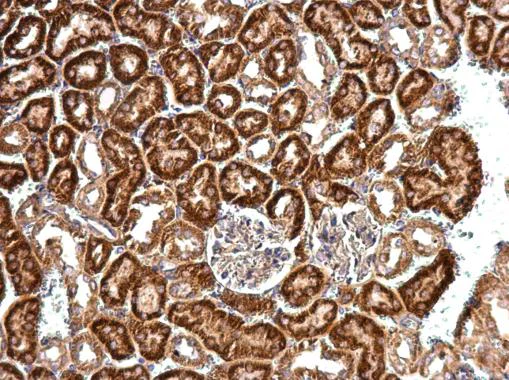
- IHC-P
Supplier Data
Immunohistochemistry (Formalin/PFA-fixed paraffin-embedded sections) - Anti-eIF4B antibody - N-terminal (AB228800)
Paraffin-embedded mouse kidney stained for eIF4B using ab228800 at 1/500 dilution in immunohistochemical analysis.
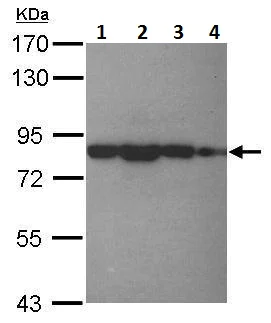
- WB
Supplier Data
Western blot - Anti-eIF4B antibody - N-terminal (AB228800)
7.5% SDS-PAGE gel.
All lanes:
Western blot - Anti-eIF4B antibody - N-terminal (ab228800) at 1/1000 dilution
Lane 1:
NTERA-2 cl.D1 [NT2/D1] (human malignant pluripotent embryonic carcinoma cell line) whole cell lysate at 30 µg
Lane 2:
IMR32 whole cell lysate at 30 µg
Lane 3:
U-87 MG (human glioblastoma-astrocytoma epithelial cell line) whole cell lysate at 30 µg
Lane 4:
MCF7 (human breast adenocarcinoma cell line) whole cell lysate at 30 µg
Predicted band size: 69 kDa
false

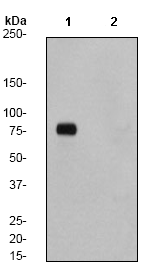
- WB
Supplier Data
Western blot - Anti-eIF4B antibody - N-terminal (AB228800)
7.5% SDS-PAGE gel.
All lanes:
Western blot - Anti-eIF4B antibody - N-terminal (ab228800) at 1/5000 dilution
Lane 1:
HEK-293T (human epithelial cell line from embryonic kidney transformed with large T antigen) whole cell lysate at 30 µg
Lane 2:
eIF4B-transfected HEK-293T whole cell lysate at 30 µg
Predicted band size: 69 kDa
false
Alternative Products


Complementary Products
Primary Antibodies
AB32072
Anti-c-Myc antibody [Y69] - ChIP Grade
BOND RX™ Validated|KO Validated|RabMAb|Recombinant|Lab Essentials|20ul selling size|Advanced Validation

- 4
- 56
Primary Antibodies
AB32024
BOND RX™ Validated|20ul selling size|RabMAb|Recombinant|KO Validated
- 0
- 0

Reactivity data
Properties and storage information
Form
Purification technique
Storage buffer
Shipped at conditions
Appropriate short-term storage duration
Appropriate short-term storage conditions
Appropriate long-term storage conditions
Aliquoting information
Storage information
Supplementary information
This supplementary information is collated from multiple sources and compiled automatically.
Biological function summary
EIF4B supports the recruitment of ribosomal subunits to mRNA by interacting with eIF3 and the large ribosomal subunit. It forms part of the larger eIF4F complex which is important for the cap-dependent initiation of translation. By working with eIF4A and eIF4G eIF4B facilitates the scanning process of the ribosome to the start codon on mRNA leading to proper protein translation.
Pathways
EIF4B participates in the mTOR signaling pathway a central regulator of cellular growth and metabolism. It also contributes to the PI3K/AKT/mTOR pathway affecting cell proliferation and survival. Additionally eIF4B interacts with other proteins like eIF4E and eIF5 linking its function to these pathways and ensuring effective coordination of translation initiation as well as regulation under various conditions.
Product protocols
- Visit the General protocols
- Visit the Troubleshooting
Target data
Alternative Names
Publications (1)
Recent publications for all applications. Explore the full listand refine your search
Phytotherapy research : PTR 35:2200-2210 PubMed33258205
2020
Applications
Unspecified application
Species
Unspecified reactive species
Product promise
Please note: All products are 'FOR RESEARCH USE ONLY. NOT FOR USE IN DIAGNOSTIC OR THERAPEUTIC PROCEDURES'.
For licensing inquiries, please contact partnerships@abcam.com