JavaScript is disabled in your browser. Please enable JavaScript to view this website.
AB130402

Anti-ELOF1 antibody

Be the first to review this product! Submit a review

|

(1 Publication)

Rabbit Polyclonal ELOF1 antibody. Suitable for IHC-P, ICC/IF and reacts with Human samples. Cited in 1 publication. Immunogen corresponding to Recombinant Fragment Protein within Human ELOF1 aa 1 to C-terminus.

View Alternative Names

Transcription elongation factor 1 homolog, ELOF1
2 Images
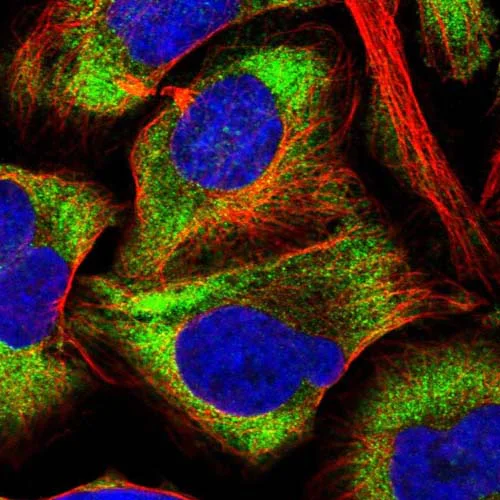
Immunocytochemistry/ Immunofluorescence - Anti-ELOF1 antibody (AB130402)
  • ICC/IF

Unknown

Immunocytochemistry/ Immunofluorescence - Anti-ELOF1 antibody (AB130402)

Immunofluorescent staining of Human cell line U-2 OS shows positivity in cytoplasm. Recommended concentration of ab130402 1-4 µg/ml. Cells treated with PFA/Triton X-100.
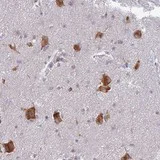
Immunohistochemistry (Formalin/PFA-fixed paraffin-embedded sections) - Anti-ELOF1 antibody (AB130402)
  • IHC-P

Unknown

Immunohistochemistry (Formalin/PFA-fixed paraffin-embedded sections) - Anti-ELOF1 antibody (AB130402)

Immunohistochemical analysis of Formalin-fixed, paraffin embedded Human lateral ventricle tissue labelled with ELOF1 antibody at 1/10 dilution.

Key facts

Host species

Rabbit

Clonality

Polyclonal

Isotype

IgG

Carrier free

No

Reacts with

Human

Applications

IHC-P, ICC/IF

applications

Immunogen

Recombinant Fragment Protein within Human ELOF1 aa 1 to C-terminus. The exact immunogen used to generate this antibody is proprietary information.

P60002

Reactivity data

{ "title": "Reactivity Data", "filters": { "stats": ["", "Species", "Dilution Info", "Notes"], "tabs": { "all-applications": {"fullname" : "All Applications", "shortname": "All Applications"}, "IHCP" : {"fullname" : "Immunohistochemistry (Formalin/PFA-fixed paraffin-embedded sections)", "shortname":"IHC-P"}, "ICCIF" : {"fullname" : "Immunocytochemistry/ Immunofluorescence", "shortname":"ICC/IF"} }, "product-promise": { "all": "all", "testedAndGuaranteed": "tested", "guaranteed": "expected", "predicted": "predicted", "notRecommended": "not-recommended" } }, "values": { "Human": { "IHCP-species-checked": "testedAndGuaranteed", "IHCP-species-dilution-info": "1/10 - 1/20", "IHCP-species-notes": "<p></p> Perform heat-mediated antigen retrieval with citrate buffer pH 6 before commencing with IHC staining protocol.", "ICCIF-species-checked": "testedAndGuaranteed", "ICCIF-species-dilution-info": "0.25-2 µg/mL", "ICCIF-species-notes": "<p></p>" } } }

Properties and storage information

Form
Liquid
Purification technique
Affinity purification Immunogen
Storage buffer
pH: 7.2 Preservative: 0.02% Sodium azide Constituents: PBS, 40% Glycerol (glycerin, glycerine)
Shipped at conditions
Blue Ice
Appropriate short-term storage conditions
+4°C
Appropriate long-term storage conditions
-20°C
Aliquoting information
Upon delivery aliquot
Storage information
Avoid freeze / thaw cycle

Supplementary information

This supplementary information is collated from multiple sources and compiled automatically.

ELOF1 known as Elongation Factor Protein 1 plays a role in the transcription process. It assists RNA polymerase II with transcription elongation and maintaining transcript integrity. ELOF1 has a molecular weight of approximately 15 kDa. It is expressed in various tissues with higher levels found in active proliferating cells due to its role in gene expression regulation.
Biological function summary

ELOF1 supports the elongation phase of transcription and interacts with components of the transcription machinery. It forms part of a complex with other elongation factors helping RNA polymerase II proceed along DNA without stalling. ELOF1 ensures efficient synthesis of messenger RNA affecting the transcriptional output of numerous genes across different cellular processes.

Pathways

The influence of ELOF1 extends to key transcriptional and signaling pathways like the mRNA processing pathway. ELOF1 also connects closely to other transcription elongation factors like SPT6 affecting how cells respond to transcriptional cues. These connections are significant in maintaining proper gene regulation and expression in reaction to various intracellular signals.

ELOF1's interplay with transcription regulation links it to cancer and neurodegenerative diseases. Changes in ELOF1 expression or function can disrupt normal transcriptional elongation contributing to the uncontrolled growth of cancer cells. Additionally dysfunction in ELOF1 influences neurodegenerative processes likely through its regulatory effect on gene expression. It is associated with proteins like RNA polymerase II which play roles in these disease pathways.

Product protocols

For this product, it's our understanding that no specific protocols are required. You can visit:

Target data

Factor involved in transcription-coupled nucleotide excision repair (TC-NER), a mechanism that rapidly removes RNA polymerase II-blocking lesions from the transcribed strand of active genes (PubMed : 34108662, PubMed : 34108663, PubMed : 38316879). Acts as a key adapter required to anchor TC-NER factors to RNA polymerase II : stably positions UVSSA and the DCX(ERCC8) complex (also named CSA complex) on arrested RNA polymerase II, leading to neddylation and activation of the DCX(ERCC8) complex and ubiquitination of RNA polymerase II (PubMed : 38316879).
See full target information ELOF1

Publications (1)

Recent publications for all applications. Explore the full list and refine your search

OncoTargets and therapy 12:7437-7450 PubMed31686849

2019

Ultrasound-microbubbles-mediated microRNA-449a inhibits lung cancer cell growth via the regulation of Notch1.

Applications

Unspecified application

Species

Unspecified reactive species

Lingwu Meng,Shaofei Yuan,Linjia Zhu,Zongxiao ShangGuan,Renguo Zhao
View all publications

Product promise

We are committed to supporting your work with high-quality reagents, and we're here for you every step of the way. In the unlikely event that one of our products does not perform as expected, you're protected by our Product Promise.
For full details, please see our Terms & Conditions

Please note: All products are 'FOR RESEARCH USE ONLY. NOT FOR USE IN DIAGNOSTIC OR THERAPEUTIC PROCEDURES'.

For licensing inquiries, please contact partnerships@abcam.com