JavaScript is disabled in your browser. Please enable JavaScript to view this website.
AB190465

Anti-entB antibody [3D10]

Be the first to review this product! Submit a review

|

(1 Publication)

Mouse Monoclonal entB antibody. Carrier free. Suitable for WB, sELISA, FuncS (Neut/Block) and reacts with Staphylococcus aureus samples. Cited in 1 publication. Immunogen corresponding to Native Full Length Protein corresponding to Staphylococcus aureus entB.

View Alternative Names

Enterotoxin type B, SEB, entB, Ent B, Enterotoxin type B, SEB, Staphylococcal enterotoxin B, Staphylococcus Enterotoxin B
3 Images
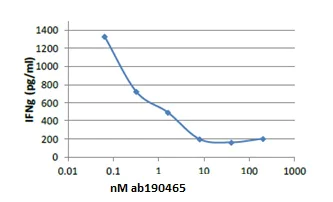
Functional Studies (Neut/Block) - Anti-entB antibody [3D10] (AB190465)
  • FuncS (Neut/Block)

Supplier Data

Functional Studies (Neut/Block) - Anti-entB antibody [3D10] (AB190465)

Toxin Neutralization : dose dependent suppression of entB-induced IFNγ production in Human peripheral mononuclear cells (PBMC).
Sandwich ELISA - Anti-entB antibody [3D10] (AB190465)
  • sELISA

Supplier Data

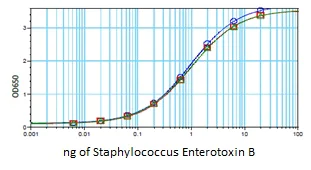
Sandwich ELISA - Anti-entB antibody [3D10] (AB190465)

Capture ELISA in which ab190465 was coated to the plate overnight at 4oC at a concentration of 1 μg/mL. entB was serially diluted semi-log (1 : 3.16 serial dilutions) from 20 ng/mL and incubated on the antibody coated plate. Captured entB was detected using an anti-entB polyclonal antibody and anti-rabbit conjugate HRP conjugate. Data represent three different curves detected across the plate.
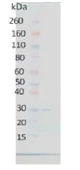
Western blot - Anti-entB antibody [3D10] (AB190465)
  • WB

Supplier Data

Western blot - Anti-entB antibody [3D10] (AB190465)

All lanes:

Western blot - Anti-entB antibody [3D10] (ab190465) at 1 µg/mL

All lanes:

entB at 0.05 µg

Secondary

All lanes:

anti-mouse HRP conjugate.

Predicted band size: 31 kDa

false

Key facts

Host species

Mouse

Clonality

Monoclonal

Clone number

3D10

Isotype

IgG1

Carrier free

Yes

Reacts with

Staphylococcus aureus

Applications

sELISA, FuncS (Neut/Block), WB

applications

Immunogen

Native Full Length Protein corresponding to Staphylococcus aureus entB.

P01552

Specificity

ab190465 does not appear to cross react with TSST-1 or SEC-1.

Reactivity data

{ "title": "Reactivity Data", "filters": { "stats": ["", "Species", "Dilution Info", "Notes"], "tabs": { "all-applications": {"fullname" : "All Applications", "shortname": "All Applications"}, "WB" : {"fullname" : "Western blot", "shortname":"WB"}, "ELISA" : {"fullname" : "ELISA", "shortname":"ELISA"}, "sELISA" : {"fullname" : "Sandwich ELISA", "shortname":"sELISA"}, "FuncSNeutBlock" : {"fullname" : "Functional Studies (Neut/Block)", "shortname":"FuncS (Neut/Block)"} }, "product-promise": { "all": "all", "testedAndGuaranteed": "tested", "guaranteed": "expected", "predicted": "predicted", "notRecommended": "not-recommended" } }, "values": { "Staphylococcus aureus": { "WB-species-checked": "testedAndGuaranteed", "WB-species-dilution-info": "1 µg/mL", "WB-species-notes": "<p></p>", "ELISA-species-checked": "notRecommended", "ELISA-species-dilution-info": "", "ELISA-species-notes": "<p>This antibody is not recommended for DIRECT detection in ELISA.</p>", "sELISA-species-checked": "testedAndGuaranteed", "sELISA-species-dilution-info": "1 µg/mL", "sELISA-species-notes": "<p>ab190465 can be used for capture of SEB in an ELISA sandwich assay.</p><p><a href='/en-us/products/primary-antibodies/staphylococcus-aureus-enterotoxins-a-b-tsst-1-antibody-ab190337'>ab190337</a> can be used as detection antibody, along with another anti rabbit HRP antibody.</p>", "FuncSNeutBlock-species-checked": "testedAndGuaranteed", "FuncSNeutBlock-species-dilution-info": "", "FuncSNeutBlock-species-notes": "<p>10 nM of ab190465 completely inhibits superantigenic activity of 0.1 ng/ml SEB.</p>" } } }

Properties and storage information

Form
Liquid
Purification technique
Affinity purification Protein G
Storage buffer
Constituents: PBS
Shipped at conditions
Blue Ice
Appropriate short-term storage duration
1-2 weeks
Appropriate short-term storage conditions
+4°C
Appropriate long-term storage conditions
-20°C
Aliquoting information
Upon delivery aliquot
Storage information
Avoid freeze / thaw cycle

Supplementary information

This supplementary information is collated from multiple sources and compiled automatically.

The EntB protein also known as 23-dihydroxybenzoate-AMP ligase is essential for the biosynthesis of enterobactin the siderophore responsible for iron transport in bacteria. This protein has a molecular mass of approximately 60 kDa and is expressed predominantly in Escherichia coli. EntB plays a mechanical role as an isochorismate lyase converting isochorismate to 23-dihydroxybenzoate (23-DHB) which is a precursor in enterobactin synthesis. This step is important for high-affinity iron uptake especially under iron-limiting conditions allowing bacteria to thrive in diverse environments.
Biological function summary

EntB is involved in the enterobactin biosynthesis pathway which plays a pivotal role in iron acquisition by pathogenic bacteria helping in evading host immune responses. EntB functions as a part of the enterobactin synthetase multi-enzyme complex working synergistically with other proteins like EntD EntE and EntF. Within this complex EntB contributes to the assembly of enterobactin helping the bacteria secure necessary iron from the host environment or surroundings which supports bacterial growth and survival.

Pathways

EntB's function integrates into the non-ribosomal peptide synthetase (NRPS) system for siderophore biosynthesis intersecting with the shikimate pathway. EntB's activity links to enzymes like EntC and EntH playing a part in converting chorismate to enterobactin. Additionally the shikimate pathway serves as a precursor for aromatic amino acids whose role extends beyond siderophore production integrating into broader bacterial metabolic networks.

EntB's role in enterobactin production links it to bacterial virulence and pathogenicity. Pathogenic strains of bacteria like E. coli and Salmonella use EntB for iron acquisition making it important for infection processes including urinary tract infections and systemic infections. By interacting with proteins like EntA and other components of the enterobactin biosynthetic pathway EntB becomes a potential target for antimicrobial drug development aiming to disrupt the bacterial siderophore-mediated iron acquisition thereby attenuating the bacterial virulence and reducing infection rates.

Product protocols

For this product, it's our understanding that no specific protocols are required. You can visit:

Target data

Staphylococcal enterotoxin that activates the host immune system by binding as unprocessed molecules to major histocompatibility (MHC) complex class II and T-cell receptor (TCR) molecules. In turn, this ternary complex activates a large number of T-lymphocytes initiating a systemic release of pro-inflammatory cytokines (PubMed : 2303780, PubMed : 25015819). Also causes the intoxication staphylococcal food poisoning syndrome (By similarity).
See full target information entB

Additional targets

entB

Publications (1)

Recent publications for all applications. Explore the full list and refine your search

Cancers 15: PubMed37894441

2023

New Insights on the Progesterone (P4) and PGRMC1/NENF Complex Interactions in Colorectal Cancer Progression.

Applications

Unspecified application

Species

Unspecified reactive species

Joanna Kamińska,Olga Martyna Koper-Lenkiewicz,Donata Ponikwicka-Tyszko,Weronika Lebiedzińska,Ewelina Palak,Maria Sztachelska,Piotr Bernaczyk,Justyna Dorf,Katarzyna Guzińska-Ustymowicz,Konrad Zaręba,Sławomir Wołczyński,Nafis Ahmed Rahman,Violetta Dymicka-Piekarska
View all publications

Product promise

We are committed to supporting your work with high-quality reagents, and we're here for you every step of the way. In the unlikely event that one of our products does not perform as expected, you're protected by our Product Promise.
For full details, please see our Terms & Conditions

Please note: All products are 'FOR RESEARCH USE ONLY. NOT FOR USE IN DIAGNOSTIC OR THERAPEUTIC PROCEDURES'.

For licensing inquiries, please contact partnerships@abcam.com