Anti-Eotaxin antibody [EPR5825]
- 20ul selling size
- RabMAb
- Recombinant
- What is this?
Be the first to review this product! Submit a review
|
(8 Publications )
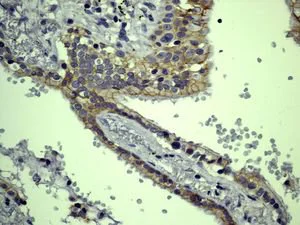
- IHC-P
Unknown
Immunohistochemistry (Formalin/PFA-fixed paraffin-embedded sections) - Anti-Eotaxin antibody [EPR5825] (AB133604)
Immunohistochemical analysis of paraffin-embedded Human lung tissue labelling Eotaxin with unpurified ab133604 at 1/1000.
Heat mediated antigen retrieval was performed before commencing with IHC staining protocol.
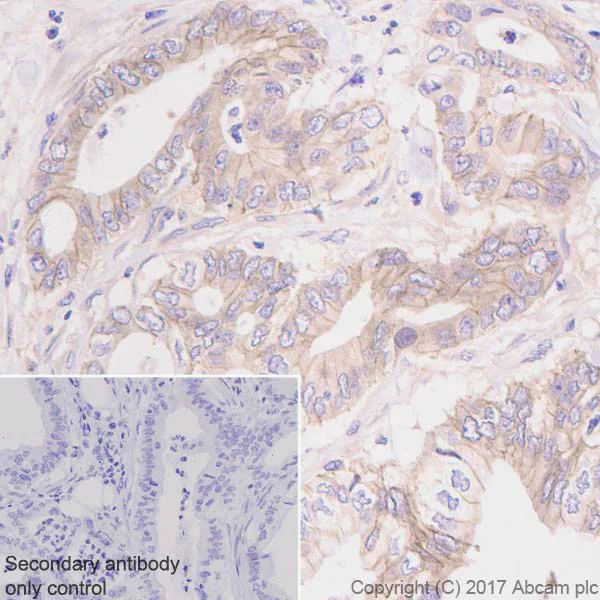
- IHC-P
Lab
Immunohistochemistry (Formalin/PFA-fixed paraffin-embedded sections) - Anti-Eotaxin antibody [EPR5825] (AB133604)
Immunohistochemistry (Formalin/PFA-fixed paraffin-embedded sections) analysis of human pancreatic carcinoma tissue sections labeling Eotaxin with Purified ab133604 at 1 : 100 dilution (1.21 μg/ml). Heat mediated antigen retrieval was performed using EDTA Buffer pH9.0. Tissue was counterstained with Hematoxylin. ImmunoHistoProbe one step HRP Polymer (ready to use) secondary antibody was used at 1 : 0 dilution. PBS instead of the primary antibody was used as the negative control.
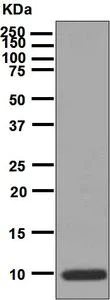
- WB
Unknown
Western blot - Anti-Eotaxin antibody [EPR5825] (AB133604)
All lanes:
Western blot - Anti-Eotaxin antibody [EPR5825] (ab133604) at 1/1000 dilution
All lanes:
Eotaxin recombinant protein at 0.01 µg
Secondary
All lanes:
Goat anti-Rabbit HRP at 1/2000 dilution
Predicted band size: 11 kDa
Observed band size: 8 kDa
false
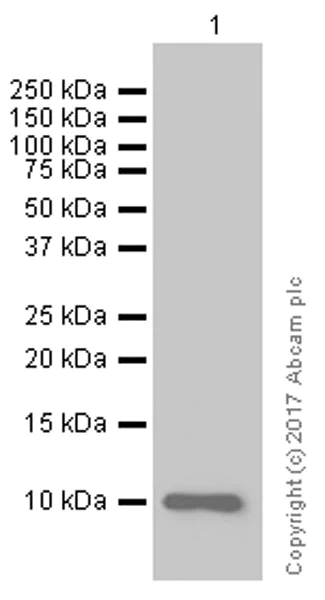
- WB
Lab
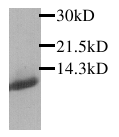
Western blot - Anti-Eotaxin antibody [EPR5825] (AB133604)
Blocking and diluting buffer : 5% NFDM/TBST
Recombinant protein source : Peprotech Inc.
The region it covers : aa24-aa97(8.3kDa)
Tag info : N/A
All lanes:
Western blot - Anti-Eotaxin antibody [EPR5825] (ab133604) at 1/10000 dilution
All lanes:
Human Eotaxin recombinant protein at 0.015 µg
Secondary
All lanes:
Western blot - Goat Anti-Rabbit IgG H&L (HRP) (<a href='/en-us/products/secondary-antibodies/goat-rabbit-igg-h-l-hrp-ab97051'>ab97051</a>) at 1/20000 dilution
Predicted band size: 11 kDa
Observed band size: 8 kDa
false
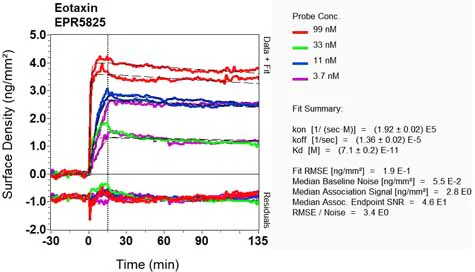
- OI-RD Scanning
Unknown
OI-RD Scanning - Anti-Eotaxin antibody [EPR5825] (AB133604)
We have systematically measured KD (the equilibrium dissociation constant between the antibody and its antigen), of more than 840 recombinant antibodies to assess not only their individual KD values but also to see the average affinity of antibody. Based on the comparison with published literature values for mouse monoclonal antibodies, Recombinant antibodies appear to be on average 1-2 order of magnitude higher affinity.
Related conjugates and formulations (1)
-
Anti-Eotaxin antibody [EPR5825] - BSA and Azide free
Alternative Products
Complementary Products


Primary Antibodies
AB32520
20ul selling size|Recombinant|Advanced Validation|RabMAb|KO Validated

- 5
- 1
Reactivity data
Product details
Species reactivity
Mouse, Rat: We have preliminary internal testing data to indicate this antibody may not react with these species.
Please contact us for more information.
Patented technology
Our RabMAb® technology is a patented hybridoma-based technology for making rabbit monoclonal antibodies. For details on our patents, please refer to RabMAb® patents.
What are the advantages of a recombinant monoclonal antibody?
This product is a recombinant monoclonal antibody, which offers several advantages including:
- - High batch-to-batch consistency and reproducibility
- - Improved sensitivity and specificity
- - Long-term security of supply
- - Animal-free batch production
For more information, read more on recombinant antibodies.
Properties and storage information
Form
Purification technique
Storage buffer
Shipped at conditions
Appropriate short-term storage duration
Appropriate short-term storage conditions
Appropriate long-term storage conditions
Aliquoting information
Storage information
Supplementary information
This supplementary information is collated from multiple sources and compiled automatically.
Biological function summary
Eotaxin plays an important role in immune response regulation particularly in allergic reactions. It functions by binding to CCR3 a receptor found on eosinophils therefore facilitating their migration. This process includes involvement in the formation of protein complexes that modulate cell signaling. Eotaxin's primary biological role lies in promoting the accumulation of eosinophils which are important for the immune defense against parasitic infections.
Pathways
Eotaxin participates in the MAPK/ERK signaling pathway which influences cell migration and proliferation. Additionally it operates within the NF-kB pathway often regulating inflammation and immune response. In these pathways eotaxin interacts with other proteins like CCR3 and IL-5 contributing to a coordinated response in immune signaling.
Product protocols
- Visit the General protocols
- Visit the Troubleshooting
Target data
Alternative Names
Publications (8)
Recent publications for all applications. Explore the full listand refine your search
Cell death discovery 10:294 PubMed38906863
2024
Applications
Unspecified application
Species
Unspecified reactive species
Acta dermato-venereologica 104:adv35401 PubMed38348729
2024
Applications
Unspecified application
Species
Unspecified reactive species
Critical reviews in eukaryotic gene expression 33:1-12 PubMed37183942
2023
Applications
Unspecified application
Species
Unspecified reactive species
The Laryngoscope 132:2132-2138 PubMed35199865
2022
Applications
Unspecified application
Species
Unspecified reactive species
The Laryngoscope 131:E800-E806 PubMed32621541
2020
Applications
Unspecified application
Species
Unspecified reactive species
Molecular medicine reports 21:2522-2532 PubMed32323817
2020
Applications
Unspecified application
Species
Unspecified reactive species
Journal of ophthalmology 2016:9292346 PubMed27340563
2016
Applications
Unspecified application
Species
Unspecified reactive species
Modern pathology : an official journal of the Unit 28:533-44 PubMed25234289
2014
Applications
Unspecified application
Species
Unspecified reactive species
Product promise
Please note: All products are 'FOR RESEARCH USE ONLY. NOT FOR USE IN DIAGNOSTIC OR THERAPEUTIC PROCEDURES'.
For licensing inquiries, please contact partnerships@abcam.com