Anti-ERCC1 antibody [EPR7062]
- RabMAb
- Recombinant
- What is this?
Be the first to review this product! Submit a review
|
(1 Publication)
- IHC-P
Unknown
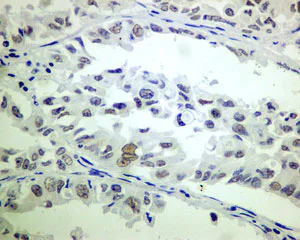
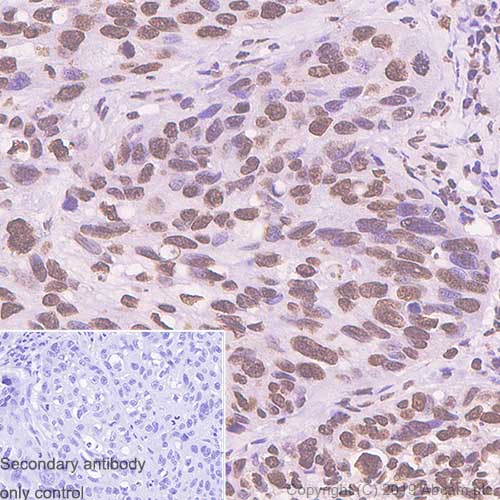
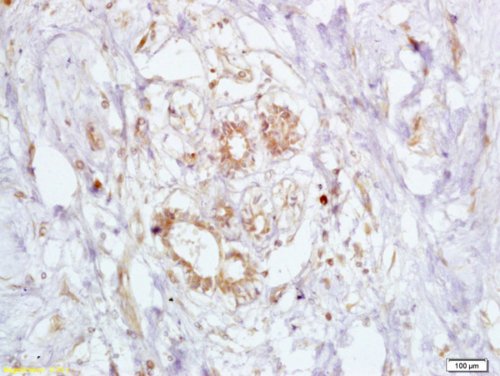
Immunohistochemistry (Formalin/PFA-fixed paraffin-embedded sections) - Anti-ERCC1 antibody [EPR7062] (AB129093)
Formalin-fixed, paraffin-embedded human lung carcinoma tissue stained for ERCC1 with ab129093 (1/25 dilution) in immunohistochemical analysis.
Perform heat mediated antigen retrieval before commencing with IHC staining protocol.
- ICC/IF
Unknown
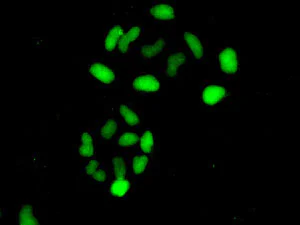
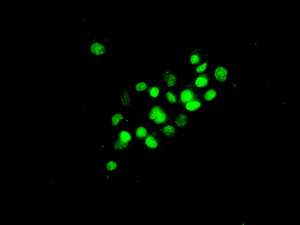
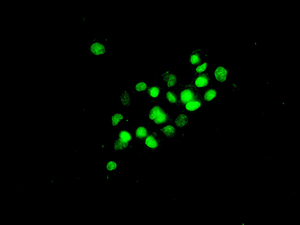
Immunocytochemistry/ Immunofluorescence - Anti-ERCC1 antibody [EPR7062] (AB129093)
ab129093, at a 1/100 dilution, staining ERCC1 in HeLa cells by Immunofluorescence.
- WB
Unknown
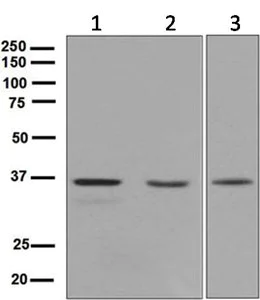
Western blot - Anti-ERCC1 antibody [EPR7062] (AB129093)
All lanes:
Western blot - Anti-ERCC1 antibody [EPR7062] (ab129093) at 1/1000 dilution
Lane 1:
HeLa cell lysates at 10 µg
Lane 2:
SKBR-3 cell lysates at 10 µg
Lane 3:
293T cell lysates at 10 µg
Secondary
All lanes:
HRP labelled goat anti-rabbit at 1/2000 dilution
Predicted band size: 33 kDa
Observed band size: 36 kDa
false
Related conjugates and formulations (1)
-
Anti-ERCC1 antibody [EPR7062] - BSA and Azide free
Alternative Products
Primary Antibodies
AB129267
20ul selling size|RabMAb|Recombinant|Trial Size
- 4
- 2

Primary Antibodies
AB232422
Anti-ERCC1 antibody [EPR7277] - BSA and Azide free
RabMAb|Recombinant
- 1
- 1
Complementary Products
Primary Antibodies
AB133534
Anti-Rad51 antibody [EPR4030(3)]
20ul selling size|RabMAb|Recombinant
- 4
- 15

Primary Antibodies
AB81299
Anti-gamma H2A.X (phospho S139) antibody [EP854(2)Y]
BOND RX™ Validated|20ul selling size|RabMAb|Recombinant

- 4
- 18
Reactivity data
Product details
Patented technology
Our RabMAb® technology is a patented hybridoma-based technology for making rabbit monoclonal antibodies. For details on our patents, please refer to RabMAb® patents.
What are the advantages of a recombinant monoclonal antibody?
This product is a recombinant monoclonal antibody, which offers several advantages including:
- - High batch-to-batch consistency and reproducibility
- - Improved sensitivity and specificity
- - Long-term security of supply
- - Animal-free batch production
For more information, read more on recombinant antibodies.
Properties and storage information
Form
Purification technique
Storage buffer
Shipped at conditions
Appropriate short-term storage duration
Appropriate short-term storage conditions
Appropriate long-term storage conditions
Aliquoting information
Storage information
Supplementary information
This supplementary information is collated from multiple sources and compiled automatically.
Biological function summary
ERCC1 plays a significant role in the DNA damage repair process where it interacts with its partner protein XPF to excise damaged DNA. The ERCC1-XPF complex recognizes and cuts both single- and double-stranded DNA therefore enabling the removal of DNA lesions caused by UV radiation or chemical mutagens. This action prevents mutations by ensuring accurate DNA replication and transcription.
Pathways
The ERCC1 protein is primarily involved in the nucleotide excision repair (NER) and interstrand cross-link repair pathways. Within these pathways ERCC1 provides repair capacity to the cell maintaining the functionality of the DNA by partnering with proteins such as XPF and participating in cross-link repair mechanisms. By coordinating with proteins like XPA and RPA ERCC1 assists in identifying and binding the damaged DNA facilitating the recruitment of other repair proteins.
Product protocols
- Visit the General protocols
- Visit the Troubleshooting
Target data
Alternative Names
Publications (1)
Recent publications for all applications. Explore the full listand refine your search
Translational psychiatry 13:269 PubMed37491335
2023
Applications
Unspecified application
Species
Unspecified reactive species
Product promise
Please note: All products are 'FOR RESEARCH USE ONLY. NOT FOR USE IN DIAGNOSTIC OR THERAPEUTIC PROCEDURES'.
For licensing inquiries, please contact partnerships@abcam.com