Anti-Estriol antibody [EPPTXR3]
- RabMAb
- Recombinant
- What is this?
Be the first to review this product! Submit a review
|
(1 Publication)
- Biophysical QC for unrivalled batch-batch consistency
- cELISA
Unknown
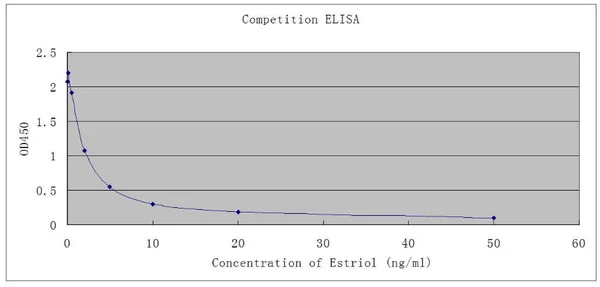
Competitive ELISA - Anti-Estriol antibody [EPPTXR3] (AB150407)
2 ug/ml of goat anti-rabbit IgG was coated into 96-wells. After blocking with 1%BSA serial dilution of Estriol (0 0.1 0.5 2 5 10 20 and 50ng/ml) were added together with HRP conjugated Estriol (1/100) and 0.075 ug/ml of ab150407 into 96-wells. After washing TMB substrate was used to develop the color.
- cELISA
Unknown
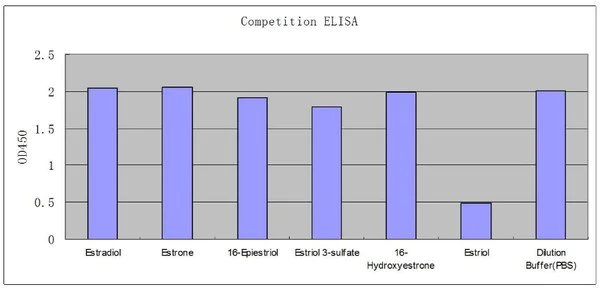
Competitive ELISA - Anti-Estriol antibody [EPPTXR3] (AB150407)
2 ug/ml of goat anti-rabbit IgG was coated into 96-wells. After blocking with 1% BSA 20ng/ml of various buffer containing Estriol Estradiol Estrone 16-Epiestriol Estriol 3-sulfate 16-Hydroxyestrone or PBS buffer only were added together with HRP conjugated Estriol (1/100) and 0.075 ug/ml of ab150407 into 96- wells. After washing TMB substrate was used to develop the color.
Related conjugates and formulations (2)
-
Anti-Estriol antibody [EPPTXR3] - BSA and Azide free
-
Anti-Estriol antibody [EPPTXR3] - Low endotoxin, Azide free
Complementary Products
Primary Antibodies
AB221960
Anti-Estriol antibody [EPPTXR3] - Low endotoxin, Azide free
RabMAb|Recombinant
- 0
- 0
Primary Antibodies
AB271914
Anti-Estriol antibody [EPPTXR3] - BSA and Azide free
RabMAb|Recombinant
- 0
- 0


Reactivity data
Product details
What is this antibody validated in?
Anti-Estriol antibody [EPPTXR3] (ab150407) is a rabbit recombinant monoclonal antibody and is validated for use in ELISA.
Other related products
We have a range of other formats of antibody clone [EPPTXR3] also available for your convenience: ab150407, Carrier free - ab221960, Carrier free - ab271914
Patented technology
Our RabMAb® technology is a patented hybridoma-based technology for making rabbit monoclonal antibodies. For details on our patents, please refer to RabMAb® patents.
What are the advantages of a recombinant monoclonal antibody?
This product is a recombinant monoclonal antibody, which offers several advantages including:
- - High batch-to-batch consistency and reproducibility
- - Improved sensitivity and specificity
- - Long-term security of supply
- - Animal-free batch production
For more information, read more on recombinant antibodies.
Properties and storage information
Form
Purification technique
Storage buffer
Shipped at conditions
Appropriate short-term storage duration
Appropriate short-term storage conditions
Appropriate long-term storage conditions
Aliquoting information
Storage information
Supplementary information
This supplementary information is collated from multiple sources and compiled automatically.
Biological function summary
Estriol plays a pivotal role in the maturation and function of female reproductive organs and maintains the uterus during pregnancy. Its function involves the modulation of the expression of genes associated with reproductive tissues. Estriol does not generally form part of a complex operating instead as a free hormone that exerts effects by binding directly to estrogen receptors located in various tissues. Despite being considered a weaker estrogen compared to estradiol estriol is essential in the biological processes it governs particularly due to its presence and function during pregnancy.
Pathways
Estriol participates in the estrogen signaling pathway which is important for regulating the reproductive system and secondary sexual characteristics. It interacts with estrogen receptors ERα and ERΒ which lead to gene transcription and subsequent biological effects. Furthermore estriol is involved in hormone synthesis pathways intersecting with the biosynthesis of other steroid hormones. Related proteins such as aromatase play a significant role in these pathways by converting androgens into estrogens including estriol thereby influencing its levels and activity.
Product protocols
- Visit the General protocols
- Visit the Troubleshooting
Target data
Alternative Names
Publications (1)
Recent publications for all applications. Explore the full listand refine your search
Acta neuropathologica 147:65 PubMed38557897
2024
Applications
Unspecified application
Species
Unspecified reactive species
Product promise
Please note: All products are 'FOR RESEARCH USE ONLY. NOT FOR USE IN DIAGNOSTIC OR THERAPEUTIC PROCEDURES'.
For licensing inquiries, please contact partnerships@abcam.com