JavaScript is disabled in your browser. Please enable JavaScript to view this website.
AB126345

Anti-EXOC3L4 antibody

Be the first to review this product! Submit a review

|

(2 Publications )

Rabbit Polyclonal EXOC3L4 antibody. Suitable for IHC-P, WB, ICC/IF and reacts with Human samples. Cited in 2 publications. Immunogen corresponding to Recombinant Fragment Protein within Human EXOC3L4 aa 50-200.
3 Images
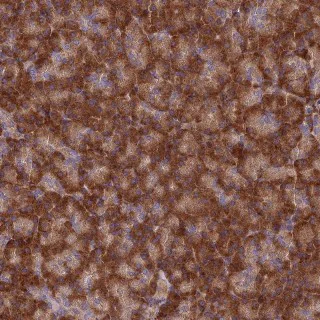
Immunohistochemistry (Formalin/PFA-fixed paraffin-embedded sections) - Anti-EXOC3L4 antibody (AB126345)
  • IHC-P

Unknown

Immunohistochemistry (Formalin/PFA-fixed paraffin-embedded sections) - Anti-EXOC3L4 antibody (AB126345)

ab126345, at a 1/200 dilution, staining EXOC3L4 in paraffin embedded Human pancreas tissue by Immunohistochemistry.
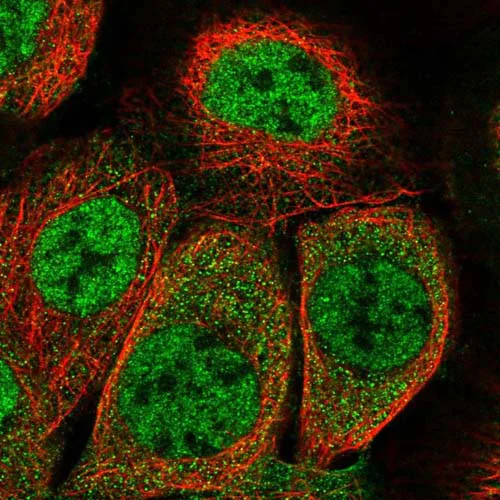
Immunocytochemistry/ Immunofluorescence - Anti-EXOC3L4 antibody (AB126345)
  • ICC/IF

Unknown

Immunocytochemistry/ Immunofluorescence - Anti-EXOC3L4 antibody (AB126345)

Immunofluorescent staining of Human cell line A-431 shows positivity in nucleus but not nucleoli and cytoplasm. Recommended concentration of ab126345 1-4 µg/ml. Cells treated with PFA/Triton X-100.
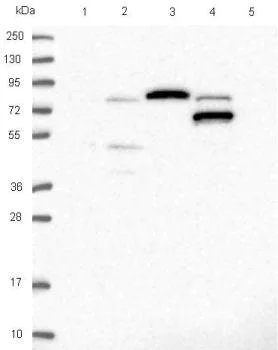
Western blot - Anti-EXOC3L4 antibody (AB126345)
  • WB

Unknown

Western blot - Anti-EXOC3L4 antibody (AB126345)

All lanes:

Western blot - Anti-EXOC3L4 antibody (ab126345) at 1/250 dilution

Lane 1:

RT4 Cell lysate

Lane 2:

U251 MG Cell lysate

Lane 3:

Human plasma

Lane 4:

Human liver lysate

Lane 5:

Human tonsil lysate

Predicted band size: 80 kDa

false

Key facts

Host species

Rabbit

Clonality

Polyclonal

Isotype

IgG

Carrier free

No

Reacts with

Human

Applications

WB, ICC/IF, IHC-P

applications

Immunogen

Recombinant Fragment Protein within Human EXOC3L4 aa 50-200. The exact immunogen used to generate this antibody is proprietary information.

Q17RC7

Reactivity data

{ "title": "Reactivity Data", "filters": { "stats": ["", "Species", "Dilution Info", "Notes"], "tabs": { "all-applications": {"fullname" : "All Applications", "shortname": "All Applications"}, "IHCP" : {"fullname" : "Immunohistochemistry (Formalin/PFA-fixed paraffin-embedded sections)", "shortname":"IHC-P"}, "WB" : {"fullname" : "Western blot", "shortname":"WB"}, "ICCIF" : {"fullname" : "Immunocytochemistry/ Immunofluorescence", "shortname":"ICC/IF"} }, "product-promise": { "all": "all", "testedAndGuaranteed": "tested", "guaranteed": "expected", "predicted": "predicted", "notRecommended": "not-recommended" } }, "values": { "Human": { "IHCP-species-checked": "testedAndGuaranteed", "IHCP-species-dilution-info": "1/200 - 1/500", "IHCP-species-notes": "<p></p> Perform heat-mediated antigen retrieval with citrate buffer pH 6 before commencing with IHC staining protocol.", "WB-species-checked": "testedAndGuaranteed", "WB-species-dilution-info": "0.04-0.4 µg/mL", "WB-species-notes": "<p></p>", "ICCIF-species-checked": "testedAndGuaranteed", "ICCIF-species-dilution-info": "1-4 µg/mL", "ICCIF-species-notes": "<p>Recommend PFA Fixation and Triton X-100 treatment</p>" } } }

Properties and storage information

Form
Liquid
Purification technique
Affinity purification Immunogen
Storage buffer
pH: 7.2 Preservative: 0.02% Sodium azide Constituents: PBS, 40% Glycerol (glycerin, glycerine)
Shipped at conditions
Blue Ice
Appropriate short-term storage conditions
+4°C
Appropriate long-term storage conditions
-20°C
Aliquoting information
Upon delivery aliquot
Storage information
Avoid freeze / thaw cycle

Supplementary information

This supplementary information is collated from multiple sources and compiled automatically.

EXOC3L4 also known as exocyst complex component 3-like 4 is a protein with a mass of approximately 38 kDa. It functions as a component of the exocyst complex a multi-protein assembly involved in the docking and fusion of vesicles with the plasma membrane. This protein plays a role in vesicle trafficking contributing to processes that require directed membrane addition or secretion. EXOC3L4 expression is variable with evidence showing occurrence in several tissue types but further research is needed to map its expression profile fully.
Biological function summary

The protein supports cellular activities involving vesicular transport. EXOC3L4 acts as a part of the exocyst complex an important player in tethering vesicles at specific sites on the plasma membrane in mammalian cells. This function is important for maintaining normal cell surface homeostasis and supporting processes such as cell migration growth and division. The exocyst complex interfaces with the actin cytoskeleton aiding precise vesicle guidance and targeting.

Pathways

This protein is integral to the secretory pathway and cellular trafficking mechanisms. EXOC3L4 interacts closely with components of the exocyst pathway including EXOC1 through EXOC8. Within these pathways it helps ensure that exocytosis and endocytosis occur efficiently. It also interacts with proteins like Rho GTPases linking EXOC3L4 to signaling pathways that assist in dictating cellular architecture and dynamics.

EXOC3L4 is currently linked to certain cellular dysfunctions although specific pathological conditions remain under investigation. Disruption in its function may relate to cancerous growths given its role in vesicle trafficking which affects cell migration. Mutations or altered expression levels could potentially influence cancer progression. Moreover EXOC3L4's interactions with other exocyst proteins like EXOC2 suggest its possible involvement in conditions where exocytosis is impaired pointing towards neurological disorders as another area of interest for future research.

Product protocols

For this product, it's our understanding that no specific protocols are required. You can visit:

Target data

See full target information EXOC3L4

Alternative Names

C14orf73, EXOC3L4, Exocyst complex component 3-like protein 4

Publications (2)

Recent publications for all applications. Explore the full listand refine your search

International journal of biological sciences 20:3956-3971 PubMed39113702

2024

PKCα Induced the Generation of Extracellular Vesicles in Activated Platelets to Promote Breast Cancer Metastasis.

Applications

Unspecified application

Species

Unspecified reactive species

Jinghua Zhao,Huan Tian,Xiaona Zhao,Lan Lan,Huanhuan Liu,Yi Sun,Fengyan Yu

Cancer biology & therapy 22:216-224 PubMed33683171

2021

YY1-inudced activation of lncRNA DUXAP8 promotes proliferation and suppresses apoptosis of triple negative breast cancer cells through upregulating SAPCD2.

Applications

Unspecified application

Species

Unspecified reactive species

Zhen Yang,Hongjian Ding,Zhiyu Pan,Huaqing Li,Junbin Ding,Qian Chen
View all publications

Product promise

We are committed to supporting your work with high-quality reagents, and we're here for you every step of the way. In the unlikely event that one of our products does not perform as expected, you're protected by our Product Promise.
For full details, please see our Terms & Conditions

Please note: All products are 'FOR RESEARCH USE ONLY. NOT FOR USE IN DIAGNOSTIC OR THERAPEUTIC PROCEDURES'.

For licensing inquiries, please contact partnerships@abcam.com