Anti-Extracellular matrix protein 1 antibody [EPR6701]
- RabMAb
- Recombinant
- What is this?
2
(1 Review)
|
(9 Publications )
- IHC-P
Unknown
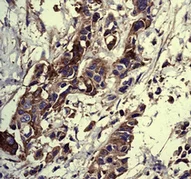
Immunohistochemistry (Formalin/PFA-fixed paraffin-embedded sections) - Anti-Extracellular matrix protein 1 antibody [EPR6701] (AB126629)
ab126629, at 1/100, staining Extracellular matrix protein 1 in formalin fixed, paraffin embedded Human breast carcinoma tissue by Immunohistochemistry.
Heat mediated antigen retrieval was performed with citrate buffer pH 6 before commencing with IHC staining protocol.
- IHC-P
Unknown
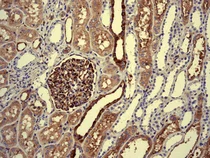
Immunohistochemistry (Formalin/PFA-fixed paraffin-embedded sections) - Anti-Extracellular matrix protein 1 antibody [EPR6701] (AB126629)
ab126629, at 1/100, staining Extracellular matrix protein 1 in formalin fixed, paraffin embedded Human kidney tissue by Immunohistochemistry.
Heat mediated antigen retrieval was performed with citrate buffer pH 6 before commencing with IHC staining protocol.

- Flow Cyt (Intra)
Unknown
Flow Cytometry (Intracellular) - Anti-Extracellular matrix protein 1 antibody [EPR6701] (AB126629)
Intracellular Flow Cytometry analysis of A375 (Human malignant melanoma epithelial cell) cells labeling Extracellular matrix protein 1 with purified ab126629 at 1/20 dilution (10 μg/ml) (red). Cells were fixed with 4% Paraformaldehyde. A Goat anti rabbit IgG (Alexa Fluor® 488, ab150077) secondary antibody was used at 1/2000. Isotype control - Rabbit monoclonal IgG (Black). Unlabeled control - Cell without incubation with primary antibody and secondary antibody (Blue).

- ICC/IF
Unknown
Immunocytochemistry/ Immunofluorescence - Anti-Extracellular matrix protein 1 antibody [EPR6701] (AB126629)
Immunocytochemistry/ Immunofluorescence analysis of A375 (Human malignant melanoma epithelial cell) cells labeling Extracellular matrix protein 1 with purified ab126629 at 1 : 100 dilution (2.0 µg/ml). Cells were fixed in 4% Paraformaldehyde and permeabilized with 0.1% tritonX-100. Cells were counterstained with ab195889 Anti-alpha Tubulin antibody [DM1A] - Microtubule Marker (Alexa Fluor® 594) 1 : 200 (2.5 µg/ml). Goat anti rabbit IgG (Alexa Fluor® 488, ab150077) was used as the secondary antibody at 1 : 1000 (2 µg/ml) dilution. DAPI nuclear counterstain. PBS instead of the primary antibody was used as the secondary antibody only control.
- IHC-P
Unknown
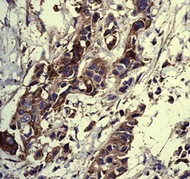
Immunohistochemistry (Formalin/PFA-fixed paraffin-embedded sections) - Anti-Extracellular matrix protein 1 antibody [EPR6701] (AB126629)
ab126629, at 1/100, staining Extracellular matrix protein 1 in formalin fixed, paraffin embedded Human breast carcinoma tissue by Immunohistochemistry. This data was developed using the same antibody clone in a different buffer formulation containing PBS, BSA, glycerol, and sodium azide (ab126629). Perform heat mediated antigen retrieval with citrate buffer pH 6 before commencing with IHC staining protocol.
- IHC-P
Unknown
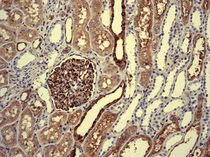
Immunohistochemistry (Formalin/PFA-fixed paraffin-embedded sections) - Anti-Extracellular matrix protein 1 antibody [EPR6701] (AB126629)
ab126629, at 1/100, staining Extracellular matrix protein 1 in formalin fixed, paraffin embedded Human kidney tissue by Immunohistochemistry. Heat mediated antigen retrieval was performed with citrate buffer pH 6 before commencing with IHC staining protocol.

- IHC-P
Unknown
Immunohistochemistry (Formalin/PFA-fixed paraffin-embedded sections) - Anti-Extracellular matrix protein 1 antibody [EPR6701] (AB126629)
Immunohistochemistry (Formalin/PFA-fixed paraffin-embedded sections) analysis of Human kidney tissue sections labeling Extracellular matrix protein 1 with purified ab126629 at 1 : 100 dilution (2.01 μg/ml). Heat mediated antigen retrieval was performed using ab93684 (Tris/EDTA buffer, pH 9.0). ImmunoHistoProbe one step HRP Polymer (ready to use)was used as the secondary antibody. Negative control : PBS instead of the primary antibody. Hematoxylin was used as a counterstain.
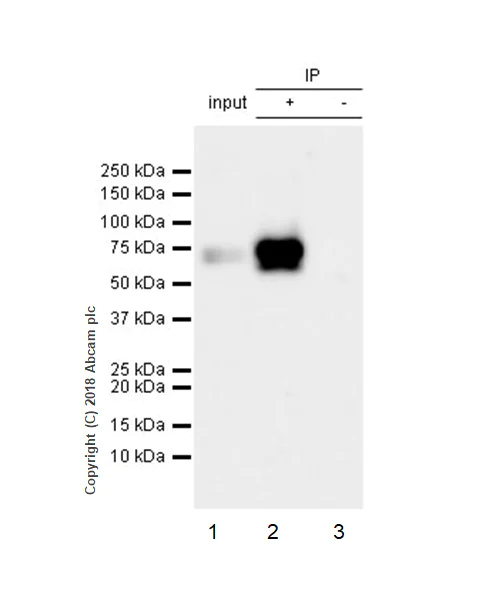
- IP
Unknown
Immunoprecipitation - Anti-Extracellular matrix protein 1 antibody [EPR6701] (AB126629)
ab126629 (purified) at 1 : 20 dilution (2μg) immunoprecipitating Extracellular matrix protein 1 in A375 whole cell lysate.
Lane 1 (input) : A375 (Human malignant melanoma epithelial cell) whole cell lysate 10μg
Lane 2 (+) : ab126629 & A375 whole cell lysate
Lane 3 (-) : Rabbit monoclonal IgG (ab172730) instead of ab126629 in A375 whole cell lysate
For western blotting, VeriBlot for IP Detection Reagent (HRP) (ab131366) was used for detection at 1 : 1000 dilution.
Blocking and diluting buffer : 5% NFDM/TBST.
All lanes:
Immunoprecipitation - Anti-Extracellular matrix protein 1 antibody [EPR6701] (ab126629)
Predicted band size: 61 kDa,78 kDa
Observed band size: 60 kDa
false
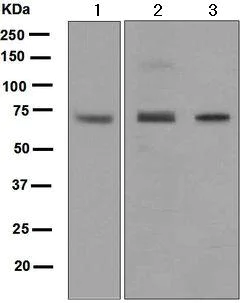
- WB
Unknown
Western blot - Anti-Extracellular matrix protein 1 antibody [EPR6701] (AB126629)
All lanes:
Western blot - Anti-Extracellular matrix protein 1 antibody [EPR6701] (ab126629) at 1/1000 dilution
Lane 1:
MDA MB 435 cell line lysate at 10 µg
Lane 2:
Human skin cell lysate at 10 µg
Lane 3:
A375 cell line lysate at 10 µg
Secondary
All lanes:
Goat anti-rabbit HRP conjugated antibodty at 1/2000 dilution
Predicted band size: 61 kDa
false

- WB
Lab
Western blot - Anti-Extracellular matrix protein 1 antibody [EPR6701] (AB126629)
All lanes:
Western blot - Anti-Extracellular matrix protein 1 antibody [EPR6701] (ab126629) at 1/2000 dilution
Lane 1:
A375 (Human malignant melanoma epithelial cell) at 15 µg
Lane 2:
Rat heart lysates at 15 µg
Lane 3:
Rat kidney lysates at 15 µg
Secondary
All lanes:
Western blot - Goat Anti-Rabbit IgG H&L (HRP) (<a href='/en-us/products/secondary-antibodies/goat-rabbit-igg-h-l-hrp-ab97051'>ab97051</a>) at 1/20000 dilution
Predicted band size: 61 kDa
Observed band size: 61 kDa
false
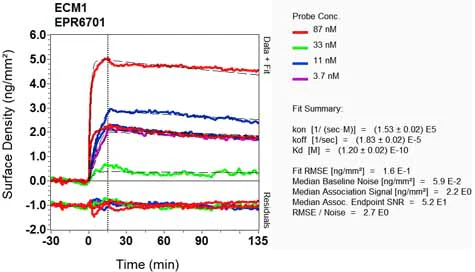
- OI-RD Scanning
Unknown
OI-RD Scanning - Anti-Extracellular matrix protein 1 antibody [EPR6701] (AB126629)
We have systematically measured KD (the equilibrium dissociation constant between the antibody and its antigen), of more than 840 recombinant antibodies to assess not only their individual KD values but also to see the average affinity of antibody. Based on the comparison with published literature values for mouse monoclonal antibodies, Recombinant antibodies appear to be on average 1-2 order of magnitude higher affinity.
Related conjugates and formulations (10)
-
Anti-Extracellular matrix protein 1 antibody [EPR6701] - BSA and Azide free
-
660 APC
APC Anti-Extracellular matrix protein 1 antibody [EPR6701]
-
519 Alexa Fluor® 488
Alexa Fluor® 488 Anti-Extracellular matrix protein 1 antibody [EPR6701]
-
565 Alexa Fluor® 555
Alexa Fluor® 555 Anti-Extracellular matrix protein 1 antibody [EPR6701]
-
603 Alexa Fluor® 568
Alexa Fluor® 568 Anti-Extracellular matrix protein 1 antibody [EPR6701]
-
617 Alexa Fluor® 594
Alexa Fluor® 594 Anti-Extracellular matrix protein 1 antibody [EPR6701]
-
665 Alexa Fluor® 647
Alexa Fluor® 647 Anti-Extracellular matrix protein 1 antibody [EPR6701]
-
775 Alexa Fluor® 750
Alexa Fluor® 750 Anti-Extracellular matrix protein 1 antibody [EPR6701]
-
HRP Anti-Extracellular matrix protein 1 antibody [EPR6701]
-
578 PE
PE Anti-Extracellular matrix protein 1 antibody [EPR6701]
Alternative Products
Primary Antibodies
AB253185
Anti-Extracellular matrix protein 1 antibody [EPR22411-279]
BOND RX™ Validated|RabMAb|Recombinant|KO Validated|Trial Size

- 0
- 1
Primary Antibodies
AB267392
Anti-Extracellular matrix protein 1 antibody [EPR22411-279] - BSA and Azide free
RabMAb|Recombinant|KO Validated

- 0
- 0
Complementary Products
Primary Antibodies
AB16667
BOND RX™ Validated|KO Validated|RabMAb|Advanced Validation|Recombinant|20ul selling size

- 5
- 133
Primary Antibodies
AB183734
RabMAb|Recombinant|Lab Essentials|20ul selling size

- 5
- 24
Primary Antibodies
AB207327
Anti-Albumin antibody [EPR20195]
20ul selling size|RabMAb|Recombinant|Lab Essentials

- 5
- 2
Primary Antibodies
AB181548
Anti-Integrin alpha 2 antibody [EPR17338] - C-terminal
RabMAb|Recombinant|KO Validated|20ul selling size

- 5
- 4
Reactivity data
Product details
Species reactivity
Mouse: We have preliminary internal testing data to indicate this antibody may not react with this species.
Please contact us for more information.
Patented technology
Our RabMAb® technology is a patented hybridoma-based technology for making rabbit monoclonal antibodies. For details on our patents, please refer to RabMAb® patents.
What are the advantages of a recombinant monoclonal antibody?
This product is a recombinant monoclonal antibody, which offers several advantages including:
- - High batch-to-batch consistency and reproducibility
- - Improved sensitivity and specificity
- - Long-term security of supply
- - Animal-free batch production
For more information, read more on recombinant antibodies.
Properties and storage information
Form
Purification technique
Storage buffer
Shipped at conditions
Appropriate short-term storage conditions
Appropriate long-term storage conditions
Storage information
Supplementary information
This supplementary information is collated from multiple sources and compiled automatically.
Biological function summary
ECM1 contributes to cell-matrix interactions and regulates various cell behaviors such as adhesion proliferation and differentiation. It does this by binding to other ECM proteins and is known not to be part of a specific complex. ECM1 facilitates communication between the cellular environment and matrix thereby supporting the architecture and dynamics of tissues. It modulates angiogenesis linking it with processes like wound healing and vascular development.
Pathways
ECM1 functions within the context of key signaling routes such as the PI3K/AKT pathway known for roles in cell growth and survival. ECM1 interacts with other proteins including matrix metalloproteinases contributing to matrix remodeling activities important for cellular migration and invasion. Cumulatively these interactions highlight ECM1’s place in connective tissue organization and regenerative processes.
Product protocols
- Visit the General protocols
- Visit the Troubleshooting
Target data
Alternative Names
Publications (9)
Recent publications for all applications. Explore the full listand refine your search
Nutrients 14: PubMed36145166
2022
Applications
Unspecified application
Species
Unspecified reactive species
Bioactive materials 16:204-217 PubMed35386327
2022
Applications
Unspecified application
Species
Unspecified reactive species
Frontiers in medicine 8:796743 PubMed35141243
2022
Applications
Unspecified application
Species
Unspecified reactive species
Frontiers in pharmacology 12:775680 PubMed34970146
2021
Applications
Unspecified application
Species
Unspecified reactive species
Bioscience reports 40: PubMed32401301
2020
Applications
Unspecified application
Species
Unspecified reactive species
Andrology 8:407-420 PubMed31364287
2019
Applications
Unspecified application
Species
Unspecified reactive species
Molecular cancer 18:22 PubMed30736860
2019
Applications
Unspecified application
Species
Unspecified reactive species
Biology of reproduction 98:752-764 PubMed29546322
2018
Applications
Unspecified application
Species
Unspecified reactive species
PloS one 11:e0158296 PubMed27355404
2016
Applications
WB
Species
Unspecified reactive species
Product promise
Please note: All products are 'FOR RESEARCH USE ONLY. NOT FOR USE IN DIAGNOSTIC OR THERAPEUTIC PROCEDURES'.
For licensing inquiries, please contact partnerships@abcam.com