Anti-FABP4 antibody
4
(2 Reviews)
|
(48 Publications )
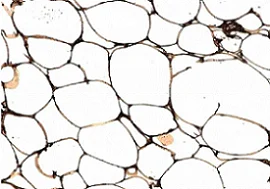
- IHC-P
Supplier Data
Immunohistochemistry (Formalin/PFA-fixed paraffin-embedded sections) - Anti-FABP4 antibody (AB13979)
Immunohistochemical analysis of FFPE human adipose tissue, labeling FABP4 with ab13979 (2μg/ml). DAB staining.
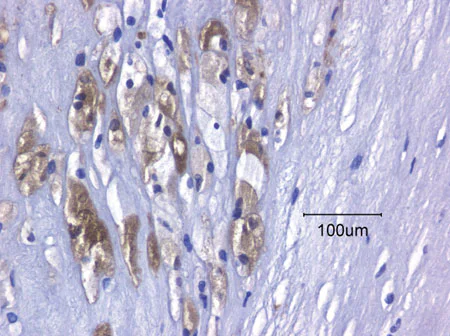
- IHC-P
PubMed
Immunohistochemistry (Formalin/PFA-fixed paraffin-embedded sections) - Anti-FABP4 antibody (AB13979)
Immunohistochemical analysis of Human carotid atherosclerotic plaques, staining FABP4 with ab13979.
Antigen retrieval was performed by heat mediation in a citrate buffer (pH 6) and blocked with 0.5% BSA. Sections were incubated with primary antibody for 1 hour at room temperature. Staining was detected using DAB.
Image from Holm S et al., PLoS One. 2011;6(12):e28785. Epub 2011 Dec 9. Fig 3.; doi:10.1371/journal.pone.0028785; December 9, 2011, PLoS ONE 6(12): e28785.
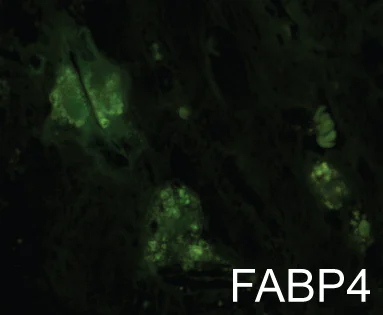
- IHC-P
PubMed
Immunohistochemistry (Formalin/PFA-fixed paraffin-embedded sections) - Anti-FABP4 antibody (AB13979)
Immunohistochemical analysis of Human carotid atherosclerotic plaques, staining FABP4 with ab13979.
Antigen retrieval was performed by heat mediation in a citrate buffer (pH 6) and blocked with 0.5% BSA. Sections were incubated with primary antibody for 1 hour at room temperature. An AlexaFluor®488-conjugated goat anti-rabbit IgG was used as the secondary antibody.
Image from Holm S et al., PLoS One. 2011;6(12):e28785. Epub 2011 Dec 9. Fig 3.; doi:10.1371/journal.pone.0028785; December 9, 2011, PLoS ONE 6(12): e28785.
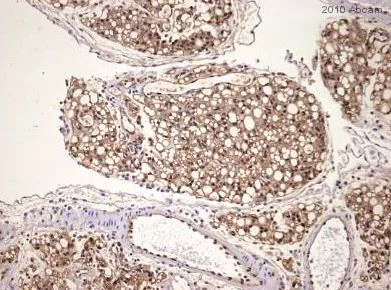
- IHC-P
AbReview20068****
Immunohistochemistry (Formalin/PFA-fixed paraffin-embedded sections) - Anti-FABP4 antibody (AB13979)
Immunohistochemical analysis of FFPE mouse pancreatic and peri-pancreatic fatty tissue, labeling FABP4 with ab13979. Tissue was fixed in 10% neutral buffered formalin, heat mediated antigen retrieval was performed using citrate buffer, and blocking was performed with 10% goat serum and 1% BSA inj TBST for 1 hour at 25°C.
Staining with ab13979 (diluted 1/500) was performed for 12 hours at 4°C. A goat anti-rabbit HRP-conjugated secondary was used, diluted 1/200.
This image is courtesy of an anonymous Abreview.
Alternative Products
Primary Antibodies
AB92501
BOND RX™ Validated|20ul selling size|RabMAb|Advanced Validation|Recombinant

- 4
- 3
Primary Antibodies
AB216528
HRP Anti-FABP4 antibody [EPR3579]
BOND RX™ Validated|RabMAb|Recombinant

- 0
- 0

Primary Antibodies
AB219595
Anti-FABP4 antibody [EPR3579] - BSA and Azide free
BOND RX™ Validated|RabMAb|Advanced Validation|Recombinant

- 0
- 0


Complementary Products
Primary Antibodies
AB183734
RabMAb|Recombinant|Lab Essentials|20ul selling size

- 5
- 24

Primary Antibodies
AB281583
BOND RX™ Validated|RabMAb|Recombinant|Lab Essentials|20ul selling size

- 5
- 5
Reactivity data
Properties and storage information
Form
Purification technique
Storage buffer
Shipped at conditions
Appropriate short-term storage duration
Appropriate short-term storage conditions
Appropriate long-term storage conditions
Aliquoting information
Storage information
Supplementary information
This supplementary information is collated from multiple sources and compiled automatically.
Biological function summary
This protein participates in the regulation of lipid homeostasis and energy metabolism. FABP4 is part of the lipid-binding protein family that helps maintain fatty acid equilibrium within cells. By controlling the transport and signaling of lipids FABP4 impacts lipid storage insulin sensitivity and inflammation processes. Its activity is not confined to a specific multimeric complex yet it interacts with other proteins to exert its functions contributing to significant metabolic pathways in the body.
Pathways
FABP4 plays essential roles in the regulation of metabolic and inflammatory signaling pathways. It is intricately involved in the peroxisome proliferator-activated receptor gamma (PPARγ) pathway where it modulates adipose tissue development and glucose metabolism. In addition FABP4 has connections with the c-Jun N-terminal kinase (JNK) signaling pathway influencing stress and inflammatory responses. Interactions with these pathways place FABP4 at a link with proteins like PPARγ and JNK essential for cellular metabolic balance and responses to metabolic stress.
Product protocols
- Visit the General protocols
- Visit the Troubleshooting
Target data
Alternative Names
Publications (48)
Recent publications for all applications. Explore the full listand refine your search
Lipids in health and disease 24:239 PubMed40660209
2025
Applications
Unspecified application
Species
Unspecified reactive species
Nature cardiovascular research 4:921-937 PubMed40579458
2025
Applications
Unspecified application
Species
Unspecified reactive species
International journal of molecular sciences 26: PubMed40429934
2025
Applications
Unspecified application
Species
Unspecified reactive species
Nature cell biology 26:2020-2034 PubMed39528700
2024
Applications
Unspecified application
Species
Unspecified reactive species
Scientific reports 14:15390 PubMed38965292
2024
Applications
Unspecified application
Species
Unspecified reactive species
BMC cancer 24:65 PubMed38216952
2024
Applications
Unspecified application
Species
Unspecified reactive species
Experimental & molecular medicine 55:1520-1530 PubMed37394587
2023
Applications
Unspecified application
Species
Unspecified reactive species
Frontiers in cellular and infection microbiology 13:1161669 PubMed37153157
2023
Applications
Unspecified application
Species
Unspecified reactive species
Frontiers in endocrinology 13:882379 PubMed35757418
2022
Applications
Unspecified application
Species
Unspecified reactive species
Theranostics 12:1904-1920 PubMed35198079
2022
Applications
Unspecified application
Species
Unspecified reactive species
Product promise
Please note: All products are 'FOR RESEARCH USE ONLY. NOT FOR USE IN DIAGNOSTIC OR THERAPEUTIC PROCEDURES'.
For licensing inquiries, please contact partnerships@abcam.com