Anti-FABP5 antibody [EPR22552-64]
- RabMAb
- Recombinant
- KO Validated
- 20ul selling size
- What is this?
Be the first to review this product! Submit a review
|
(11 Publications )
- IHC-P
Supplier Data
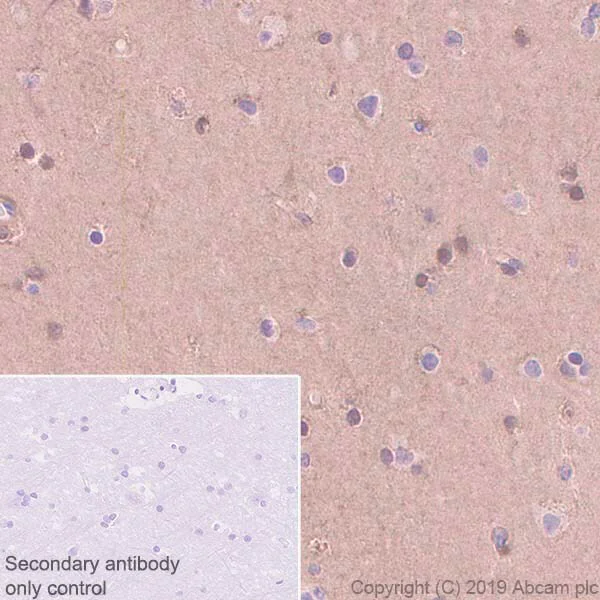
Immunohistochemistry (Formalin/PFA-fixed paraffin-embedded sections) - Anti-FABP5 antibody [EPR22552-64] (AB255276)
Immunohistochemical analysis of paraffin-embedded human cerebral cortex tissue labeling FABP5 with ab255276 at 1/4000 dilution, followed by Goat Anti-Rabbit IgG H&L (HRP) ready to use. Positive staining on human cerebral cortex (PMID : 24114376) is observed. Counter stained with hematoxylin.
Secondary antibody only control : Used PBS instead of primary antibody, secondary antibody is Goat Anti-Rabbit IgG H&L (HRP) ready to use.Heat mediated antigen retrieval using ab93684 (Tris/EDTA buffer, pH 9.0).
- IHC-P
Supplier Data
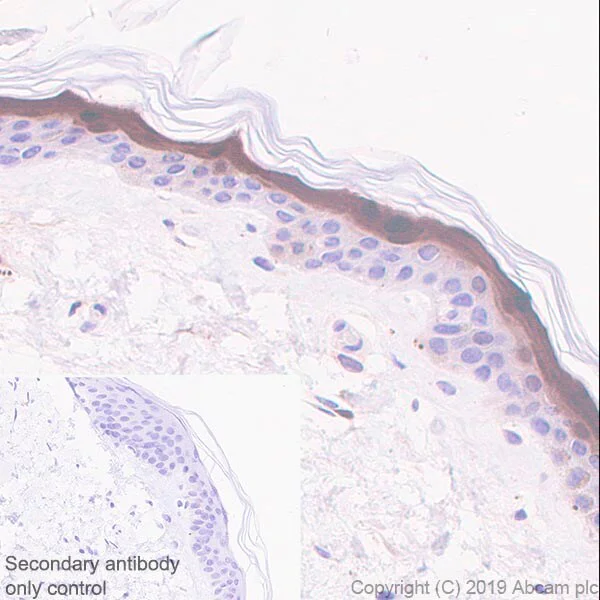
Immunohistochemistry (Formalin/PFA-fixed paraffin-embedded sections) - Anti-FABP5 antibody [EPR22552-64] (AB255276)
Immunohistochemical analysis of paraffin-embedded human skin tissue labeling FABP5 with ab255276 at 1/4000 dilution, followed by Goat Anti-Rabbit IgG H&L (HRP) ready to use. Positive staining on human skin (PMID : 8092987) is observed. Counter stained with hematoxylin. Secondary antibody only control : Used PBS instead of primary antibody, secondary antibody is Goat Anti-Rabbit IgG H&L (HRP) ready to use. Heat mediated antigen retrieval using ab93684 (Tris/EDTA buffer, pH 9.0).
- IHC-P
Supplier Data
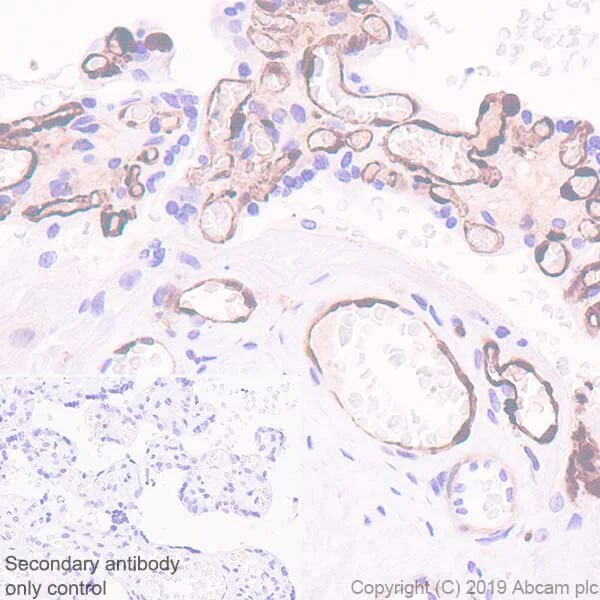
Immunohistochemistry (Formalin/PFA-fixed paraffin-embedded sections) - Anti-FABP5 antibody [EPR22552-64] (AB255276)
Immunohistochemical analysis of paraffin-embedded human placenta tissue labeling FABP5 with ab255276 at 1/4000 dilution, followed by Goat Anti-Rabbit IgG H&L (HRP) ready to use. Positive staining on blood vessels of human placenta (PMID : 19625659) is observed. Counter stained with hematoxylin.
Secondary antibody only control : Used PBS instead of primary antibody, secondary antibody is Goat Anti-Rabbit IgG H&L (HRP) ready to use.Heat mediated antigen retrieval using ab93684 (Tris/EDTA buffer, pH 9.0).
- ICC/IF
Supplier Data
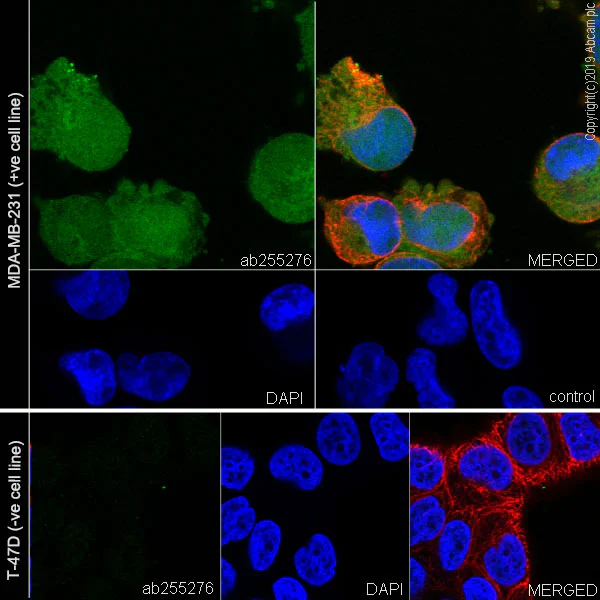
Immunocytochemistry/ Immunofluorescence - Anti-FABP5 antibody [EPR22552-64] (AB255276)
Immunofluorescent analysis of 4% paraformaldehyde-fixed, 0.1% Triton X-100 permeabilized MDA-MB-231 (human breast adenocarcinoma epithelial cell) labeling FABP5 with ab255276 at 1/50 dilution, followed by Goat Anti-Rabbit IgG H&L (Alexa Fluor® 488) (ab150077) secondary antibody at 1/1000 dilution (green).
Anti-alpha Tubulin antibody [DM1A] - Microtubule Marker (Alexa Fluor® 594) (ab195889) at 1/200 was used as a counterstain (red).
The nuclear counterstain is DAPI (blue).
Confocal image showing cytoplasmic and nuclear staining in MDA-MB-231 cells.
Negative Control : T-47D (PMID : 21356353).
- WB
Supplier Data
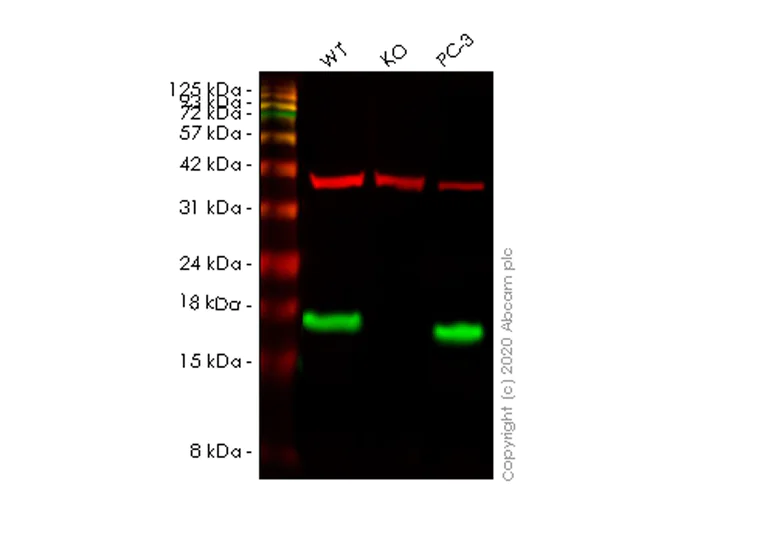
Western blot - Anti-FABP5 antibody [EPR22552-64] (AB255276)
Lanes 1-3 : Merged signal (red and green). Green - ab255276 observed at 17 kDa. Red - loading control ab8245 observed at 36 kDa.
ab255276 Anti-FABP5 antibody [EPR22552-64] was shown to specifically react with FABP5 in wild-type HeLa cells. Loss of signal was observed when knockout cell line ab265905 (knockout cell lysate ab257431) was used. Wild-type and FABP5 knockout samples were subjected to SDS-PAGE. ab255276 and Anti-GAPDH antibody [6C5] - Loading Control (ab8245) were incubated at room temperature for 2.5 hours at 1 in 1000 dilution and 1 in 20000 dilution respectively. Blots were developed with Goat anti-Rabbit IgG H&L (IRDye® 800CW) preadsorbed (ab216773) and Goat anti-Mouse IgG H&L (IRDye® 680RD) preadsorbed (ab216776) secondary antibodies at 1 in 20000 dilution for 1 hour at room temperature before imaging.
All lanes:
Western blot - Anti-FABP5 antibody [EPR22552-64] (ab255276) at 1/1000 dilution
Lane 1:
Wild-type HeLa cell lysate at 20 µg
Lane 2:
FABP5 knockout HeLa cell lysate at 20 µg
Lane 2:
Western blot - Human FABP5 knockout HeLa cell lysate (<a href='/en-us/products/cell-lysates/human-fabp5-knockout-hela-cell-lysate-ab257431'>ab257431</a>)
Lane 2:
Western blot - Human FABP5 knockout HeLa cell line (<a href='/en-us/products/cell-lines/human-fabp5-knockout-hela-cell-line-ab265905'>ab265905</a>)
Lane 3:
PC-3 cell lysate at 20 µg
Secondary
All lanes:
Western blot - Goat anti-Rabbit IgG H&L (IRDye® 800CW) preadsorbed (<a href='/en-us/products/secondary-antibodies/goat-rabbit-igg-h-l-irdye-800cw-preadsorbed-ab216773'>ab216773</a>) at 1/10000 dilution
Observed band size: 17 kDa
false
- WB
Supplier Data
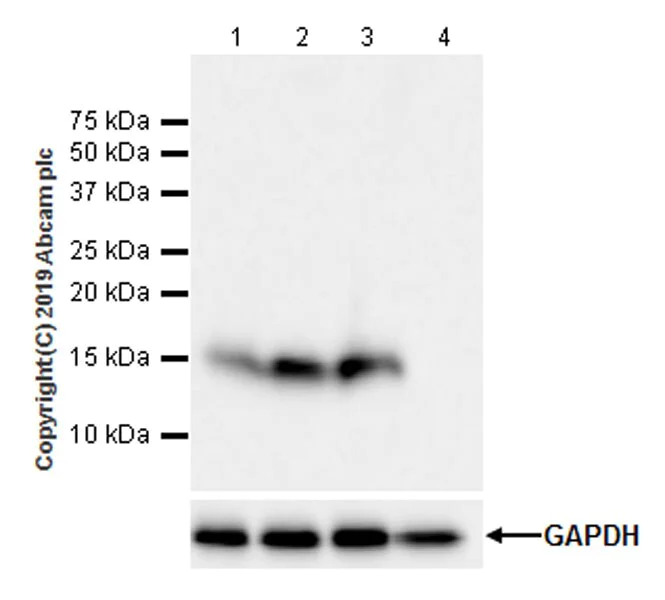
Western blot - Anti-FABP5 antibody [EPR22552-64] (AB255276)
Blocking and dilution buffer : 5% NFDM/TBST.
The molecular weight observed is consistent with what has been described in the literature (PMID : 25260874).Negative control : T47D (PMID : 21356353).
All lanes:
Western blot - Anti-FABP5 antibody [EPR22552-64] (ab255276) at 1/1000 dilution
Lane 1:
MDA-MB-231 (human breast adenocarcinoma cell line) whole cell lysate at 20 µg
Lane 2:
HeLa (human epithelial cell line from cervix adenocarcinoma) whole cell lysate at 20 µg
Lane 3:
PC-3 (human prostate adenocarcinoma epithelial cell line) whole cell lysate at 20 µg
Lane 4:
T-47D (human ductal breast epithelial tumor cell line) whole cell lysate at 20 µg
Secondary
All lanes:
Western blot - Goat Anti-Rabbit IgG H&L (HRP) (<a href='/en-us/products/secondary-antibodies/goat-rabbit-igg-h-l-hrp-ab97051'>ab97051</a>) at 1/100000 dilution
Observed band size: 15 kDa
false
Exposure time: 8s
Related conjugates and formulations (1)
-
Anti-FABP5 antibody [EPR22552-64] - BSA and Azide free
Alternative Products

Complementary Products
Primary Antibodies
AB308526
Anti-ALDH1A3 antibody [EPR27504-83]
20ul selling size|RabMAb|Recombinant
- 0
- 0
Primary Antibodies
AB211927
Anti-CRABP2 antibody [EPR17376]
RabMAb|Recombinant|20ul selling size
- 4
- 1
Primary Antibodies
AB16667
BOND RX™ Validated|KO Validated|RabMAb|Advanced Validation|Recombinant|20ul selling size

- 5
- 133
Reactivity data
Product details
Patented technology
Our RabMAb® technology is a patented hybridoma-based technology for making rabbit monoclonal antibodies. For details on our patents, please refer to RabMAb® patents.
What are the advantages of a recombinant monoclonal antibody?
This product is a recombinant monoclonal antibody, which offers several advantages including:
- - High batch-to-batch consistency and reproducibility
- - Improved sensitivity and specificity
- - Long-term security of supply
- - Animal-free batch production
For more information, read more on recombinant antibodies.
Properties and storage information
Form
Purification technique
Storage buffer
Shipped at conditions
Appropriate short-term storage duration
Appropriate short-term storage conditions
Appropriate long-term storage conditions
Aliquoting information
Storage information
Supplementary information
This supplementary information is collated from multiple sources and compiled automatically.
Biological function summary
FABP5 interacts with specific ligands such as long-chain fatty acids which influences cellular processes like growth differentiation and energy homeostasis. It is not known to be part of a larger complex. This protein is integral in regulating lipid signaling pathways and responses due to its binding capacity which modulates the availability of fatty acids for metabolic processes. Its expression pattern hints at a possible role in the body's adaptation to dietary lipid intake.
Pathways
FABP5 holds a significant position in the peroxisome proliferator-activated receptor (PPAR) signaling pathway and the fatty acid metabolism pathway. In the PPAR signaling pathway FABP5 influences the activity of PPARβ/δ receptors which regulate gene expression involved in lipid metabolism and energy homeostasis. It is related to other fatty acid binding proteins such as FABP4 which similarly participate in lipid metabolic processes and have roles in the regulation of lipid and glucose metabolism.
Product protocols
- Visit the General protocols
- Visit the Troubleshooting
Target data
Alternative Names
Publications (11)
Recent publications for all applications. Explore the full listand refine your search
MedComm 6:e70311 PubMed40761479
2025
Applications
Unspecified application
Species
Unspecified reactive species
Communications biology 8:514 PubMed40155473
2025
Applications
Unspecified application
Species
Unspecified reactive species
Cell regeneration (London, England) 13:24 PubMed39542983
2024
Applications
Unspecified application
Species
Unspecified reactive species
Journal of clinical pathology 77:330-337 PubMed36854623
2024
Applications
Unspecified application
Species
Unspecified reactive species
Skin research and technology : official journal of International Society for Bioengineering and the Skin (ISBS) [and] International Society for Digital Imaging of Skin (ISDIS) [and] International Society for Skin Imaging (ISSI) 29:e13497 PubMed37881057
2023
Applications
Unspecified application
Species
Unspecified reactive species
Stem cells international 2023:2826815 PubMed37964983
2023
Applications
Unspecified application
Species
Unspecified reactive species
BMC biology 20:276 PubMed36482461
2022
Applications
Unspecified application
Species
Unspecified reactive species
Cell proliferation 56:e13355 PubMed36331058
2022
Applications
Unspecified application
Species
Unspecified reactive species
Medical oncology (Northwood, London, England) 39:202 PubMed36175596
2022
Applications
Unspecified application
Species
Unspecified reactive species
Open medicine (Warsaw, Poland) 16:1444-1458 PubMed34632074
2021
Applications
Unspecified application
Species
Unspecified reactive species
Product promise
Please note: All products are 'FOR RESEARCH USE ONLY. NOT FOR USE IN DIAGNOSTIC OR THERAPEUTIC PROCEDURES'.
For licensing inquiries, please contact partnerships@abcam.com