JavaScript is disabled in your browser. Please enable JavaScript to view this website.
AB115825

Anti-FGF10 antibody

Be the first to review this product! Submit a review

|

(1 Publication)

Rabbit Polyclonal FGF10 antibody. Suitable for WB and reacts with Human samples. Cited in 1 publication. Immunogen corresponding to Synthetic Peptide within Human FGF10.
1 Images
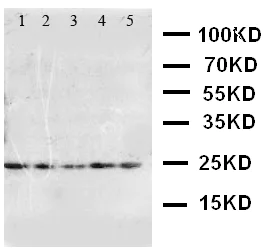
Western blot - Anti-FGF10 antibody (AB115825)
  • WB

Unknown

Western blot - Anti-FGF10 antibody (AB115825)

All lanes:

Western blot - Anti-FGF10 antibody (ab115825) at 1 µg/mL

Lane 1:

U87 whole cell lysate

Lane 2:

HeLa whole cell lysate

Lane 3:

A549 whole cell lysate

Lane 4:

293T whole cell lysate

Lane 5:

MCF7 whole cell lysate

Predicted band size: 23 kDa

false

Key facts

Host species

Rabbit

Clonality

Polyclonal

Isotype

IgG

Carrier free

No

Reacts with

Human

Applications

WB

applications

Immunogen

Synthetic Peptide within Human FGF10. The exact immunogen used to generate this antibody is proprietary information.

O15520

Reactivity data

{ "title": "Reactivity Data", "filters": { "stats": ["", "Species", "Dilution Info", "Notes"], "tabs": { "all-applications": {"fullname" : "All Applications", "shortname": "All Applications"}, "WB" : {"fullname" : "Western blot", "shortname":"WB"} }, "product-promise": { "all": "all", "testedAndGuaranteed": "tested", "guaranteed": "expected", "predicted": "predicted", "notRecommended": "not-recommended" } }, "values": { "Human": { "WB-species-checked": "testedAndGuaranteed", "WB-species-dilution-info": "1 µg/mL", "WB-species-notes": "<p></p>" }, "Mouse": { "WB-species-checked": "predicted", "WB-species-dilution-info": "", "WB-species-notes": "" } } }

Properties and storage information

Form
Liquid
Purification technique
Affinity purification Protein A
Storage buffer
Preservative: 0.025% Sodium azide, 0.025% Thimerosal (merthiolate) Constituents: 2.5% BSA, 0.45% Sodium chloride, 0.1% Disodium hydrogenorthophosphate
Shipped at conditions
Blue Ice
Appropriate short-term storage conditions
+4°C
Appropriate long-term storage conditions
-20°C
Aliquoting information
Upon delivery aliquot
Storage information
Avoid freeze / thaw cycle

Supplementary information

This supplementary information is collated from multiple sources and compiled automatically.

FGF10 also known as fibroblast growth factor 10 (FGF-10) is a member of the FGF family. It plays an important role in various developmental processes. It is a protein with a molecular mass of approximately 23 kDa. FGF10 is expressed in several tissues including the lungs limbs and salivary glands. Peprotech and recombinant versions of the FGF-10 protein are often utilized in research. In addition to its standard expression FGF10 is sometimes referenced in the context of biotin sublingual preparations which are used to study signaling processes more effectively.
Biological function summary

The FGF10 protein participates in important signaling necessary for embryonic development and tissue repair. It functions as a signaling molecule mediating interaction between epithelial and mesenchymal cells. FGF10 acts as a ligand for fibroblast growth factor receptor 2 (FGFR2) and is essential for limb bud formation and lung epithelium branching morphogenesis. This protein often works without forming part of a larger complex instead interacting with receptors directly to accomplish its functions.

Pathways

Fibroblast growth factor 10 is an integral part of the FGFR signaling pathway which is vital for cell proliferation differentiation and survival. Its interaction with FGFR2 activates downstream signaling cascades including the MAPK/ERK pathway. This involves related proteins such as FGFR1 and Ras important for transmitting extracellular signals to the nuclear environment affecting gene expression patterns essential for development and cell maintenance.

FGF10 has significant implications in pathologies such as lacrimo-auriculo-dento-digital (LADD) syndrome and congenital lung diseases. Mutations or dysregulation in FGF10 expression can lead to developmental abnormalities in the organs it helps form. LADD syndrome showcases its interplay with FGFR2 where mutations in FGF10 or its receptor are implicated in congenital features. Additionally abnormalities in its signaling can contribute to improper lung development where FGF10 again interacts prominently with proteins related to the FGFR family emphasizing its role in proper organogenesis.

Product protocols

For this product, it's our understanding that no specific protocols are required. You can visit:

Target data

Plays an important role in the regulation of embryonic development, cell proliferation and cell differentiation. Required for normal branching morphogenesis. May play a role in wound healing.
See full target information FGF10

Alternative Names

Fibroblast growth factor 10, FGF-10, Keratinocyte growth factor 2, FGF10

Publications (1)

Recent publications for all applications. Explore the full listand refine your search

Scientific reports 6:19869 PubMed26813160

2016

Neuron-derived FGF10 ameliorates cerebral ischemia injury via inhibiting NF-κB-dependent neuroinflammation and activating PI3K/Akt survival signaling pathway in mice.

Applications

Unspecified application

Species

Mouse

Yong-Hua Li,Hai-Long Fu,Mou-Li Tian,Yong-Qiang Wang,Wei Chen,Lin-Lin Cai,Xu-Hui Zhou,Hong-Bin Yuan
View all publications

Product promise

We are committed to supporting your work with high-quality reagents, and we're here for you every step of the way. In the unlikely event that one of our products does not perform as expected, you're protected by our Product Promise.
For full details, please see our Terms & Conditions

Please note: All products are 'FOR RESEARCH USE ONLY. NOT FOR USE IN DIAGNOSTIC OR THERAPEUTIC PROCEDURES'.

For licensing inquiries, please contact partnerships@abcam.com