FITC Anti-4-1BB/CD137 antibody [4B4 (4B4-1)]
Be the first to review this product! Submit a review
|
(2 Publications )
Design your panel with our interactive flow cytometry panel builder. Click here.
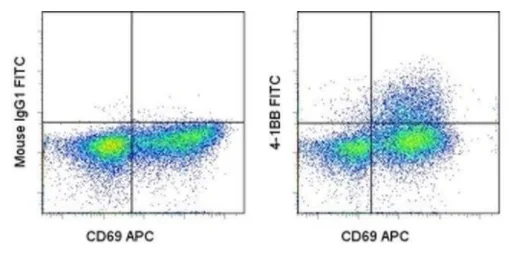
- Flow Cyt
Supplier Data
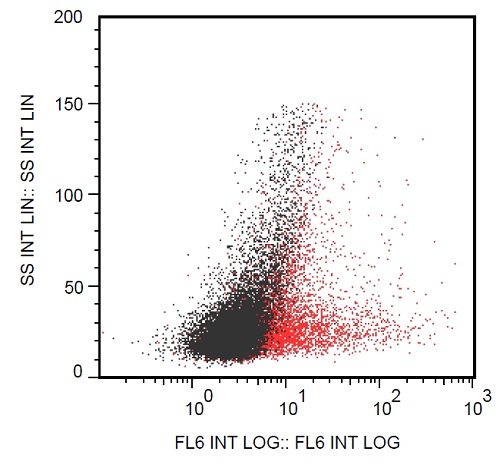
Flow Cytometry - FITC Anti-4-1BB/CD137 antibody [4B4 (4B4-1)] (AB93520)
Staining of ConA-stimulated human peripheral blood cells with Anti-Human CD69 APC and Mouse IgG1 kappa Isotype Control FITC (left) or ab93520 (right). Total viable cells were used for analysis.
Alternative Products
Primary Antibodies
AB222213
Recombinant Human PD-1/CD279 (mutated I126A) protein (Biotin) (Fc tag C-term + Avi tag C-term)
- 0
- 0
Primary Antibodies
AB232990
Recombinant Human PD-1/CD279 (mutated K78A) protein (Biotin) (Avi tag C-term + Fc tag C-term)
- 0
- 0
Primary Antibodies
AB209256
Anti-4-1BB/CD137 antibody [EPR20238]
20ul selling size|RabMAb|Recombinant|Trial Size
- 0
- 0
Primary Antibodies
AB240382
Recombinant Human PD-1/CD279 (mutated P130A) protein (Biotin) (Avi tag C-term + Fc tag C-term)
RabMAb|Recombinant
- 0
- 0
Primary Antibodies
AB234169
Recombinant Human PD-1/CD279 (mutated L128A) protein (Biotin) (Avi tag C-term + Fc tag C-term)
- 0
- 0
Primary Antibodies
AB243648
Recombinant Human PD-L1/CD274 (mutated D26A) protein (Biotin) (Fc tag C-term + Avi tag C-term)
20ul selling size|RabMAb|Recombinant

- 0
- 0
Primary Antibodies
AB270527
Recombinant Human PD-L1/CD274 (mutated Q66A) protein (Biotin) (Fc tag C-term + Avi tag C-term)
RabMAb|Recombinant
- 0
- 0
Complementary Products
Assay Kits
AB229892
Recombinant Human PD-1/CD279 (mutated I134A) protein (Biotin) (Avi tag C-term + Fc tag C-term)
Recombinant|SimpleStep
- 0
- 0

Primary Antibodies
AB305048
Alexa Fluor® 647 Anti-CD8 alpha antibody [CAL66]
BOND RX™ Validated|RabMAb|Recombinant

- 5
- 1
Primary Antibodies
AB307134
Alexa Fluor® 488 Anti-CD3 antibody [SP162]
BOND RX™ Validated|RabMAb|Recombinant
- 0
- 0
Reactivity data
Properties and storage information
Form
Purification technique
Storage buffer
Shipped at conditions
Appropriate short-term storage conditions
Appropriate long-term storage conditions
Supplementary information
This supplementary information is collated from multiple sources and compiled automatically.
Biological function summary
CD137 plays an important role in T cell activation and survival. It is a member of a receptor-ligand system that enhances immune cell functions. CD137 is part of a receptor complex that when bound by its ligand CD137L promotes cell proliferation and cytokine production. It also supports the development of memory T cells contributing to the body's ability to mount long-term immune responses.
Pathways
CD137 takes part in the NF-kB signaling and MAPK pathways. These pathways are vital for regulating immune responses and inflammation. CD137 signaling through these pathways involves interaction with proteins such as TRAF1 and TRAF2 which help mediate downstream effects critical for cell survival and proliferation. These interactions enhance the body's defense against pathogens and tumors.
Product protocols
- Visit the General protocols
- Visit the Troubleshooting
Target data
Alternative Names
Publications (2)
Recent publications for all applications. Explore the full listand refine your search
Translational lung cancer research 11:2192-2207 PubMed36519023
2022
Applications
Unspecified application
Species
Unspecified reactive species
Journal of immunology (Baltimore, Md. : 1950) 176:5455-62 PubMed16622013
2006
Applications
Unspecified application
Species
Unspecified reactive species
Product promise
Please note: All products are 'FOR RESEARCH USE ONLY. NOT FOR USE IN DIAGNOSTIC OR THERAPEUTIC PROCEDURES'.
For licensing inquiries, please contact partnerships@abcam.com