JavaScript is disabled in your browser. Please enable JavaScript to view this website.
AB275947

FITC Anti-CD23 antibody [EBVCS-5]

Be the first to review this product! Submit a review

|

(0 Publication)

Anti-CD23 antibody [EBVCS-5] conjugated to FITC - suitable for flow cytometry, and reacts with human samples. Clone [EBVCS-5] is a mouse monoclonal antibody cited in 11 publications.

Design your panel with our interactive flow cytometry panel builder. Click here.
3 Images
Flow Cytometry - FITC Anti-CD23 antibody [EBVCS-5] (AB275947)
  • Flow Cyt

Unknown

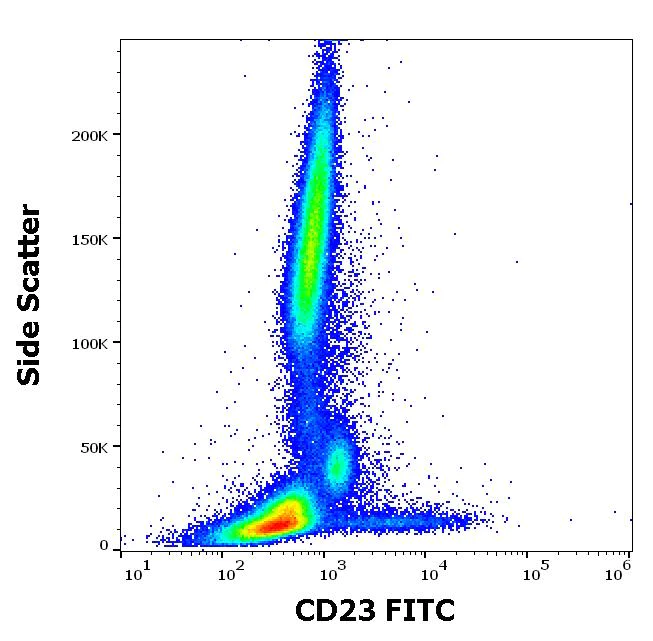
Flow Cytometry - FITC Anti-CD23 antibody [EBVCS-5] (AB275947)

Flow cytometry surface staining pattern of human peripheral whole blood stained using ab275947 (4 μl reagent / 100 μl of peripheral whole blood).
Flow Cytometry - FITC Anti-CD23 antibody [EBVCS-5] (AB275947)
  • Flow Cyt

Unknown

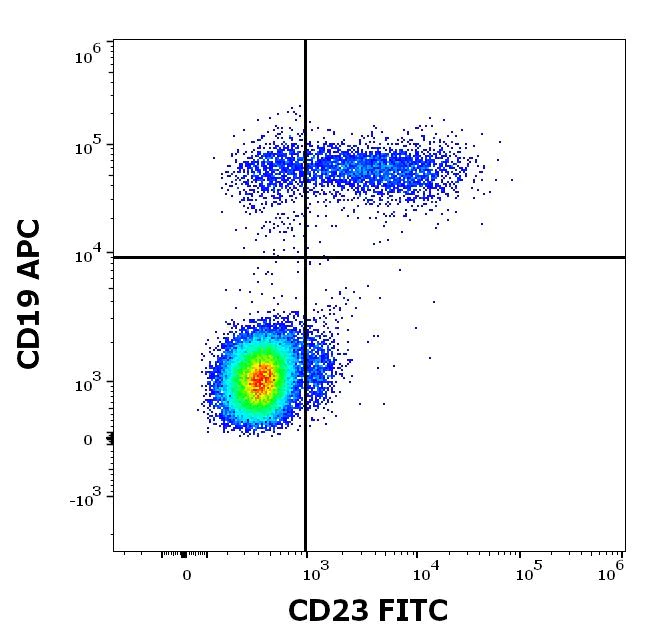
Flow Cytometry - FITC Anti-CD23 antibody [EBVCS-5] (AB275947)

Flow cytometry multicolor surface staining of human lymphocytes stained using ab275947 (4 μl reagent / 100 μl of peripheral whole blood) and anti-human CD19 (LT19) APC antibody (10 μl reagent / 100 μl of peripheral whole blood).
Flow Cytometry - FITC Anti-CD23 antibody [EBVCS-5] (AB275947)
  • Flow Cyt

Unknown

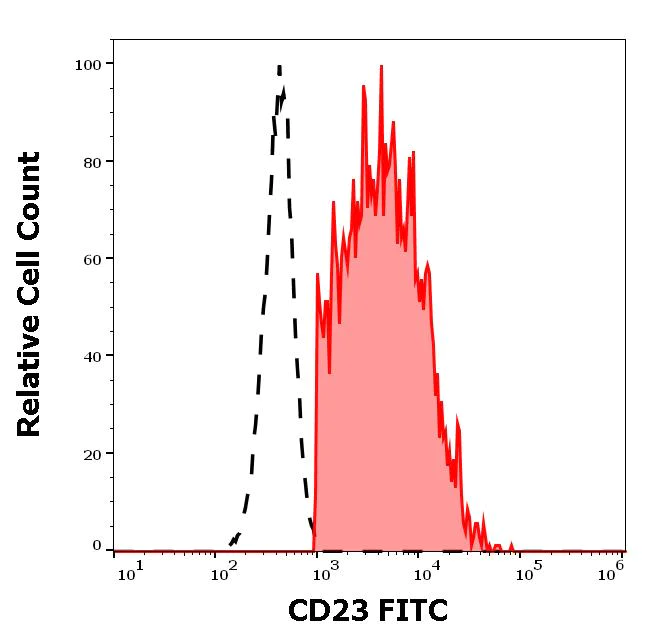
Flow Cytometry - FITC Anti-CD23 antibody [EBVCS-5] (AB275947)

Separation of human CD23 positive B cells (red-filled) from CD23 negative CD19 negative lymphocytes (black-dashed) in flow cytometry analysis (surface staining) of human peripheral whole blood stained using ab275947 (4 μl reagent / 100 μl of peripheral whole blood).

Key facts

Host species

Mouse

Clonality

Monoclonal

Clone number

EBVCS-5

Isotype

IgG1

Light chain type

kappa

Conjugation

FITC

Excitation/Emission

Ex: 495nm, Em: 519nm

Carrier free

No

Reacts with

Human

Applications

Flow Cyt

applications

Immunogen

Cell preparation containing FCER2 protein. The exact immunogen used to generate this antibody is proprietary information.

P06734

Reactivity data

{ "title": "Reactivity Data", "filters": { "stats": ["", "Species", "Dilution Info", "Notes"], "tabs": { "all-applications": {"fullname" : "All Applications", "shortname": "All Applications"}, "FlowCyt" : {"fullname" : "Flow Cytometry", "shortname":"Flow Cyt"} }, "product-promise": { "all": "all", "testedAndGuaranteed": "tested", "guaranteed": "expected", "predicted": "predicted", "notRecommended": "not-recommended" } }, "values": { "Human": { "FlowCyt-species-checked": "testedAndGuaranteed", "FlowCyt-species-dilution-info": "", "FlowCyt-species-notes": "<p>4 μl reagent / 100 μl of whole blood or 10<sup>6</sup> cells in a suspension</p>" } } }

Properties and storage information

Form
Liquid
Purification technique
Size-exclusion chromatography
Storage buffer
pH: 7.4 Preservative: 0.1% Sodium azide Constituents: PBS
Shipped at conditions
Blue Ice
Appropriate short-term storage conditions
+4°C
Appropriate long-term storage conditions
+4°C
Storage information
Do Not Freeze|Store in the dark

Supplementary information

This supplementary information is collated from multiple sources and compiled automatically.

CD23 also known as Fc epsilon receptor II (FcεRII) or BU38 is a type II integral membrane protein with a molecular mass of approximately 45 kDa. It is expressed mainly on B cells but also appears on various other cell types such as macrophages eosinophils and Langerhans cells. CD23 expression occurs in both soluble and membrane-bound forms. The protein consists of a lectin-like extracellular domain a short transmembrane domain and a cytoplasmic tail.
Biological function summary

CD23 facilitates several immune functions including the regulation of immunoglobulin E (IgE) production and its receptor-mediated endocytosis. It has a role in cell adhesion growth and differentiation. CD23 exists independently localizing primarily to the surface of CD23-positive cells. Furthermore this protein influences the release and activity of various cytokines impacting both innate and adaptive immunity.

Pathways

CD23 plays central roles in IgE-mediated immune responses and allergic reactions. It is importantly involved in the synthesis and regulation of IgE connecting it to the IgE signaling pathway and immune system pathways. CD23 interacts with IgE and its receptors which include the high-affinity receptor FcεRI forming an interface between the antigen and immune effector functions. Additionally CD23 participates in pathways that involve immune response modulation and inflammation prevention.

CD23 is most notably associated with allergic diseases such as asthma and allergic rhinitis due to its role in IgE regulation. It is also linked to chronic lymphocytic leukemia (CLL) in which CD23 serves as a marker for disease progression. In CLL interactions involving CD23 and related proteins such as BCMA and BAFF have been studied to better understand the disorder and its treatment. Anti-CD23 antibodies have been used as both diagnostic tools and therapeutic agents to target CD23-positive cells in these diseases.

Product protocols

For this product, it's our understanding that no specific protocols are required. You can visit:

Target data

Low-affinity receptor for immunoglobulin E (IgE) and CR2/CD21. Has essential roles in the regulation of IgE production and in the differentiation of B cells. On B cells, initiates IgE-dependent antigen uptake and presentation to T cells (PubMed : 2167225). On macrophages, upon IgE binding and antigen cross-linking induces intracellular killing of parasites through activation of L-Arginine-nitric oxide pathway (PubMed : 7544003).
See full target information FCER2

Alternative Names

CD23, CD23A, CLEC4J, FCE2, IGEBF, FCER2, Low affinity immunoglobulin epsilon Fc receptor, BLAST-2, C-type lectin domain family 4 member J, Fc-epsilon-RII, Immunoglobulin E-binding factor, Lymphocyte IgE receptor

Product promise

We are committed to supporting your work with high-quality reagents, and we're here for you every step of the way. In the unlikely event that one of our products does not perform as expected, you're protected by our Product Promise.
For full details, please see our Terms & Conditions

Please note: All products are 'FOR RESEARCH USE ONLY. NOT FOR USE IN DIAGNOSTIC OR THERAPEUTIC PROCEDURES'.

For licensing inquiries, please contact partnerships@abcam.com