JavaScript is disabled in your browser. Please enable JavaScript to view this website.
AB187588

FITC Anti-PDGFR alpha antibody [16A1]

Be the first to review this product! Submit a review

|

(1 Publication)

Anti-PDGFR alpha antibody [16A1] conjugated to FITC - suitable for flow cytometry, and reacts with human samples. Clone [16A1] is a mouse monoclonal antibody cited in 35 publications.

Design your panel with our interactive flow cytometry panel builder. Click here.
1 Images
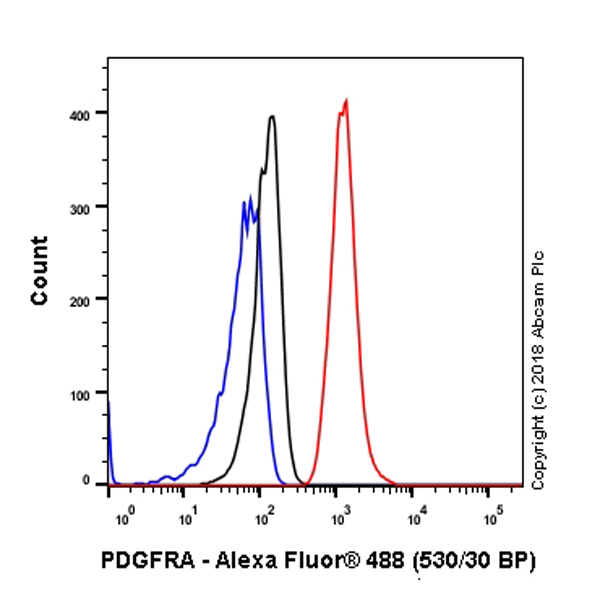
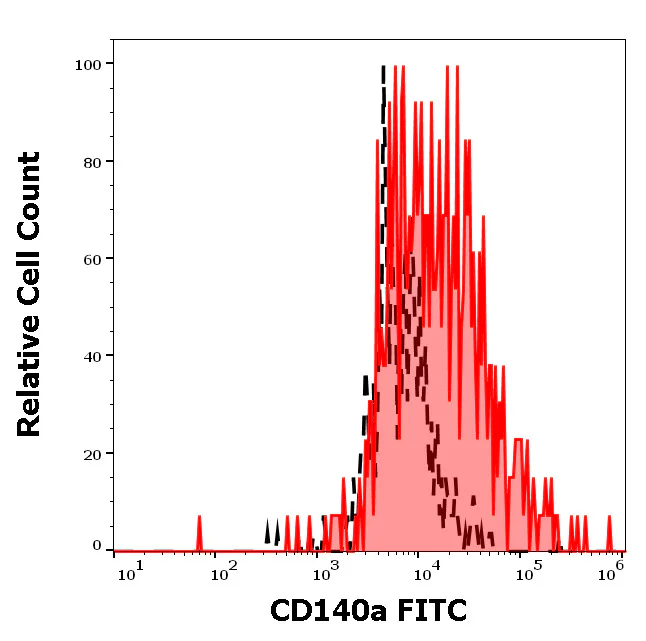
Flow Cytometry - FITC Anti-PDGFR alpha antibody [16A1] (AB187588)
  • Flow Cyt

Supplier Data

Flow Cytometry - FITC Anti-PDGFR alpha antibody [16A1] (AB187588)

Separation of cells stained using anti-human CD140a (16A1) FITC antibody (4 µl reagent per million cells in 100 µl of cell suspension, red-filled) from cells stained using mouse IgG1 isotype control (MOPC-21) FITC antibody (concentration in sample 3 µg/ml, same as CD140a FITC concentration, black-dashed) in flow cytometry analysis (surface staining) of PDGF-RA transfected cells.

Key facts

Host species

Mouse

Clonality

Monoclonal

Clone number

16A1

Isotype

IgG1

Conjugation

FITC

Excitation/Emission

Ex: 495nm, Em: 519nm

Carrier free

No

Reacts with

Human

Applications

Flow Cyt

applications

Immunogen

Cell preparation containing Pdgfra protein. The exact immunogen used to generate this antibody is proprietary information.

P26618

Reactivity data

{ "title": "Reactivity Data", "filters": { "stats": ["", "Species", "Dilution Info", "Notes"], "tabs": { "all-applications": {"fullname" : "All Applications", "shortname": "All Applications"}, "FlowCyt" : {"fullname" : "Flow Cytometry", "shortname":"Flow Cyt"} }, "product-promise": { "all": "all", "testedAndGuaranteed": "tested", "guaranteed": "expected", "predicted": "predicted", "notRecommended": "not-recommended" } }, "values": { "Human": { "FlowCyt-species-checked": "testedAndGuaranteed", "FlowCyt-species-dilution-info": "4 µL for 10^6 Cells", "FlowCyt-species-notes": "<p><a href='/en-us/products/primary-antibodies/fitc-mouse-igg1-b11-6-isotype-control-ab91356'>ab91356</a> - Mouse monoclonal IgG1, is suitable for use as an isotype control with this antibody.</p>" } } }

Properties and storage information

Form
Liquid
Purification technique
Size-exclusion chromatography
Storage buffer
pH: 7.4 Preservative: 0.097% Sodium azide Constituents: PBS, 0.2% BSA
Shipped at conditions
Blue Ice
Appropriate short-term storage conditions
+4°C
Appropriate long-term storage conditions
+4°C
Storage information
Store in the dark

Supplementary information

This supplementary information is collated from multiple sources and compiled automatically.

PDGFR alpha also known as platelet-derived growth factor receptor alpha is a cell surface receptor tyrosine kinase with a mass of approximately 123 kDa. It plays a mechanical role in transmitting signals across the cell membrane initiating cellular responses. PDGFR alpha is widely expressed in mesenchymal cells including fibroblasts and smooth muscle cells. Researchers frequently employ techniques such as PDGFRA IHC and PDGFRA staining to study the localization and expression levels in tissues.
Biological function summary

PDGFR alpha mediates cell proliferation survival and differentiation especially in embryonic development and wound healing. The receptor often forms a complex by dimerizing with itself or with PDGFR beta to activate intracellular signaling cascades. This process is initiated upon ligand binding which triggers autophosphorylation on tyrosine residues. The receptor is also recognized in the detection of PDGFRA with assays such as PDGFRA ELISA.

Pathways

PDGFR alpha significantly affects the MAPK and PI3K/AKT signaling pathways which regulate cellular growth and survival signals. Through these pathways PDGFR alpha interacts with related proteins like SHP-2 and PI3K contributing to signal transduction involved in cellular responses. This role links PDGFR alpha to important cellular processes via its kinase activity and signal integration.

PDGFR alpha is implicated in conditions such as gastrointestinal stromal tumors (GISTs) and idiopathic pulmonary fibrosis (IPF). It connects to proteins such as KIT in GISTs where mutations cause aberrant receptor signaling leading to tumorigenesis. Aberrant PDGFR alpha signaling also associates with IPF a disorder characterized by increased fibroblast proliferation and fibrotic tissue formation. These connections make PDGFR alpha a significant target for research and therapeutic intervention.

Product protocols

For this product, it's our understanding that no specific protocols are required. You can visit:

Target data

Tyrosine-protein kinase that acts as a cell-surface receptor for PDGFA, PDGFB and PDGFC and plays an essential role in the regulation of embryonic development, cell proliferation, survival and chemotaxis. Depending on the context, promotes or inhibits cell proliferation and cell migration. Plays an important role in the differentiation of bone marrow-derived mesenchymal stem cells. Required for normal skeleton development and cephalic closure during embryonic development. Required for normal development of the mucosa lining the gastrointestinal tract, and for recruitment of mesenchymal cells and normal development of intestinal villi. Plays a role in cell migration and chemotaxis in wound healing. Plays a role in platelet activation, secretion of agonists from platelet granules, and in thrombin-induced platelet aggregation. Binding of its cognate ligands - homodimeric PDGFA, homodimeric PDGFB, heterodimers formed by PDGFA and PDGFB or homodimeric PDGFC -leads to the activation of several signaling cascades; the response depends on the nature of the bound ligand and is modulated by the formation of heterodimers between PDGFRA and PDGFRB. Phosphorylates PIK3R1, PLCG1, and PTPN11. Activation of PLCG1 leads to the production of the cellular signaling molecules diacylglycerol and inositol 1,4,5-trisphosphate, mobilization of cytosolic Ca(2+) and the activation of protein kinase C. Phosphorylates PIK3R1, the regulatory subunit of phosphatidylinositol 3-kinase, and thereby mediates activation of the AKT1 signaling pathway. Mediates activation of HRAS and of the MAP kinases MAPK1/ERK2 and/or MAPK3/ERK1. Promotes activation of STAT family members STAT1, STAT3 and STAT5A and/or STAT5B. Receptor signaling is down-regulated by protein phosphatases that dephosphorylate the receptor and its down-stream effectors, and by rapid internalization of the activated receptor.
See full target information PDGFRA

Alternative Names

CD140a, PDGFR2, RHEPDGFRA, PDGFRA, Platelet-derived growth factor receptor alpha, PDGF-R-alpha, PDGFR-alpha, Alpha platelet-derived growth factor receptor, Alpha-type platelet-derived growth factor receptor, CD140 antigen-like family member A, CD140a antigen, Platelet-derived growth factor alpha receptor, Platelet-derived growth factor receptor 2, PDGFR-2

Publications (1)

Recent publications for all applications. Explore the full listand refine your search

Cancer management and research 11:7405-7425 PubMed31496801

2019

Postoperative metastasis prediction based on portal vein circulating tumor cells detected by flow cytometry in periampullary or pancreatic cancer.

Applications

Unspecified application

Species

Unspecified reactive species

Lianyuan Tao,Li Su,Chunhui Yuan,Zhaolai Ma,Lingfu Zhang,Shiping Bo,Yunyun Niu,Sijia Lu,Dianrong Xiu
View all publications

Product promise

We are committed to supporting your work with high-quality reagents, and we're here for you every step of the way. In the unlikely event that one of our products does not perform as expected, you're protected by our Product Promise.
For full details, please see our Terms & Conditions

Please note: All products are 'FOR RESEARCH USE ONLY. NOT FOR USE IN DIAGNOSTIC OR THERAPEUTIC PROCEDURES'.

For licensing inquiries, please contact partnerships@abcam.com