FITC Anti-RFP antibody [EPR28246-45]
- RabMAb
- Recombinant
- What is this?
Be the first to review this product! Submit a review
|
(0 Publication)
- Flow Cyt (Intra)
Lab
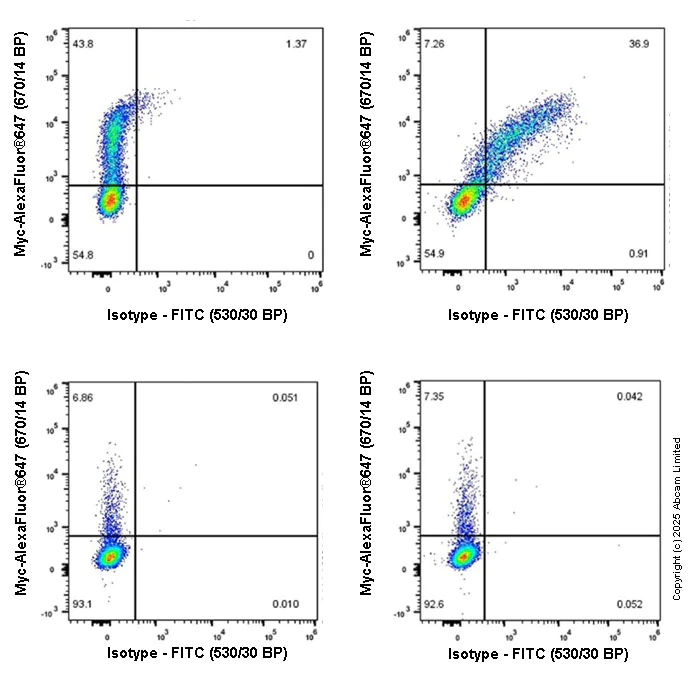
Flow Cytometry (Intracellular) - FITC Anti-RFP antibody [EPR28246-45] (AB323681)
Flow cytometry staining of 293T cells transfected with a Red fluorescent protein expression vector containing a Myc-His-tag (upper right) / 293T cells transfected with an empty vector containing a Myc-His-tag (lower right) with ab323681 or 293T cells transfected with a Red fluorescent protein expression vector containing a Myc-His-tag (upper left) / 293T cells transfected with an empty vector containing a Myc-His-tag (lower left) with Rabbit IgG monoclonal [EPR25A] - Isotype Control (FITC) (ab223339). The cells were fixed with 4% formaldehyde (10 min) and then permeabilised with 90% methanol for 30 min. Cells were incubated in 1x PBS containing 10% normal goat serum to block non-specific protein-protein interaction followed by the antibody (ab323681) (1x 10⁶ in 100μl at 1 μg/ml (1/500)) for 30min at 22°C.
Isotype control antibody Rabbit IgG monoclonal [EPR25A] - Isotype Control (FITC) (ab223339) was used at the same concentration and conditions as the primary antibody. The cells were simultaneously stained with Myc.
Acquisition of >5000 events were collected using a 50 mW Blue laser (488nm) and 530/30 bandpass filter. Events were gated on viable cells.
Related conjugates and formulations (4)
-
Anti-RFP antibody [EPR28246-45]
-
Anti-RFP antibody [EPR28246-45] - BSA and Azide free
-
665 Alexa Fluor® 647
Alexa Fluor® 647 Anti-RFP antibody [EPR28246-45]
-
Biotin Anti-RFP antibody [EPR28246-45]
Complementary Products
Primary Antibodies
AB183734
RabMAb|Recombinant|Lab Essentials|20ul selling size
- 5
- 24
Primary Antibodies
AB300425
Anti-PD-1/CD279 antibody [EPR26302-8]
20ul selling size|RabMAb|Recombinant
- 0
- 0

Reactivity data
Product details
Patented technology
Our RabMAb® technology is a patented hybridoma-based technology for making rabbit monoclonal antibodies. For details on our patents, please refer to RabMAb® patents.
What are the advantages of a recombinant monoclonal antibody?
This product is a recombinant monoclonal antibody, which offers several advantages including:
- - High batch-to-batch consistency and reproducibility
- - Improved sensitivity and specificity
- - Long-term security of supply
- - Animal-free batch production
For more information, read more on recombinant antibodies.
Properties and storage information
Form
Purification technique
Storage buffer
Shipped at conditions
Appropriate short-term storage duration
Appropriate short-term storage conditions
Appropriate long-term storage conditions
Aliquoting information
Storage information
Product protocols
- Visit the General protocols
- Visit the Troubleshooting
Target data
Alternative Names
Product promise
Please note: All products are 'FOR RESEARCH USE ONLY. NOT FOR USE IN DIAGNOSTIC OR THERAPEUTIC PROCEDURES'.
For licensing inquiries, please contact partnerships@abcam.com