JavaScript is disabled in your browser. Please enable JavaScript to view this website.
AB126790

Anti-FMO3 antibody [EPR6967]

Be the first to review this product! Submit a review

|

(12 Publications )
Rabbit Recombinant Monoclonal FMO3 antibody. Suitable for WB, Flow Cyt (Intra) and reacts with Mouse, Human, Rat samples. Cited in 12 publications.
2 Images
Flow Cytometry (Intracellular) - Anti-FMO3 antibody [EPR6967] (AB126790)
  • Flow Cyt (Intra)

Unknown

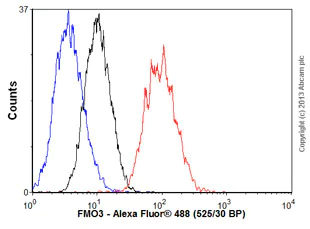
Flow Cytometry (Intracellular) - Anti-FMO3 antibody [EPR6967] (AB126790)

Overlay histogram showing HepG2 cells stained with ab126790 (red line). The cells were fixed with 80% methanol (5 min) and then permeabilized with 0.1% PBS-Tween for 20 min. The cells were then incubated in 1x PBS / 10% normal goat serum / 0.3M glycine to block non-specific protein-protein interactions followed by the antibody (ab126790 1/65 dilution) for 30 min at 22°C. The secondary antibody used was Alexa Fluor® 488 goat anti-rabbit IgG (H&L) (ab150077) at 1/2000 dilution for 30 min at 22°C. Isotype control antibody (black line) was rabbit IgG (monoclonal) (1μg/1x106 cells) used under the same conditions. Unlabelled sample (blue line) was also used as a control. Acquisition of >5000 events were collected using a 20mW Argon ion laser (488nm) and 525/30 bandpass filter.
Western blot - Anti-FMO3 antibody [EPR6967] (AB126790)
  • WB

Unknown

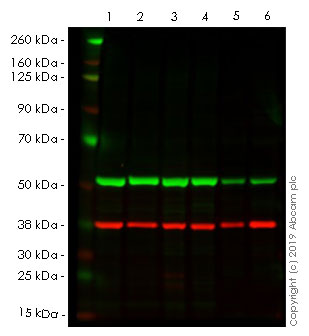
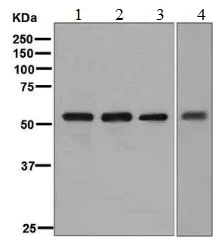
Western blot - Anti-FMO3 antibody [EPR6967] (AB126790)

All lanes:

Western blot - Anti-FMO3 antibody [EPR6967] (ab126790) at 1/1000 dilution

Lane 1:

Rat kidney lysate at 10 µg

Lane 2:

Mouse liver lysate at 10 µg

Lane 3:

Rat liver lysate at 10 µg

Lane 4:

Human fetal liver lysate at 10 µg

Secondary

All lanes:

HRP labelled goat anti-rabbit at 1/2000 dilution

Predicted band size: 60 kDa

false

  • Carrier free

    Anti-FMO3 antibody [EPR6967] - BSA and Azide free

Key facts

Host species

Rabbit

Clonality

Monoclonal

Clone number

EPR6967

Isotype

IgG

Carrier free

No

Reacts with

Mouse, Rat, Human

Applications

WB, Flow Cyt (Intra)

applications

Immunogen

The exact immunogen used to generate this antibody is proprietary information.

Reactivity data

{ "title": "Reactivity Data", "filters": { "stats": ["", "Species", "Dilution Info", "Notes"], "tabs": { "all-applications": {"fullname" : "All Applications", "shortname": "All Applications"}, "IP" : {"fullname" : "Immunoprecipitation", "shortname":"IP"}, "WB" : {"fullname" : "Western blot", "shortname":"WB"}, "IHCP" : {"fullname" : "Immunohistochemistry (Formalin/PFA-fixed paraffin-embedded sections)", "shortname":"IHC-P"}, "FlowCytIntra" : {"fullname" : "Flow Cytometry (Intracellular)", "shortname":"Flow Cyt (Intra)"} }, "product-promise": { "all": "all", "testedAndGuaranteed": "tested", "guaranteed": "expected", "predicted": "predicted", "notRecommended": "not-recommended" } }, "values": { "Human": { "IP-species-checked": "notRecommended", "IP-species-dilution-info": "", "IP-species-notes": "<p></p>", "WB-species-checked": "testedAndGuaranteed", "WB-species-dilution-info": "1/1000 - 1/10000", "WB-species-notes": "<p></p>", "IHCP-species-checked": "notRecommended", "IHCP-species-dilution-info": "", "IHCP-species-notes": "<p></p>", "FlowCytIntra-species-checked": "testedAndGuaranteed", "FlowCytIntra-species-dilution-info": "1/65", "FlowCytIntra-species-notes": "<p><a href='/en-us/products/primary-antibodies/rabbit-igg-monoclonal-epr25a-isotype-control-ab172730'>ab172730</a> - Rabbit monoclonal IgG, is suitable for use as an isotype control with this antibody.</p>" }, "Mouse": { "IP-species-checked": "notRecommended", "IP-species-dilution-info": "", "IP-species-notes": "<p></p>", "WB-species-checked": "testedAndGuaranteed", "WB-species-dilution-info": "1/1000 - 1/10000", "WB-species-notes": "<p></p>", "IHCP-species-checked": "notRecommended", "IHCP-species-dilution-info": "", "IHCP-species-notes": "<p></p>", "FlowCytIntra-species-checked": "guaranteed", "FlowCytIntra-species-dilution-info": "", "FlowCytIntra-species-notes": "" }, "Rat": { "IP-species-checked": "notRecommended", "IP-species-dilution-info": "", "IP-species-notes": "<p></p>", "WB-species-checked": "testedAndGuaranteed", "WB-species-dilution-info": "1/1000 - 1/10000", "WB-species-notes": "<p></p>", "IHCP-species-checked": "notRecommended", "IHCP-species-dilution-info": "", "IHCP-species-notes": "<p></p>", "FlowCytIntra-species-checked": "guaranteed", "FlowCytIntra-species-dilution-info": "", "FlowCytIntra-species-notes": "" } } }

Product details

Patented technology
Our RabMAb® technology is a patented hybridoma-based technology for making rabbit monoclonal antibodies. For details on our patents, please refer to RabMAb® patents.

What are the advantages of a recombinant monoclonal antibody?
This product is a recombinant monoclonal antibody, which offers several advantages including:

  • - High batch-to-batch consistency and reproducibility
  • - Improved sensitivity and specificity
  • - Long-term security of supply
  • - Animal-free batch production

For more information, read more on recombinant antibodies.

Properties and storage information

Form
Liquid
Purification technique
Affinity purification Protein A
Storage buffer
pH: 7.2 - 7.4 Preservative: 0.01% Sodium azide Constituents: PBS, 40% Glycerol (glycerin, glycerine), 0.05% BSA
Shipped at conditions
Conditional Ambient
Appropriate short-term storage conditions
+4°C
Appropriate long-term storage conditions
-20°C
Storage information
Stable for 12 months at -20°C

Product protocols

For this product, it's our understanding that no specific protocols are required. You can visit:

Target data

Essential hepatic enzyme that catalyzes the oxygenation of a wide variety of nitrogen- and sulfur-containing compounds including drugs as well as dietary compounds (PubMed : 10759686, PubMed : 30381441, PubMed : 32156684). Plays an important role in the metabolism of trimethylamine (TMA), via the production of trimethylamine N-oxide (TMAO) metabolite (PubMed : 9776311). TMA is generated by the action of gut microbiota using dietary precursors such as choline, choline containing compounds, betaine or L-carnitine. By regulating TMAO concentration, FMO3 directly impacts both platelet responsiveness and rate of thrombus formation (PubMed : 29981269).
See full target information FMO3

Alternative Names

Flavin-containing monooxygenase 3, Dimethylaniline monooxygenase [N-oxide-forming] 3, Dimethylaniline oxidase 3, FMO II, FMO form 2, Hepatic flavin-containing monooxygenase 3, Trimethylamine monooxygenase, FMO 3, FMO3

Publications (12)

Recent publications for all applications. Explore the full listand refine your search

Biological & pharmaceutical bulletin 48:1062-1069 PubMed40691058

2025

In Silico Binary Classification of Catalytic Function (Unaffected or Impaired) of Flavin-Containing Monooxygenase 3 (FMO3) Variants and in Vitro Validation Using New Variants Found in a Japanese Genome Resource Database.

Applications

Unspecified application

Species

Unspecified reactive species

Makiko Shimizu,Eiji Hishinuma,Rika Igarashi,Sakae Saito,Miaki Makiguchi,Masahiro Hiratsuka,Hiroshi Yamazaki

Magnetic resonance in medicine 94:521-529 PubMed40228097

2025

In vivo H-MR spectroscopy and imaging of hepatic metabolic formation of trimethylamine-N-oxide.

Applications

Unspecified application

Species

Unspecified reactive species

Hadar Dessau,Talia Harris,Robin A de Graaf,Elton T Montrazi,Hyla Allouche-Arnon,Amnon Bar-Shir

Drug metabolism and disposition: the biological fate of chemicals 51:884-891 PubMed37041084

2023

Variants of Flavin-Containing Monooxygenase 3 Found in Subjects in an Updated Database of Genome Resources.

Applications

Unspecified application

Species

Unspecified reactive species

Miaki Makiguchi,Makiko Shimizu,Yuka Yokota,Erika Shimamura,Eiji Hishinuma,Sakae Saito,Masahiro Hiratsuka,Hiroshi Yamazaki

Metabolites 12: PubMed35448550

2022

Flavin-Containing Monooxygenase 3 (FMO3) Is Critical for Dioxin-Induced Reorganization of the Gut Microbiome and Host Insulin Sensitivity.

Applications

Unspecified application

Species

Unspecified reactive species

William Massey,Lucas J Osborn,Rakhee Banerjee,Anthony Horak,Kevin K Fung,Danny Orabi,E Ricky Chan,Naseer Sangwan,Zeneng Wang,J Mark Brown

eLife 11: PubMed35084335

2022

Gut microbial trimethylamine is elevated in alcohol-associated hepatitis and contributes to ethanol-induced liver injury in mice.

Applications

Unspecified application

Species

Unspecified reactive species

Robert N Helsley,Tatsunori Miyata,Anagha Kadam,Venkateshwari Varadharajan,Naseer Sangwan,Emily C Huang,Rakhee Banerjee,Amanda L Brown,Kevin K Fung,William J Massey,Chase Neumann,Danny Orabi,Lucas J Osborn,Rebecca C Schugar,Megan R McMullen,Annette Bellar,Kyle L Poulsen,Adam Kim,Vai Pathak,Marko Mrdjen,James T Anderson,Belinda Willard,Craig J McClain,Mack Mitchell,Arthur J McCullough,Svetlana Radaeva,Bruce Barton,Gyongyi Szabo,Srinivasan Dasarathy,Jose Carlos Garcia-Garcia,Daniel M Rotroff,Daniela S Allende,Zeneng Wang,Stanley L Hazen,Laura E Nagy,Jonathan Mark Brown

Drug metabolism and pharmacokinetics 35:383-388 PubMed32653296

2020

Novel variants in outer protein surface of flavin-containing monooxygenase 3 found in an Argentinian case with impaired capacity for trimethylamine N-oxygenation.

Applications

Unspecified application

Species

Unspecified reactive species

Leonardo Dionisio,Makiko Shimizu,Sofia Stupniki,Saki Oyama,Eugenio Aztiria,Maximiliano Alda,Hiroshi Yamazaki,Guillermo Spitzmaul

Scientific reports 9:15901 PubMed31685846

2019

Metabolic Activation of Flavin Monooxygenase-mediated Trimethylamine-N-Oxide Formation in Experimental Kidney Disease.

Applications

Unspecified application

Species

Unspecified reactive species

Alexander J Prokopienko,Raymond E West,Daniel P Schrum,Jason R Stubbs,François A Leblond,Vincent Pichette,Thomas D Nolin

Cell metabolism 30:1141-1151.e5 PubMed31543404

2019

Trimethylamine N-Oxide Binds and Activates PERK to Promote Metabolic Dysfunction.

Applications

Unspecified application

Species

Unspecified reactive species

Sifan Chen,Ayana Henderson,Michael C Petriello,Kymberleigh A Romano,Mary Gearing,Ji Miao,Mareike Schell,Walter J Sandoval-Espinola,Jiahui Tao,Bingdong Sha,Mark Graham,Rosanne Crooke,Andre Kleinridders,Emily P Balskus,Federico E Rey,Andrew J Morris,Sudha B Biddinger

Drug metabolism and pharmacokinetics 34:334-339 PubMed31401033

2019

Genetic variants of flavin-containing monooxygenase 3 (FMO3) derived from Japanese subjects with the trimethylaminuria phenotype and whole-genome sequence data from a large Japanese database.

Applications

Unspecified application

Species

Unspecified reactive species

Makiko Shimizu,Hiromi Yoda,Komei Nakakuki,Aoi Saso,Iria Saito,Eiji Hishinuma,Sakae Saito,Masahiro Hiratsuka,Hiroshi Yamazaki

Journal of thrombosis and haemostasis : JTH 16:1857-1872 PubMed29981269

2018

Flavin monooxygenase 3, the host hepatic enzyme in the metaorganismal trimethylamine N-oxide-generating pathway, modulates platelet responsiveness and thrombosis risk.

Applications

Unspecified application

Species

Unspecified reactive species

W Zhu,J A Buffa,Z Wang,M Warrier,R Schugar,D M Shih,N Gupta,J C Gregory,E Org,X Fu,L Li,J A DiDonato,A J Lusis,J M Brown,S L Hazen
View all publications

Product promise

We are committed to supporting your work with high-quality reagents, and we're here for you every step of the way. In the unlikely event that one of our products does not perform as expected, you're protected by our Product Promise.
For full details, please see our Terms & Conditions

Please note: All products are 'FOR RESEARCH USE ONLY. NOT FOR USE IN DIAGNOSTIC OR THERAPEUTIC PROCEDURES'.

For licensing inquiries, please contact partnerships@abcam.com