JavaScript is disabled in your browser. Please enable JavaScript to view this website.
AB137614

Anti-GC-1 antibody

Be the first to review this product! Submit a review

|

(6 Publications )

Rabbit Polyclonal GC-1 antibody. Suitable for IHC-P, WB, ICC/IF and reacts with Human, Mouse samples. Cited in 6 publications. Immunogen corresponding to Recombinant Fragment Protein within Human SLC25A22 aa 1 to C-terminus.
3 Images
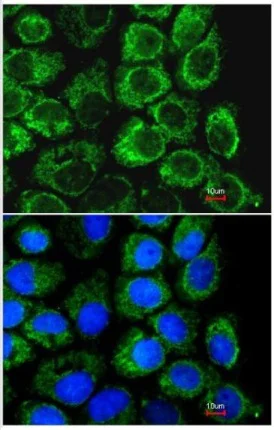
Immunocytochemistry/ Immunofluorescence - Anti-GC-1 antibody (AB137614)
  • ICC/IF

Unknown

Immunocytochemistry/ Immunofluorescence - Anti-GC-1 antibody (AB137614)

ab137614 at 1/200 dilution staining GC-1 in paraformaldehyde fixed A431 cells by Immunofluorescence. Lower image merged with DNA probe.
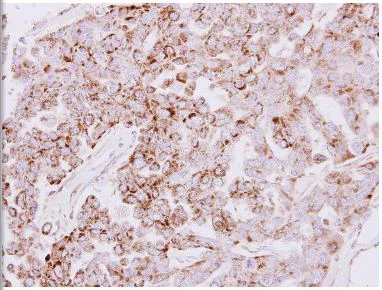
Immunohistochemistry (Formalin/PFA-fixed paraffin-embedded sections) - Anti-GC-1 antibody (AB137614)
  • IHC-P

Unknown

Immunohistochemistry (Formalin/PFA-fixed paraffin-embedded sections) - Anti-GC-1 antibody (AB137614)

ab137614 at 1/500 dilution, staining GC-1 in paraffin embedded OVCAR3 xenograft tissue by Immunohistochemistry.
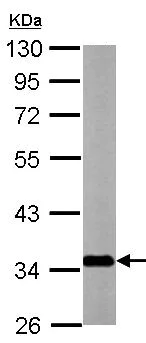
Western blot - Anti-GC-1 antibody (AB137614)
  • WB

Unknown

Western blot - Anti-GC-1 antibody (AB137614)

10% SDS PAGE

All lanes:

Western blot - Anti-GC-1 antibody (ab137614) at 1/10000 dilution

All lanes:

Mouse brain whole cell lysate at 20 µg

Predicted band size: 34 kDa

false

Key facts

Host species

Rabbit

Clonality

Polyclonal

Isotype

IgG

Carrier free

No

Reacts with

Mouse, Human

Applications

IHC-P, WB, ICC/IF

applications

Immunogen

Recombinant Fragment Protein within Human SLC25A22 aa 1 to C-terminus. The exact immunogen used to generate this antibody is proprietary information.

Q9H936

Reactivity data

{ "title": "Reactivity Data", "filters": { "stats": ["", "Species", "Dilution Info", "Notes"], "tabs": { "all-applications": {"fullname" : "All Applications", "shortname": "All Applications"}, "IHCP" : {"fullname" : "Immunohistochemistry (Formalin/PFA-fixed paraffin-embedded sections)", "shortname":"IHC-P"}, "WB" : {"fullname" : "Western blot", "shortname":"WB"}, "ICCIF" : {"fullname" : "Immunocytochemistry/ Immunofluorescence", "shortname":"ICC/IF"} }, "product-promise": { "all": "all", "testedAndGuaranteed": "tested", "guaranteed": "expected", "predicted": "predicted", "notRecommended": "not-recommended" } }, "values": { "Human": { "IHCP-species-checked": "testedAndGuaranteed", "IHCP-species-dilution-info": "1/100 - 1/1000", "IHCP-species-notes": "<p></p> Perform heat-mediated antigen retrieval with citrate buffer pH 6 before commencing with IHC staining protocol.", "WB-species-checked": "testedAndGuaranteed", "WB-species-dilution-info": "1/1000 - 1/10000", "WB-species-notes": "<p></p>", "ICCIF-species-checked": "testedAndGuaranteed", "ICCIF-species-dilution-info": "1/100 - 1/1000", "ICCIF-species-notes": "<p></p>" }, "Mouse": { "IHCP-species-checked": "guaranteed", "IHCP-species-dilution-info": "", "IHCP-species-notes": "", "WB-species-checked": "testedAndGuaranteed", "WB-species-dilution-info": "1/1000 - 1/10000", "WB-species-notes": "<p></p>", "ICCIF-species-checked": "guaranteed", "ICCIF-species-dilution-info": "", "ICCIF-species-notes": "" }, "Cow": { "IHCP-species-checked": "predicted", "IHCP-species-dilution-info": "", "IHCP-species-notes": "", "WB-species-checked": "predicted", "WB-species-dilution-info": "", "WB-species-notes": "", "ICCIF-species-checked": "predicted", "ICCIF-species-dilution-info": "", "ICCIF-species-notes": "" } } }

Properties and storage information

Form
Liquid
Purification technique
Affinity purification Immunogen
Storage buffer
pH: 7 Preservative: 0.01% Thimerosal (merthiolate) Constituents: 10% Glycerol (glycerin, glycerine), 1.21% Tris, 0.75% Glycine
Shipped at conditions
Blue Ice
Appropriate short-term storage conditions
+4°C
Appropriate long-term storage conditions
-20°C
Aliquoting information
Upon delivery aliquot
Storage information
Avoid freeze / thaw cycle

Supplementary information

This supplementary information is collated from multiple sources and compiled automatically.

GC-1 also known as guanylate cyclase 1 is an enzyme with an approximate molecular mass of 82 kDa. It functions mechanically by converting GTP to cGMP a critical second messenger in various cellular processes. GC-1 is expressed in a range of tissues including the brain and retina where it plays important roles in visual and neural functions. Its distribution indicates its involvement in both sensory perception and broader neurological activities.
Biological function summary

GC-1 plays an important role in the signal transduction pathways involving nitric oxide as part of a complex with protein partners. As a subunit of the soluble guanylate cyclase (sGC) complex it helps mediate the effects of nitric oxide by regulating cGMP levels. This activity is essential for promoting vasodilation and blood flow which is observed in the cardiovascular system. The GC-1 complex translates extracellular signals to intracellular responses affecting various physiological processes.

Pathways

GC-1 is a critical component in the nitric oxide signaling pathway where it facilitates communication between nitric oxide and cGMP-dependent pathways. It interacts closely with proteins such as endothelial nitric oxide synthase (eNOS) and is directly involved in the pathway regulating vascular tone and blood pressure. Additionally GC-1 is part of the phototransduction pathway in retinal cells influencing the conversion of light into electrical signals through its production of cGMP.

GC-1 has significant implications in cardiovascular diseases and certain eye disorders. For cardiovascular diseases GC-1 contributes to conditions related to hypertension and heart failure as it affects the nitric oxide-cGMP pathway's ability to mediate vascular relaxation. In the realm of eye disorders particularly retinitis pigmentosa impaired GC-1 function affects photoreceptor cells and visual signal transduction. GC-1's activity is linked to proteins like phosphodiesterase 6 (PDE6) which further highlights its role in maintaining visual acuity and retinal health.

Product protocols

For this product, it's our understanding that no specific protocols are required. You can visit:

Target data

Mitochondrial glutamate/H(+) symporter. Responsible for the transport of glutamate from the cytosol into the mitochondrial matrix with the concomitant import of a proton (PubMed : 11897791). Plays a role in the control of glucose-stimulated insulin secretion (By similarity).
See full target information SLC25A22

Alternative Names

GC1, SLC25A22, Mitochondrial glutamate carrier 1, GC-1, Glutamate/H(+) symporter 1, Solute carrier family 25 member 22

Publications (6)

Recent publications for all applications. Explore the full listand refine your search

Cell biology and toxicology 41:31 PubMed39820591

2025

Innovative treatment of age-related hearing loss using MSCs and EVs with Apelin.

Applications

Unspecified application

Species

Unspecified reactive species

Shengqun Xu,Dongliang Liu,Fang Zhang,Yuan Tian

Gastroenterology 159:2163-2180.e6 PubMed32814111

2020

In Colorectal Cancer Cells With Mutant KRAS, SLC25A22-Mediated Glutaminolysis Reduces DNA Demethylation to Increase WNT Signaling, Stemness, and Drug Resistance.

Applications

Unspecified application

Species

Unspecified reactive species

Chi Chun Wong,Jiaying Xu,Xiqing Bian,Jian-Lin Wu,Wei Kang,Yun Qian,Weilin Li,Huarong Chen,Hongyan Gou,Dabin Liu,Simson Tsz Yat Luk,Qiming Zhou,Fenfen Ji,Lam-Shing Chan,Senji Shirasawa,Joseph Jy Sung,Jun Yu

eLife 8: PubMed31682224

2019

Function of hTim8a in complex IV assembly in neuronal cells provides insight into pathomechanism underlying Mohr-Tranebjærg syndrome.

Applications

Unspecified application

Species

Unspecified reactive species

Yilin Kang,Alexander J Anderson,Thomas Daniel Jackson,Catherine S Palmer,David P De Souza,Kenji M Fujihara,Tegan Stait,Ann E Frazier,Nicholas J Clemons,Deidreia Tull,David R Thorburn,Malcolm J McConville,Michael T Ryan,David A Stroud,Diana Stojanovski

Technology in cancer research & treatment 17:1533033818811143 PubMed30482097

2018

SLC25A22 Promotes Proliferation and Metastasis of Osteosarcoma Cells via the PTEN Signaling Pathway.

Applications

Unspecified application

Species

Unspecified reactive species

Ming-Wei Chen,Xue-Jian Wu

Molecular cell 67:457-470.e5 PubMed28712726

2017

Sengers Syndrome-Associated Mitochondrial Acylglycerol Kinase Is a Subunit of the Human TIM22 Protein Import Complex.

Applications

Unspecified application

Species

Unspecified reactive species

Yilin Kang,David A Stroud,Michael J Baker,David P De Souza,Ann E Frazier,Michael Liem,Dedreia Tull,Suresh Mathivanan,Malcolm J McConville,David R Thorburn,Michael T Ryan,Diana Stojanovski

eLife 5: PubMed27554484

2016

Tim29 is a novel subunit of the human TIM22 translocase and is involved in complex assembly and stability.

Applications

Unspecified application

Species

Unspecified reactive species

Yilin Kang,Michael James Baker,Michael Liem,Jade Louber,Matthew McKenzie,Ishara Atukorala,Ching-Seng Ang,Shivakumar Keerthikumar,Suresh Mathivanan,Diana Stojanovski
View all publications

Product promise

We are committed to supporting your work with high-quality reagents, and we're here for you every step of the way. In the unlikely event that one of our products does not perform as expected, you're protected by our Product Promise.
For full details, please see our Terms & Conditions

Please note: All products are 'FOR RESEARCH USE ONLY. NOT FOR USE IN DIAGNOSTIC OR THERAPEUTIC PROCEDURES'.

For licensing inquiries, please contact partnerships@abcam.com