Anti-Glutaminase antibody [EPR28716-72]
- 20ul selling size
- Recombinant
- RabMAb
- What is this?
Be the first to review this product! Submit a review
|
(0 Publication)
- ICC/IF
Supplier Data
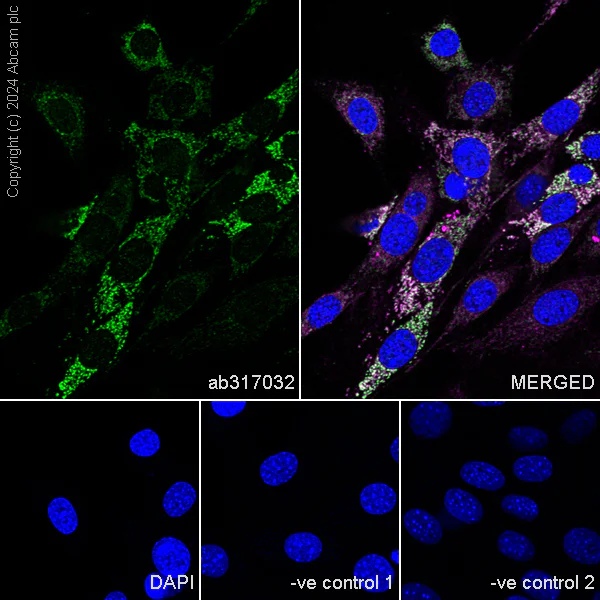
Immunocytochemistry/ Immunofluorescence - Anti-Glutaminase antibody [EPR28716-72] (AB317032)
Immunofluorescent analysis of 4% Paraformaldehyde-fixed, 0.1% TritonX-100 permeabilized NIH/3T3 (mouse embryonic fibroblast) cells labelling Glutaminase with ab317032 at 1/500 (1.016 ug/ml) dilution, followed by ab150081 Goat Anti-Rabbit IgG H&L (Alexa Fluor® 488) preadsorbed antibody at 1/1000 (2 ug/ml) dilution (Green).
Confocal image showing mitochondrial staining in NIH/3T3 cell line (shown in green). The counterstain was observed in magenta. Nuclear DNA was labeled with DAPI (shown in blue).
Image was taken with a confocal microscope(Leica-Microsystems, TCS SP8).
anti-COX IV mouse monoclonal antibody - Mitochondrial Marker was used to counterstain at 1/200 (2.5ug/ml) dilution (Magenta). The Nuclear counterstain was DAPI (Blue).
Secondary antibody only control : Secondary antibody is ab150081 Goat Anti-Rabbit IgG H&L (Alexa Fluor® 488) preadsorbed at 1/1000 (2 ug/ml) dilution.
- ICC/IF
Supplier Data
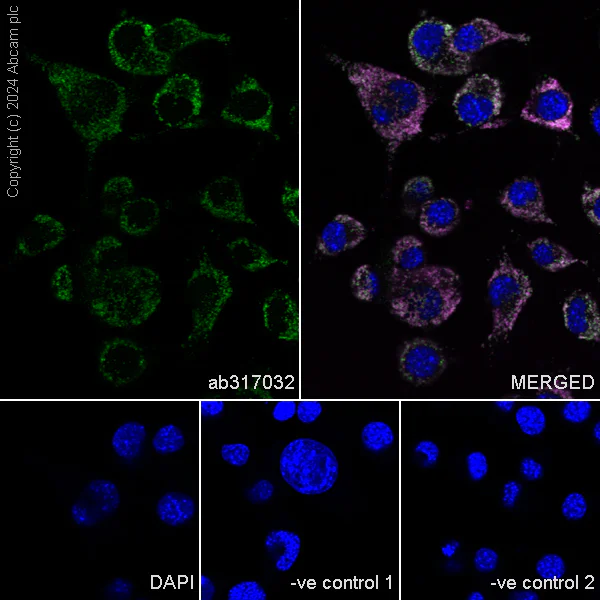
Immunocytochemistry/ Immunofluorescence - Anti-Glutaminase antibody [EPR28716-72] (AB317032)
Immunofluorescent analysis of 4% Paraformaldehyde-fixed, 0.1% TritonX-100 permeabilized Neuro-2a (mouse neuroblastoma neuroblast) cells labelling Glutaminase with ab317032 at 1/500 (1.016 ug/ml) dilution, followed by ab150081 Goat Anti-Rabbit IgG H&L (Alexa Fluor® 488) preadsorbed antibody at 1/1000 (2 ug/ml) dilution (Green).
Confocal image showing mitochondrial staining in Neuro-2a cell line (shown in green). The counterstain was observed in magenta. Nuclear DNA was labeled with DAPI (shown in blue).
Image was taken with a confocal microscope(Leica-Microsystems, TCS SP8).
anti-COX IV mouse monoclonal antibody - Mitochondrial Marker was used to counterstain at 1/200 (2.5ug/ml) dilution (Magenta). The Nuclear counterstain was DAPI (Blue).
Secondary antibody only control : Secondary antibody is ab150081 Goat Anti-Rabbit IgG H&L (Alexa Fluor® 488) preadsorbed at 1/1000 (2 ug/ml) dilution.
- Flow Cyt (Intra)
Supplier Data
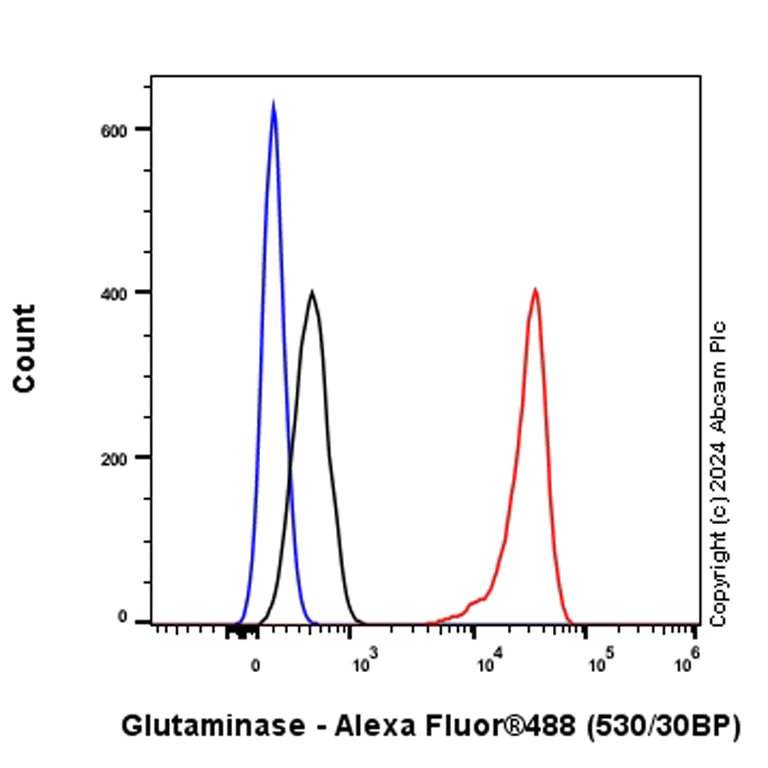
Flow Cytometry (Intracellular) - Anti-Glutaminase antibody [EPR28716-72] (AB317032)
Flow cytometric analysis of 4% paraformaldehyde fixed 90% methanol permeabilized NIH/3T3 (mouse embryonic fibroblast) cells labelling Glutaminase with ab317032 at 1/50 dilution (1 ug)/Red compared with a Rabbit monoclonal IgG (ab172730) (Black) isotype control and an unlabelled control (cells without incubation with primary antibody and secondary antibody) (Blue).
Goat Anti-Rabbit IgG (Alexa Fluor® 488, ab150081) at 1/5000 dilution was used as the secondary antibody.
- WB
Supplier Data
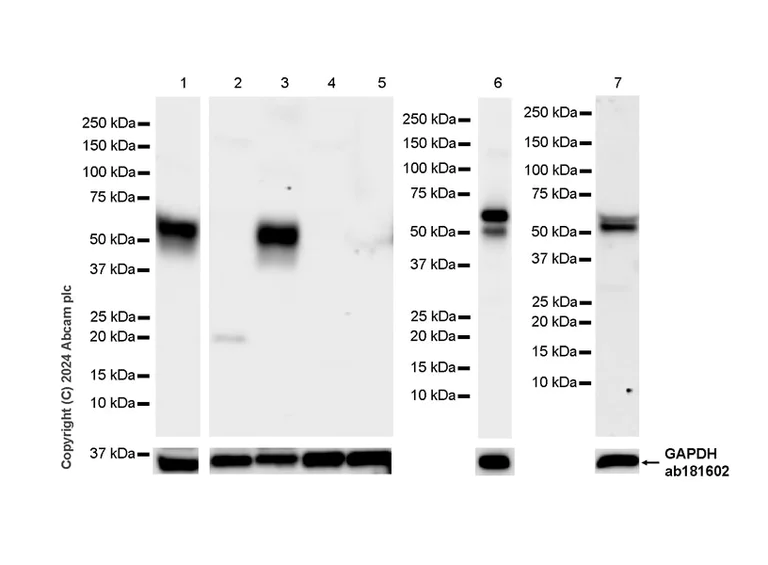
Western blot - Anti-Glutaminase antibody [EPR28716-72] (AB317032)
Negative control : liver (PMID : 19428809).
This antibody could detect 2 isoforms produced by alternative splicing.
In Western blot, Anti-GAPDH antibody [EPR16891] - Loading Control (ab181602) staining at 1/200000 dilution.
Exposure time : Lane 1-5 : 15 seconds, Lane 6 : 3 seconds, Lane 7 : 70 seconds
All lanes:
Western blot - Anti-Glutaminase antibody [EPR28716-72] (ab317032) at 1/1000 dilution
Lane 1:
Mouse kidney tissue lysate at 50 µg
Lane 2:
Mouse liver tissue lysate at 50 µg
Lane 3:
Rat kidney tissue lysate at 50 µg
Lane 4:
Rat liver tissue lysate at 50 µg
Lane 5:
Human liver tissue lysate at 50 µg
Lane 6:
Human kidney tissue lysate at 20 µg
Lane 7:
Human lung tissue lysate at 50 µg
Secondary
All lanes:
Goat Anti-Rabbit IgG (HRP) with minimal cross-reactivity with human IgG at 1/2000 dilution
Observed band size: 66 kDa,73 kDa,36 kDa
false
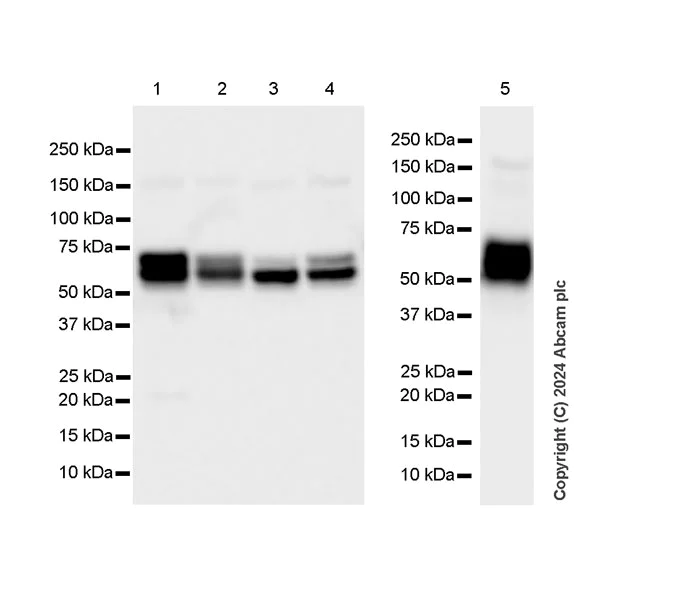
- WB
Supplier Data
Western blot - Anti-Glutaminase antibody [EPR28716-72] (AB317032)
This antibody could detect 2 isoforms produced by alternative splicing.
Exposure time : Lane 1-4 : 10 seconds, Lane 5 : 15 seconds
All lanes:
Western blot - Anti-Glutaminase antibody [EPR28716-72] (ab317032) at 1/1000 dilution
Lane 1:
Neuro-2a (mouse neuroblastoma neuroblast) whole cell lysate at 50 µg
Lane 2:
B16-F10 (Mouse skin melanoma), whole cell lysate at 50 µg
Lane 3:
HEK-293 (human embryonic kidney epithelial cell) whole cell lysate at 50 µg
Lane 4:
G-401(human rhabdoid tumor kidney epithelial cell) whole cell lysate at 50 µg
Lane 5:
NIH/3T3 (mouse embryonic fibroblast) whole cell lysate at 50 µg
Secondary
All lanes:
Goat Anti-Rabbit IgG (HRP) with minimal cross-reactivity with human IgG at 1/2000 dilution
Observed band size: 66 kDa,73 kDa
false
- Dot
Supplier Data
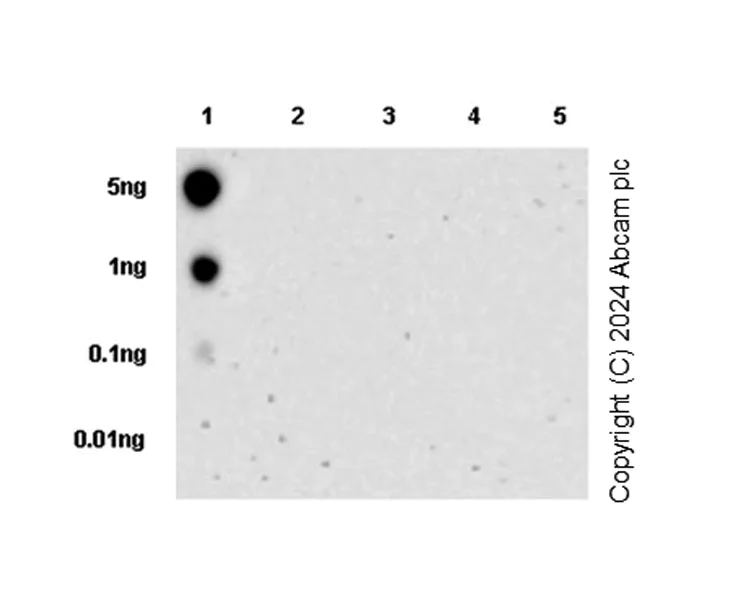
Dot Blot - Anti-Glutaminase antibody [EPR28716-72] (AB317032)
Dot blot analysis of Glutaminase using ab317032 at 1 : 1000 (0.508 ug/ml) followed by a Goat Anti-Rabbit IgG, (H+L), Peroxidase conjugated (ab97051) at 1 : 100,000 dilution.
Blocking and diluting buffer and concentration : 5% NFDM/TBST.
This antibody does not cross-react with human/Mouse/Rat GLS2.
All lanes:
Dot Blot - Anti-Glutaminase antibody [EPR28716-72] (ab317032) at 1/1000 dilution
Lane 1:
Mouse GLS1 peptide a
Lane 2:
Human GLS2 peptide b
Lane 3:
Mouse/Rat GLS2 peptide c
Lane 4:
Human GLS2 peptide d
Lane 5:
Mouse/Rat GLS2 peptide e
Secondary
All lanes:
Dot Blot - Goat Anti-Rabbit IgG H&L (HRP) (<a href='/en-us/products/secondary-antibodies/goat-rabbit-igg-h-l-hrp-ab97051'>ab97051</a>) at 1/100000 dilution
false
Exposure time: 180s
Related conjugates and formulations (1)
-
Anti-Glutaminase antibody [EPR28716-72] - BSA and Azide free
Complementary Products

Primary Antibodies
AB115730
Anti-Glucose Transporter GLUT1 antibody [EPR3915]
BOND RX™ Validated|20ul selling size|RabMAb|Recombinant|KO Validated

- 4
- 20
Primary Antibodies
AB235841
Anti-CPT1A antibody [EPR21843-71-2F] - BSA and Azide free
RabMAb|Recombinant|KO Validated
- 4
- 3
Primary Antibodies
AB237704
Anti-SLC1A5/ASCT2 antibody [CAL33]
BOND RX™ Validated|20ul selling size|KO Validated|RabMAb|Recombinant
- 0
- 0
Reactivity data
Product details
Patented technology
Our RabMAb® technology is a patented hybridoma-based technology for making rabbit monoclonal antibodies. For details on our patents, please refer to RabMAb® patents.
What are the advantages of a recombinant monoclonal antibody?
This product is a recombinant monoclonal antibody, which offers several advantages including:
- - High batch-to-batch consistency and reproducibility
- - Improved sensitivity and specificity
- - Long-term security of supply
- - Animal-free batch production
For more information, read more on recombinant antibodies.
Properties and storage information
Form
Purification technique
Storage buffer
Shipped at conditions
Appropriate short-term storage duration
Appropriate short-term storage conditions
Appropriate long-term storage conditions
Aliquoting information
Storage information
Supplementary information
This supplementary information is collated from multiple sources and compiled automatically.
Biological function summary
Glutaminase plays a central role in cellular processes by facilitating the production of glutamate which is an important neurotransmitter in the brain and a precursor for the synthesis of gamma-aminobutyric acid (GABA). It is not part of a larger complex but acts independently in the mitochondrial matrix where it performs the glutaminase reaction. The activity of this enzyme is monitored closely because it affects multiple cellular functions and has implications in many diseases.
Pathways
Glutaminase is instrumental in the glutaminolysis and tricarboxylic acid (TCA) cycles. These pathways are essential for cellular energy production and biosynthesis. GLS1 activity influences other proteins such as alanine transaminase (ALT) and aspartate transaminase (AST) which also play roles in amino acid metabolism and energy production. Glutaminase inhibitors have been explored as potential therapeutic agents by disrupting the glutaminolysis pathway in cancer cells leading to decreased tumor growth.
Product protocols
- Visit the General protocols
- Visit the Troubleshooting
Target data
Alternative Names
Product promise
Please note: All products are 'FOR RESEARCH USE ONLY. NOT FOR USE IN DIAGNOSTIC OR THERAPEUTIC PROCEDURES'.
For licensing inquiries, please contact partnerships@abcam.com