- IP
Supplier Data
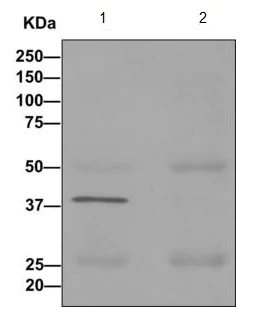
Immunoprecipitation - Anti-GNAI3 antibody [EPR11894] (AB173527)
Western blot analysis on immunoprecipitation pellet from (Lane 1) Human fetal brain lysate or (Lane 2) 1X PBS (negative control) using ab173527 at a 1/10 dilution, and HRP-conjugated anti-rabbit IgG preferentially detecting the non-reduced form of rabbit IgG.
All lanes:
Immunoprecipitation - Anti-GNAI3 antibody [EPR11894] (ab173527)
Predicted band size: 41 kDa
false
- WB
Supplier Data
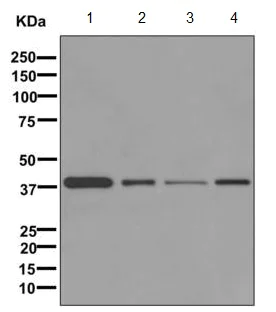
Western blot - Anti-GNAI3 antibody [EPR11894] (AB173527)
All lanes:
Western blot - Anti-GNAI3 antibody [EPR11894] (ab173527) at 1/1000 dilution
Lane 1:
Human fetal brain lysates at 10 µg
Lane 2:
Human fetal kidney lysates at 10 µg
Lane 3:
HepG2 lysates at 10 µg
Lane 4:
A431 cell lysate at 10 µg
Predicted band size: 41 kDa
false
Related conjugates and formulations (1)
-
Anti-GNAI3 antibody [EPR11894] - BSA and Azide free
Alternative Products

Complementary Products
Primary Antibodies
AB32537
BOND RX™ Validated|KO Validated|RabMAb|Recombinant|Lab Essentials|20ul selling size
- 5
- 4
Primary Antibodies
AB52623
Anti-beta III Tubulin antibody [EP1569Y] - Neuronal Marker
BOND RX™ Validated|KO Validated|RabMAb|Advanced Validation|Recombinant|Lab Essentials|20ul selling size

- 5
- 6

Reactivity data
Product details
Patented technology
Our RabMAb® technology is a patented hybridoma-based technology for making rabbit monoclonal antibodies. For details on our patents, please refer to RabMAb® patents.
What are the advantages of a recombinant monoclonal antibody?
This product is a recombinant monoclonal antibody, which offers several advantages including:
- - High batch-to-batch consistency and reproducibility
- - Improved sensitivity and specificity
- - Long-term security of supply
- - Animal-free batch production
For more information, read more on recombinant antibodies.
Properties and storage information
Form
Purification technique
Storage buffer
Shipped at conditions
Appropriate short-term storage duration
Appropriate short-term storage conditions
Appropriate long-term storage conditions
Aliquoting information
Storage information
Supplementary information
This supplementary information is collated from multiple sources and compiled automatically.
Biological function summary
GNAI3 contributes to inhibiting adenylate cyclase activity reducing cyclic AMP levels and therefore modulating downstream signaling events. It forms part of the heterotrimeric guanine nucleotide-binding protein complex which consists of alpha beta and gamma subunits. By interacting with this complex GNAI3 regulates processes like cell division immune response and sensory perception demonstrating its diverse functional roles within the cell.
Pathways
GNAI3 is involved in the G protein-coupled receptor (GPCR) signaling pathway which is essential for transmitting numerous extracellular signals to the inside of the cell. GNAI3 modulates signals from neurotransmitters and hormones that activate this pathway. Additionally GNAI3 interacts with other proteins such as beta-arrestins which are important for receptor desensitization and signal termination within the GPCR signaling system.
Product protocols
- Visit the General protocols
- Visit the Troubleshooting
Target data
Alternative Names
Publications (4)
Recent publications for all applications. Explore the full listand refine your search
International journal of biological sciences 18:3237-3250 PubMed35637969
2022
Applications
Unspecified application
Species
Unspecified reactive species
Nature communications 12:4590 PubMed34321466
2021
Applications
Unspecified application
Species
Unspecified reactive species
EMBO reports 20:e47097 PubMed31321879
2019
Applications
Unspecified application
Species
Unspecified reactive species
Molecular medicine reports 12:173-9 PubMed25760095
2015
Applications
Unspecified application
Species
Unspecified reactive species
Product promise
Please note: All products are 'FOR RESEARCH USE ONLY. NOT FOR USE IN DIAGNOSTIC OR THERAPEUTIC PROCEDURES'.
For licensing inquiries, please contact partnerships@abcam.com