JavaScript is disabled in your browser. Please enable JavaScript to view this website.
AB150584

Anti-GPCR GPR14 antibody - N-terminal

Be the first to review this product! Submit a review

|

(2 Publications )

Rabbit Polyclonal GPCR GPR14 antibody. Suitable for IHC-P and reacts with Human samples. Cited in 2 publications. Immunogen corresponding to Synthetic Peptide within Human UTS2R.

View Alternative Names

GPR14, UTS2R, Urotensin-2 receptor, UR-2-R, G-protein coupled receptor 14, Urotensin II receptor, UR-II-R
1 Images
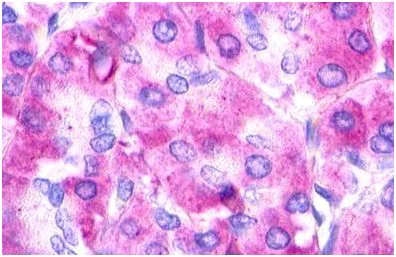
Immunohistochemistry (Formalin/PFA-fixed paraffin-embedded sections) - Anti-GPCR GPR14 antibody - N-terminal (AB150584)
  • IHC-P

Unknown

Immunohistochemistry (Formalin/PFA-fixed paraffin-embedded sections) - Anti-GPCR GPR14 antibody - N-terminal (AB150584)

Immunohistochemical analysis of formalin-fixed, paraffin-embedded Human pancreas (acinar epithelium) tissue labelling GPCR GPR14 with ab150584 at 11 μg/ml.

Key facts

Host species

Rabbit

Clonality

Polyclonal

Isotype

IgG

Carrier free

No

Reacts with

Human

Applications

IHC-P

applications

Immunogen

Synthetic Peptide within Human UTS2R. The exact immunogen used to generate this antibody is proprietary information.

Q9UKP6

Specificity

BLAST analysis of the peptide immunogen showed no homology with other Human proteins.

Reactivity data

{ "title": "Reactivity Data", "filters": { "stats": ["", "Species", "Dilution Info", "Notes"], "tabs": { "all-applications": {"fullname" : "All Applications", "shortname": "All Applications"}, "IHCP" : {"fullname" : "Immunohistochemistry (Formalin/PFA-fixed paraffin-embedded sections)", "shortname":"IHC-P"} }, "product-promise": { "all": "all", "testedAndGuaranteed": "tested", "guaranteed": "expected", "predicted": "predicted", "notRecommended": "not-recommended" } }, "values": { "Human": { "IHCP-species-checked": "testedAndGuaranteed", "IHCP-species-dilution-info": "6-11 µg/mL", "IHCP-species-notes": "<p></p> Perform heat-mediated antigen retrieval before commencing with IHC staining protocol." }, "Monkey": { "IHCP-species-checked": "predicted", "IHCP-species-dilution-info": "", "IHCP-species-notes": "" } } }

Properties and storage information

Form
Liquid
Purification technique
Affinity purification Immunogen
Storage buffer
pH: 7.4 Preservative: 0.1% Sodium azide Constituents: PBS
Shipped at conditions
Blue Ice
Appropriate short-term storage conditions
+4°C
Appropriate long-term storage conditions
-20°C

Supplementary information

This supplementary information is collated from multiple sources and compiled automatically.

GPR14 also known as the urotensin II receptor (UTR) is a G protein-coupled receptor (GPCR) that responds to the peptide urotensin II. It consists of approximately 389 amino acids giving it a mass of about 42 kDa. This receptor is expressed mainly in cardiovascular tissues like the heart and blood vessels but is also found in the kidney brain and other organs. The primary mechanical role of GPR14 involves transducing signals across the cell membrane activating intracellular signaling cascades involving G proteins when urotensin II binds.
Biological function summary

The interaction between urotensin II and GPR14 modulates cardiovascular function. This receptor is significant in regulating vascular tone and cardiac function. Research shows that GPR14 does not operate as part of a larger complex but directly influences downstream signaling pathways. This activity can impact blood pressure by increasing vasoconstriction and plays a role in remodeling cardiac structure under certain conditions.

Pathways

GPR14 participates in key biological processes that regulate cardiovascular health. The receptor is involved in the urotensin II signaling pathway where it interacts with proteins such as phospholipase C and the protein kinase C family. These interactions further affect calcium mobilization within cells. Additionally GPR14 plays a role in the broader network of the endothelin signaling pathway creating connections with endothelin receptors and other vasoactive proteins.

Researchers associate dysfunctional GPR14 expression with hypertension and heart failure. The receptor's impact on vasoconstriction and cardiac remodeling can worsen these conditions. GPR14 also interacts with proteins like endothelin-1 in these diseases highlighting its potential role in pathophysiological states associated with cardiovascular stress and decreased cardiac output. Understanding of GPR14's function offers pathways for therapeutic intervention in these cardiovascular diseases.

Product protocols

For this product, it's our understanding that no specific protocols are required. You can visit:

Target data

G protein-coupled receptor for the vasoactive neuropeptides urotensin-2 and urotensin-2B (PubMed : 14550283). Upon ligand binding, activates intracellular signaling cascades via G-protein coupling, primarily through Gq/11, leading to phospholipase C activation, increased intracellular calcium, and activation of protein kinase C (PKC) (PubMed : 18314227). Through coupling to G(i)/G(o) alpha subunits, stimulates MAPK/ERK pathways and thereby contributes to regulation of vascular tone, cardiac contractility, and cell proliferation (PubMed : 12503613, PubMed : 14753294). Ligand binding also triggers a marked reduction in the biogenesis of autophagosomes by inhibiting the recruitment of ATG16L1 to pre-autophagosomal endocytic vesicles (PubMed : 27715446).
See full target information UTS2R

Publications (2)

Recent publications for all applications. Explore the full list and refine your search

International journal of hypertension 2016:9146870 PubMed28097020

2016

Renal Urotensin II System Plays Roles in the Regulation of Blood Pressure in Dahl Salt-Resistant Rat.

Applications

Unspecified application

Species

Unspecified reactive species

Fei Wu,Guanjong Chen,Aihua Zhang,Yang Yu,Minhua Fan,Chaoshu Tang

Kidney & blood pressure research 41:434-49 PubMed27467277

2016

Urotensin II Induces ER Stress and EMT and Increase Extracellular Matrix Production in Renal Tubular Epithelial Cell in Early Diabetic Mice.

Applications

Unspecified application

Species

Unspecified reactive species

Xin-Xin Pang,Qiong Bai,Fei Wu,Guan-Jong Chen,Ai-Hua Zhang,Chao-Shu Tang
View all publications

Product promise

We are committed to supporting your work with high-quality reagents, and we're here for you every step of the way. In the unlikely event that one of our products does not perform as expected, you're protected by our Product Promise.
For full details, please see our Terms & Conditions

Please note: All products are 'FOR RESEARCH USE ONLY. NOT FOR USE IN DIAGNOSTIC OR THERAPEUTIC PROCEDURES'.

For licensing inquiries, please contact partnerships@abcam.com