JavaScript is disabled in your browser. Please enable JavaScript to view this website.
AB153995

Anti-GSTZ1 antibody

Be the first to review this product! Submit a review

|

(3 Publications )

Rabbit Polyclonal GSTZ1 antibody. Suitable for IHC-P, WB, ICC/IF and reacts with Human samples. Cited in 3 publications. Immunogen corresponding to Recombinant Fragment Protein within Human GSTZ1 aa 1-250.
2 Images
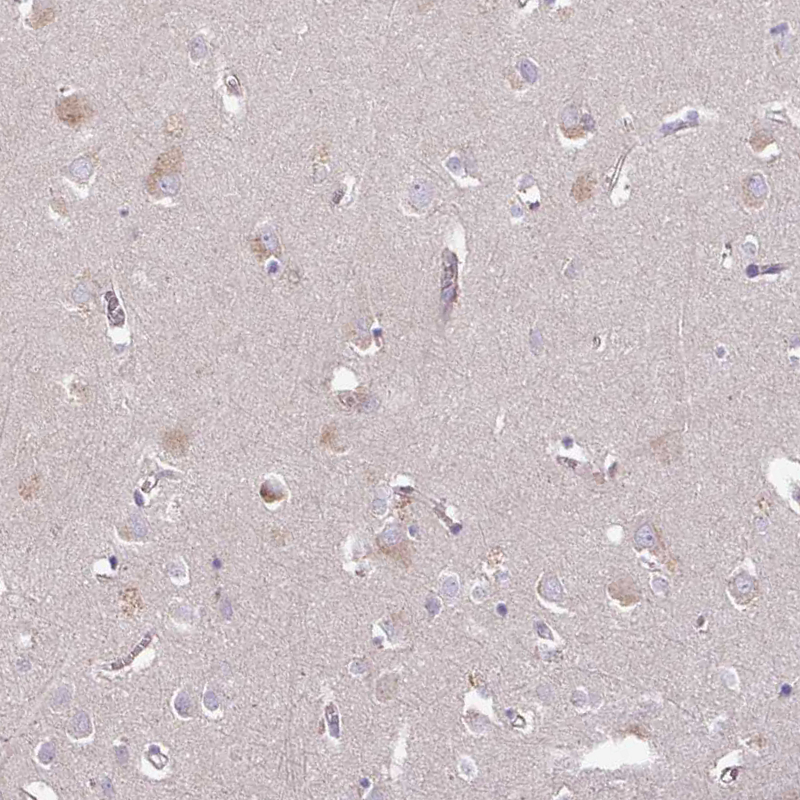
Immunohistochemistry (Formalin/PFA-fixed paraffin-embedded sections) - Anti-GSTZ1 antibody (AB153995)
  • IHC-P

Unknown

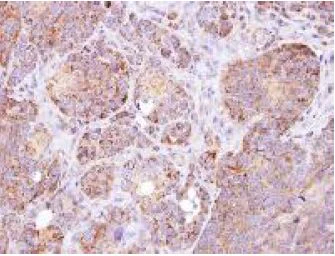
Immunohistochemistry (Formalin/PFA-fixed paraffin-embedded sections) - Anti-GSTZ1 antibody (AB153995)

Immunohistochemical analysis of paraffin- embedded SW480 xenograft labeling GSTZ1 using ab153995 at 1/100 dilution.
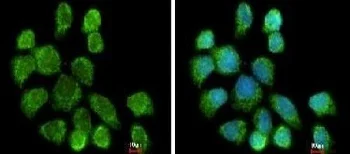
Immunocytochemistry/ Immunofluorescence - Anti-GSTZ1 antibody (AB153995)
  • ICC/IF

Unknown

Immunocytochemistry/ Immunofluorescence - Anti-GSTZ1 antibody (AB153995)

Immunofluorescence analysis of methanol-fixed A431 cells, labeling GSTZ1 using ab153995 at 1/200 dilution. Right panel costained with Hoechst 33342.

Key facts

Host species

Rabbit

Clonality

Polyclonal

Isotype

IgG

Carrier free

No

Reacts with

Human

Applications

ICC/IF, IHC-P, WB

applications

Immunogen

Recombinant Fragment Protein within Human GSTZ1 aa 1-250. The exact immunogen used to generate this antibody is proprietary information.

O43708

Reactivity data

{ "title": "Reactivity Data", "filters": { "stats": ["", "Species", "Dilution Info", "Notes"], "tabs": { "all-applications": {"fullname" : "All Applications", "shortname": "All Applications"}, "IHCP" : {"fullname" : "Immunohistochemistry (Formalin/PFA-fixed paraffin-embedded sections)", "shortname":"IHC-P"}, "WB" : {"fullname" : "Western blot", "shortname":"WB"}, "ICCIF" : {"fullname" : "Immunocytochemistry/ Immunofluorescence", "shortname":"ICC/IF"} }, "product-promise": { "all": "all", "testedAndGuaranteed": "tested", "guaranteed": "expected", "predicted": "predicted", "notRecommended": "not-recommended" } }, "values": { "Human": { "IHCP-species-checked": "testedAndGuaranteed", "IHCP-species-dilution-info": "1/100 - 1/1000", "IHCP-species-notes": "<p>10mM Citrate Buffer</p> Perform heat-mediated antigen retrieval with citrate buffer pH 6 before commencing with IHC staining protocol.", "WB-species-checked": "testedAndGuaranteed", "WB-species-dilution-info": "1/500 - 1/3000", "WB-species-notes": "<p></p>", "ICCIF-species-checked": "testedAndGuaranteed", "ICCIF-species-dilution-info": "1/100 - 1/1000", "ICCIF-species-notes": "<p></p>" } } }

Properties and storage information

Form
Liquid
Purification technique
Affinity purification Immunogen
Storage buffer
pH: 7 Preservative: 0.01% Thimerosal (merthiolate) Constituents: 20% Glycerol (glycerin, glycerine), 1.21% Tris, 0.75% Glycine
Shipped at conditions
Blue Ice
Appropriate short-term storage conditions
+4°C
Appropriate long-term storage conditions
-20°C
Aliquoting information
Upon delivery aliquot
Storage information
Avoid freeze / thaw cycle

Supplementary information

This supplementary information is collated from multiple sources and compiled automatically.

GSTZ1 also known as Glutathione S-Transferase Zeta 1 is an enzyme that plays an important role in the metabolism of various chemical compounds. It has a molecular mass of approximately 34 kDa. GSTZ1 is ubiquitously expressed in many tissues with significant levels in the liver kidney and heart. This enzyme is part of the GST family which contributes to detoxification processes by conjugating reduced glutathione to various substrates.
Biological function summary

GSTZ1 participates in the breakdown of amino acids specifically in the catabolic pathway of L-phenylalanine and L-tyrosine. The enzyme assists in the production of maleylacetoacetate and its isomerization to fumarylacetoacetate an essential step in the phenylalanine and tyrosine catabolism. GSTZ1 does not form part of a larger multi-protein complex but its function is critical in maintaining cellular homeostasis by preventing the accumulation of potentially toxic intermediates.

Pathways

GSTZ1 integrates into the metabolic pathway that includes glutathione metabolism and the phenylalanine and tyrosine degradation pathway. It interacts functionally with other enzymes like Fumarylacetoacetate hydrolase (FAH) and Phenylalanine hydroxylase (PAH) playing roles in sequential catalysis steps. These pathways are vital for maintaining amino acid balance and detoxification of byproducts within the organism.

GSTZ1 has been linked to metabolic disorders like Tyrosinemia type I and various forms of cancer. Tyrosinemia type I a disorder caused by defects in tyrosine metabolism directly implicates GSTZ1 as an important player in managing toxic intermediates. Additionally altered expression of GSTZ1 has been observed in different cancer types suggesting its potential role in tumorigenesis. FAH related through the Tyrosinemia disorder represents another key protein that GSTZ1 activity impacts highlighting its disease association.

Product protocols

For this product, it's our understanding that no specific protocols are required. You can visit:

Target data

Bifunctional enzyme showing minimal glutathione-conjugating activity with ethacrynic acid and 7-chloro-4-nitrobenz-2-oxa-1,3-diazole and maleylacetoacetate isomerase activity. Also has low glutathione peroxidase activity with T-butyl and cumene hydroperoxides. Is able to catalyze the glutathione dependent oxygenation of dichloroacetic acid to glyoxylic acid.
See full target information GSTZ1

Alternative Names

MAAI, GSTZ1, Maleylacetoacetate isomerase, GSTZ1-1, Glutathione S-transferase zeta 1

Publications (3)

Recent publications for all applications. Explore the full listand refine your search

Journal of inflammation research 16:5677-5695 PubMed38050561

2023

Identification of a Novel Target Implicated in Chronic Obstructive Sleep Apnea-Related Atrial Fibrillation by Integrative Analysis of Transcriptome and Proteome.

Applications

Unspecified application

Species

Unspecified reactive species

Jun Shen,Junqing Liang,Manzeremu Rejiepu,Ping Yuan,Jie Xiang,Yankai Guo,Jiasuoer Xiaokereti,Ling Zhang,Baopeng Tang

Cancer medicine 12:5035-5054 PubMed36205357

2022

Systemic analysis of the DNA replication regulator origin recognition complex in lung adenocarcinomas identifies prognostic and expression significance.

Applications

Unspecified application

Species

Unspecified reactive species

Min Tang,Juan Chen,Tian Zeng,Dong-Mei Ye,Yu-Kun Li,Juan Zou,Yu-Ping Zhang

Stem cell research & therapy 12:142 PubMed33596998

2021

Differential SOD2 and GSTZ1 profiles contribute to contrasting dental pulp stem cell susceptibilities to oxidative damage and premature senescence.

Applications

Unspecified application

Species

Unspecified reactive species

Nadia Y A Alaidaroos,Amr Alraies,Rachel J Waddington,Alastair J Sloan,Ryan Moseley
View all publications

Product promise

We are committed to supporting your work with high-quality reagents, and we're here for you every step of the way. In the unlikely event that one of our products does not perform as expected, you're protected by our Product Promise.
For full details, please see our Terms & Conditions

Please note: All products are 'FOR RESEARCH USE ONLY. NOT FOR USE IN DIAGNOSTIC OR THERAPEUTIC PROCEDURES'.

For licensing inquiries, please contact partnerships@abcam.com