JavaScript is disabled in your browser. Please enable JavaScript to view this website.
AB131236

Anti-Haptoglobin antibody [EPSISR7]

Be the first to review this product! Submit a review

|

(14 Publications )
Rabbit Recombinant Monoclonal Haptoglobin antibody. Suitable for WB and reacts with Human samples. Cited in 14 publications.
1 Images
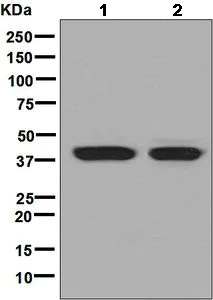
Western blot - Anti-Haptoglobin antibody [EPSISR7] (AB131236)
  • WB

Unknown

Western blot - Anti-Haptoglobin antibody [EPSISR7] (AB131236)

All lanes:

Western blot - Anti-Haptoglobin antibody [EPSISR7] (ab131236) at 1/10000 dilution

Lane 1:

Human plasma lysate at 10 µg

Lane 2:

Human fetal liver lysate at 10 µg

Secondary

All lanes:

HRP labelled goat anti-rabbit at 1/2000 dilution

Predicted band size: 45 kDa

false

  • Carrier free

    Anti-Haptoglobin antibody [EPSISR7] - BSA and Azide free

Key facts

Host species

Rabbit

Clonality

Monoclonal

Clone number

EPSISR7

Isotype

IgG

Carrier free

No

Reacts with

Human

Applications

WB

applications

Immunogen

The exact immunogen used to generate this antibody is proprietary information.

Specificity

ab131236 may also recognize Haptoglobin or Haptoglobin-related protein based on the immunogen sequences.

Reactivity data

{ "title": "Reactivity Data", "filters": { "stats": ["", "Species", "Dilution Info", "Notes"], "tabs": { "all-applications": {"fullname" : "All Applications", "shortname": "All Applications"}, "IP" : {"fullname" : "Immunoprecipitation", "shortname":"IP"}, "WB" : {"fullname" : "Western blot", "shortname":"WB"}, "IHCP" : {"fullname" : "Immunohistochemistry (Formalin/PFA-fixed paraffin-embedded sections)", "shortname":"IHC-P"} }, "product-promise": { "all": "all", "testedAndGuaranteed": "tested", "guaranteed": "expected", "predicted": "predicted", "notRecommended": "not-recommended" } }, "values": { "Human": { "IP-species-checked": "notRecommended", "IP-species-dilution-info": "", "IP-species-notes": "<p></p>", "WB-species-checked": "testedAndGuaranteed", "WB-species-dilution-info": "1/10000 - 1/50000", "WB-species-notes": "<p></p>", "IHCP-species-checked": "notRecommended", "IHCP-species-dilution-info": "", "IHCP-species-notes": "<p></p>" }, "Mouse": { "IP-species-checked": "notRecommended", "IP-species-dilution-info": "", "IP-species-notes": "", "WB-species-checked": "predicted", "WB-species-dilution-info": "", "WB-species-notes": "", "IHCP-species-checked": "notRecommended", "IHCP-species-dilution-info": "", "IHCP-species-notes": "" }, "Rat": { "IP-species-checked": "notRecommended", "IP-species-dilution-info": "", "IP-species-notes": "", "WB-species-checked": "predicted", "WB-species-dilution-info": "", "WB-species-notes": "", "IHCP-species-checked": "notRecommended", "IHCP-species-dilution-info": "", "IHCP-species-notes": "" } } }

Product details

Patented technology
Our RabMAb® technology is a patented hybridoma-based technology for making rabbit monoclonal antibodies. For details on our patents, please refer to RabMAb® patents.

What are the advantages of a recombinant monoclonal antibody?
This product is a recombinant monoclonal antibody, which offers several advantages including:

  • - High batch-to-batch consistency and reproducibility
  • - Improved sensitivity and specificity
  • - Long-term security of supply
  • - Animal-free batch production

For more information, read more on recombinant antibodies.

Properties and storage information

Form
Liquid
Purification technique
Affinity purification Protein A
Storage buffer
pH: 7.2 - 7.4 Preservative: 0.01% Sodium azide Constituents: PBS, 40% Glycerol (glycerin, glycerine), 0.05% BSA
Shipped at conditions
Conditional Ambient
Appropriate short-term storage conditions
+4°C
Appropriate long-term storage conditions
-20°C
Storage information
Stable for 12 months at -20°C

Supplementary information

This supplementary information is collated from multiple sources and compiled automatically.

Haptoglobin (Hp) also known as Hp protein is a glycoprotein with a molecular weight ranging from 85 to 100 kDa varying due to its ability to form different dimeric and multimeric structures. It is primarily synthesized in the liver and circulating in the plasma. Mechanically haptoglobin binds free hemoglobin released from erythrocytes preventing oxidative damage and hemoglobin-driven deleterious effects. Haptoglobin's binding to hemoglobin forms a haptoglobin-hemoglobin complex that gets cleared by the CD163 receptor on macrophages mainly in the liver and spleen.
Biological function summary

Haptoglobin functions as an antioxidant and an acute phase protein playing roles in inflammation and immune response. It is an essential component of the antioxidant defense system reducing oxidative stress by binding free hemoglobin. Additionally haptoglobin can participate in complex formation with hemoglobin to facilitate the clearance of excess free hemoglobin from circulation. Its expression increases during inflammation under the regulation of cytokines like IL-6.

Pathways

The haptoglobin protein is part of the hemoglobin clearance pathway integral for iron metabolism and homeostasis. This pathway ensures the safe removal of hemoglobin from the blood helping to prevent kidney damage. Haptoglobin is related to other proteins such as CD163 and the liver-derived hepatocellular proteins involved in the clearance process. Also haptoglobin is linked to antioxidant pathways collaborating with oxidative stress regulators to manage reactive oxygen species levels.

Changes in haptoglobin levels are associated with hemolytic anemia and inflammatory conditions. Low haptoglobin levels often suggest hemolytic anemia due to its rapid binding with free hemoglobin in the bloodstream. During inflammation and infections 'anti-Hp' tests (haptoglobin tests) may show increased haptoglobin levels as a response to cytokine signaling. Moreover haptoglobin polymorphisms have a connection with ischemic stroke susceptibility where its isoforms show differing efficiencies in binding free hemoglobin. These findings highlight haptoglobin's relevance as a biomarker for these conditions and illustrate its interaction with hematologic and immune proteins in disease contexts.

Product protocols

For this product, it's our understanding that no specific protocols are required. You can visit:

Target data

As a result of hemolysis, hemoglobin is found to accumulate in the kidney and is secreted in the urine. Haptoglobin captures, and combines with free plasma hemoglobin to allow hepatic recycling of heme iron and to prevent kidney damage. Haptoglobin also acts as an antioxidant, has antibacterial activity, and plays a role in modulating many aspects of the acute phase response. Hemoglobin/haptoglobin complexes are rapidly cleared by the macrophage CD163 scavenger receptor expressed on the surface of liver Kupfer cells through an endocytic lysosomal degradation pathway.. The uncleaved form of allele alpha-2 (2-2), known as zonulin, plays a role in intestinal permeability, allowing intercellular tight junction disassembly, and controlling the equilibrium between tolerance and immunity to non-self antigens.
See full target information HP

Alternative Names

Haptoglobin, Zonulin, HP

Publications (14)

Recent publications for all applications. Explore the full listand refine your search

BMC sports science, medicine & rehabilitation 17:279 PubMed41024199

2025

The impact of altered intestinal microbiota on intestinal immune function after acute exhaustive exercise in mice.

Applications

Unspecified application

Species

Unspecified reactive species

Guang Yang,Lina Gao,Yuqian Liu,Xiaoyang Xu,Wenqian Yang

Acta neuropathologica communications 13:187 PubMed40898360

2025

Identification and validation of a tear fluid-derived protein biomarker signature in patients with amyotrophic lateral sclerosis.

Applications

Unspecified application

Species

Unspecified reactive species

Lena-Sophie Scholl,Antonia F Demleitner,Jenny Riedel,Seren Adachi,Lisa Neuenroth,Clara Meijs,Laura Tzeplaeff,Lucas Caldi Gomes,Ana Galhoz,Isabell Cordts,Christof Lenz,Michael Menden,Paul Lingor

International journal of molecular sciences 26: PubMed39940923

2025

NHERF2 as a Novel Biomarker for Distinguishing MAC Pulmonary Disease from Tuberculosis Based on Proteome Analysis of Serum Extracellular Vesicles.

Applications

Unspecified application

Species

Unspecified reactive species

Maiko Naito,Yoshito Takeda,Ryuya Edahiro,Yuya Shirai,Takatoshi Enomoto,Mana Nakayama,Satoshi Nojima,Mari Nogami-Ito,Masahide Mori,Yukihiro Yano,Takanori Matsuki,Hanako Yoshimura,Reina Hara,Makoto Yamamoto,Kentaro Masuhiro,Yujiro Naito,Shohei Koyama,Kota Iwahori,Izumi Nagatomo,Takayuki Shiroyama,Kotaro Miyake,Haruhiko Hirata,Hiroaki Hase,Kazutake Tsujikawa,Koji Ueda,Atsushi Kumanogoh

Molecular and cellular biochemistry : PubMed37902886

2023

Exercise training decreases the load and changes the content of circulating SDS-resistant protein aggregates in patients with heart failure with reduced ejection fraction.

Applications

Unspecified application

Species

Unspecified reactive species

Marisol Gouveia,Cristine Schmidt,Priscilla Gois Basilio,Susana S Aveiro,Pedro Domingues,Ke Xia,Wilfredo Colón,Rui Vitorino,Rita Ferreira,Mário Santos,Sandra I Vieira,Fernando Ribeiro

Inflammation and regeneration 42:53 PubMed36451245

2022

Next-generation proteomics of serum extracellular vesicles combined with single-cell RNA sequencing identifies MACROH2A1 associated with refractory COVID-19.

Applications

Unspecified application

Species

Unspecified reactive species

Takahiro Kawasaki,Yoshito Takeda,Ryuya Edahiro,Yuya Shirai,Mari Nogami-Itoh,Takanori Matsuki,Hiroshi Kida,Takatoshi Enomoto,Reina Hara,Yoshimi Noda,Yuichi Adachi,Takayuki Niitsu,Saori Amiya,Yuta Yamaguchi,Teruaki Murakami,Yasuhiro Kato,Takayoshi Morita,Hanako Yoshimura,Makoto Yamamoto,Daisuke Nakatsubo,Kotaro Miyake,Takayuki Shiroyama,Haruhiko Hirata,Jun Adachi,Yukinori Okada,Atsushi Kumanogoh

EMBO molecular medicine 13:e14059 PubMed34125490

2021

Gut microbiota-CRAMP axis shapes intestinal barrier function and immune responses in dietary gluten-induced enteropathy.

Applications

Unspecified application

Species

Unspecified reactive species

Zhengnan Ren,Li-Long Pan,Yiwen Huang,Hongbing Chen,Yu Liu,He Liu,Xing Tu,Yanyan Liu,Binbin Li,Xiaoliang Dong,Xiaohua Pan,Hanfei Li,Yu V Fu,Birgitta Agerberth,Julien Diana,Jia Sun

Scientific reports 11:1305 PubMed33446709

2021

The effects of meldonium on the acute ischemia/reperfusion liver injury in rats.

Applications

Unspecified application

Species

Unspecified reactive species

Siniša Đurašević,Maja Stojković,Jelena Sopta,Slađan Pavlović,Slavica Borković-Mitić,Anđelija Ivanović,Nebojša Jasnić,Tomislav Tosti,Saša Đurović,Jelena Đorđević,Zoran Todorović

The Journal of infectious diseases 220:1147-1151 PubMed31095689

2019

Postexposure Administration of a Yersinia pestis Live Vaccine for Potentiation of Second-Line Antibiotic Treatment Against Pneumonic Plague.

Applications

Unspecified application

Species

Unspecified reactive species

Ayelet Zauberman,David Gur,Yinon Levy,Moshe Aftalion,Yaron Vagima,Avital Tidhar,Theodor Chitlaru,Emanuelle Mamroud

Blood advances 2:95-104 PubMed29365317

2018

Quantitative proteomics of plasma vesicles identify novel biomarkers for hemoglobin E/β-thalassemic patients.

Applications

Unspecified application

Species

Unspecified reactive species

Janejira Kittivorapart,Vanja Karamatic Crew,Marieangela C Wilson,Kate J Heesom,Noppadol Siritanaratkul,Ashley M Toye

International journal of molecular medicine 39:1357-1370 PubMed28440464

2017

Proteomic profiling of mdx-4cv serum reveals highly elevated levels of the inflammation-induced plasma marker haptoglobin in muscular dystrophy.

Applications

Unspecified application

Species

Unspecified reactive species

Sandra Murphy,Paul Dowling,Margit Zweyer,Michael Henry,Paula Meleady,Rustam R Mundegar,Dieter Swandulla,Kay Ohlendieck
View all publications

Product promise

We are committed to supporting your work with high-quality reagents, and we're here for you every step of the way. In the unlikely event that one of our products does not perform as expected, you're protected by our Product Promise.
For full details, please see our Terms & Conditions

Please note: All products are 'FOR RESEARCH USE ONLY. NOT FOR USE IN DIAGNOSTIC OR THERAPEUTIC PROCEDURES'.

For licensing inquiries, please contact partnerships@abcam.com